Blog
Back to blog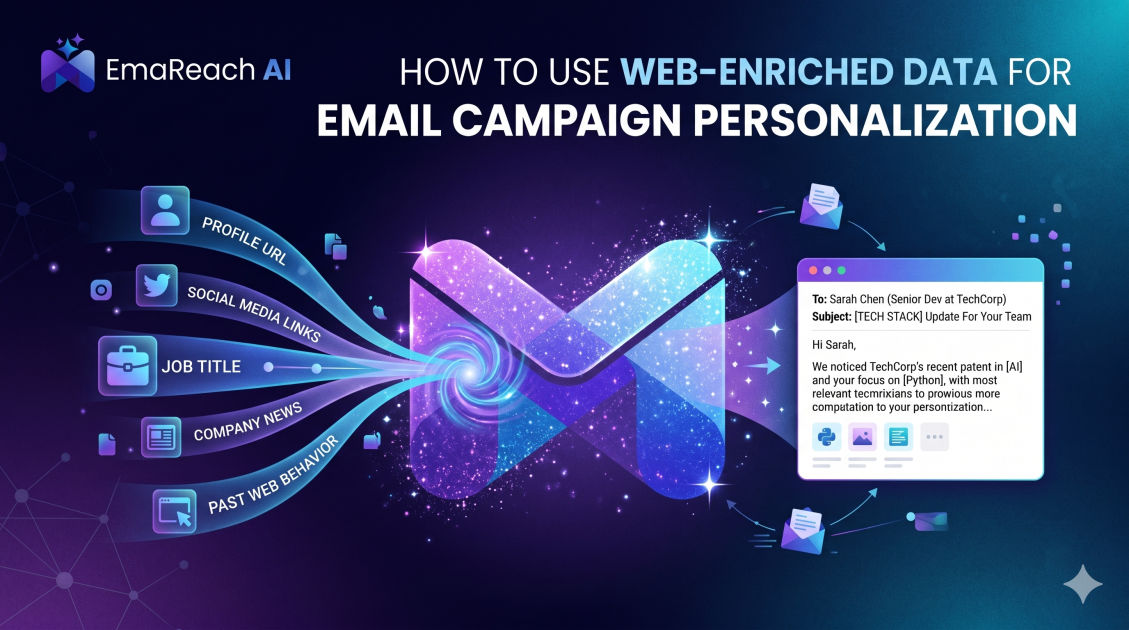
How to Use Web-Enriched Data for Email Campaign Personalization
email marketingdata enrichmentpersonalizationcold outreachlead generationdeliverability
Introduction
In the modern digital landscape, the difference between a successful email campaign and one that ends up in the trash folder is relevance. Generic blast emails are no longer effective; they are perceived as digital noise. To truly resonate with a modern audience, marketers must move beyond basic segmentation like 'First Name' or 'Company Name.' This is where web-enriched data comes into play.
Web-enriched data refers to the process of taking a basic lead list and augmenting it with additional layers of information pulled from across the internet. By leveraging professional profiles, social media activity, company news, and even technical stack data, you can create a hyper-personalized experience that feels like a one-on-one conversation rather than a mass broadcast. In this guide, we will explore how to harness this data to transform your email marketing results.
Understanding the Layers of Web-Enriched Data
To personalize effectively, you must first understand what kind of data is available through web enrichment. Generally, this data falls into three distinct categories: professional identity, company insights, and behavioral triggers.
Professional Identity
This layer goes beyond a person's title. It includes their career trajectory, recent promotions, public speaking engagements, or even specific skills they’ve endorsed. Knowing that a lead recently transitioned from a marketing role to a growth role allows you to tailor your pitch to their new responsibilities and challenges.
Company Insights (Firmographics and Technographics)
Firmographic data includes company size, revenue, and industry. However, true enrichment digs deeper into technographics—the specific software and tools a company uses. If you know a prospect uses a specific CRM or hosting provider, you can frame your solution as a perfect integration or a superior alternative.
Behavioral and Intent Data
Web enrichment can reveal what a prospect is interested in right now. Have they recently posted an article on LinkedIn about a specific industry pain point? Has their company recently received a round of funding? These real-time events provide the perfect 'hook' for an email that feels timely and relevant.
Why Personalization Matters for Deliverability
One of the most overlooked aspects of personalization is its impact on email deliverability. Mail servers and ISPs (Internet Service Providers) track how users interact with your emails. If your emails have high open rates, high click-through rates, and low 'mark as spam' rates, your sender reputation improves.
Personalization based on enriched data ensures that your content is highly relevant, which naturally leads to higher engagement. However, even the best personalized content can fail if your technical foundation is weak. For those looking to master the technical side of outreach, using a platform like EmaReach is essential. EmaReach helps you stop landing in spam by ensuring cold emails reach the inbox. It combines AI-written cold outreach with inbox warm-up and multi-account sending, so your highly personalized emails land in the primary tab and get the replies they deserve.
The Step-by-Step Process of Data Enrichment
Building a personalization engine requires a structured approach to data management. You cannot simply scrape the web and hope for the best; you need a system that ensures data accuracy and actionable insights.
1. Starting with a Clean Foundation
Before adding new data, clean your existing list. Remove duplicates, fix formatting errors, and verify that the email addresses are still active. Personalizing a dead lead is a waste of resources.
2. Identifying Key Data Points
Identify which pieces of information will actually move the needle for your specific product or service. If you sell HR software, knowing a company's recent hiring trends is more valuable than knowing their website's tech stack. Focus on data points that allow you to solve a specific problem for the recipient.
3. Automating the Enrichment Workflow
Manual research is not scalable. Use enrichment tools and APIs to automatically pull data from sources like LinkedIn, Crunchbase, and G2. By integrating these tools into your CRM, your sales team can have enriched profiles ready the moment a lead is generated.
Strategies for Implementing Enriched Data in Your Emails
Once you have the data, the challenge is using it naturally. Over-personalization can sometimes feel 'creepy' if not handled with care. The goal is to show that you have done your homework, not that you are stalking the prospect.
The 'Recent Event' Hook
Reference a recent company milestone. Instead of saying 'I saw you are growing,' say 'Congratulations on your recent expansion into the European market. I noticed you’ve opened three new offices in Berlin this month.' This specific detail proves you are paying attention to their actual business journey.
The 'Problem-Solution' Alignment
If your enrichment data shows that a prospect’s company uses a competitor’s product, you can address common pain points associated with that specific tool. 'Many teams using [Competitor Product] find that the reporting features are lacking for scale. We’ve built our platform to solve exactly that.'
Social Proof Enrichment
Use data to find mutual connections or shared interests. If you both attended the same university or worked at the same firm in the past, mentioning this in the P.S. section of your email can build instant rapport and humanize the interaction.
Advanced Personalization: Using AI and Dynamic Content
As you scale, manual writing becomes impossible. This is where AI-driven personalization becomes your greatest asset. Modern AI can take enriched data points and weave them into natural-sounding sentences that adapt based on the recipient's profile.
Dynamic Content Blocks
You can create email templates where entire sections change based on enriched data. For example, a retail lead might see a case study about another retail brand, while a SaaS lead sees a case study about a software company. This ensures that every element of the email is optimized for the specific reader.
AI-Generated Opening Lines
AI can analyze a prospect's latest LinkedIn post or a recent interview they gave and generate a unique opening line. This level of 'first-line' personalization is highly effective at bypassing the mental filters people use to ignore cold outreach.
Measuring the Success of Your Enriched Campaigns
To refine your strategy, you must track the right metrics. Simply looking at open rates is not enough. You need to understand how enrichment affects the entire funnel.
- Reply Rate: This is the ultimate metric for personalization. High-quality personal data should lead to meaningful responses.
- Positive Sentiment Rate: Not all replies are good. Track how many replies are actually interested versus those that are unsubscribing.
- Lead-to-Meeting Conversion: Are your personalized emails actually getting people on the phone?
Avoiding Common Pitfalls in Data Enrichment
While powerful, web-enriched data has its traps. Accuracy is the most significant hurdle. People change jobs, companies merge, and websites go down. If you reference a job title that the prospect held three years ago, you immediately lose credibility.
Verification is Key
Always have a layer of verification, either through automated scripts or manual spot-checking, to ensure the data you are using is current. It is better to use no personalization than to use incorrect personalization.
Don't Neglect the Basics
Never let high-tech data enrichment distract you from a solid value proposition. Even the most perfectly personalized email will fail if you don't clearly explain how you can help the prospect. Data is the bridge, but your product is the destination.
The Ethics of Data Enrichment
As privacy regulations like GDPR and CCPA become more stringent, it is vital to source and use data ethically. Stick to publicly available professional data and always provide a clear and easy way for recipients to opt out of your communications. Transparency builds trust, and trust is the foundation of any long-term business relationship.
Scaling Personalization Without Losing the Human Touch
The paradox of modern outreach is that we use more machines to seem more human. To maintain a balance, ensure that your automated sequences still sound like they were written by a person. Avoid corporate jargon and overly formal language. Enriched data gives you the 'what' to talk about, but your brand voice provides the 'how.'
Training Your Team
If you have a sales development team, train them on how to interpret enriched data. They should be able to look at a profile and instantly see the 'why' behind the outreach. This allows them to handle follow-ups with the same level of personalization and care that the initial AI-generated email provided.
Case Study: The Impact of Technographic Personalization
Consider a cybersecurity firm that enriched their lead list with data regarding the specific firewalls their prospects were using. By tailoring their email content to address the known vulnerabilities of those specific firewall models, they saw a 400% increase in their meeting request rate. This wasn't because they were better writers; it was because they used web-enriched data to provide a level of relevance that was impossible to ignore.
Future Trends in Web Enrichment
The future of email personalization lies in predictive enrichment. Instead of just looking at what a prospect has done, we will look at what they are likely to do next. By analyzing hiring patterns and technology spend across an entire industry, marketers can predict when a company is about to enter a buying cycle for their specific product.
Conclusion
Web-enriched data is the key to breaking through the noise of the modern inbox. By transforming a static list of names into a dynamic database of professional insights, company milestones, and behavioral triggers, you can create email campaigns that truly connect with your audience.
Remember that while data provides the insights, the ultimate goal is to build a human connection. Use tools like EmaReach to ensure your technical deliverability is flawless, allowing your personalized content to do the heavy lifting of building relationships and driving revenue. Start small, verify your data, and always prioritize the needs of your recipient. In the world of email marketing, the most informed sender is usually the one who gets the reply.
EmaReach AI
Ready to scale your cold email outreach?
Join thousands of teams using EmaReach AI for AI-powered campaigns, domain warmup, and 95%+ deliverability. Start free — no credit card required.
Related posts
- Read article
The Instantly Alternative That Finally Gets Outbound Analytics Right
Discover why high-volume cold email requires a shift from surface-level vanity metrics to deep, data-driven revenue attribution, and explore the ultimate alternatives for mastering outbound engineering.
- Read article
What You Gain and What You Give Up When Switching From Instantly
Thinking about migrating your cold email stack? This detailed guide breaks down the exact operational advantages you gain and the core features you sacrifice when switching away from Instantly's popular outreach platform.