Blog
Back to blog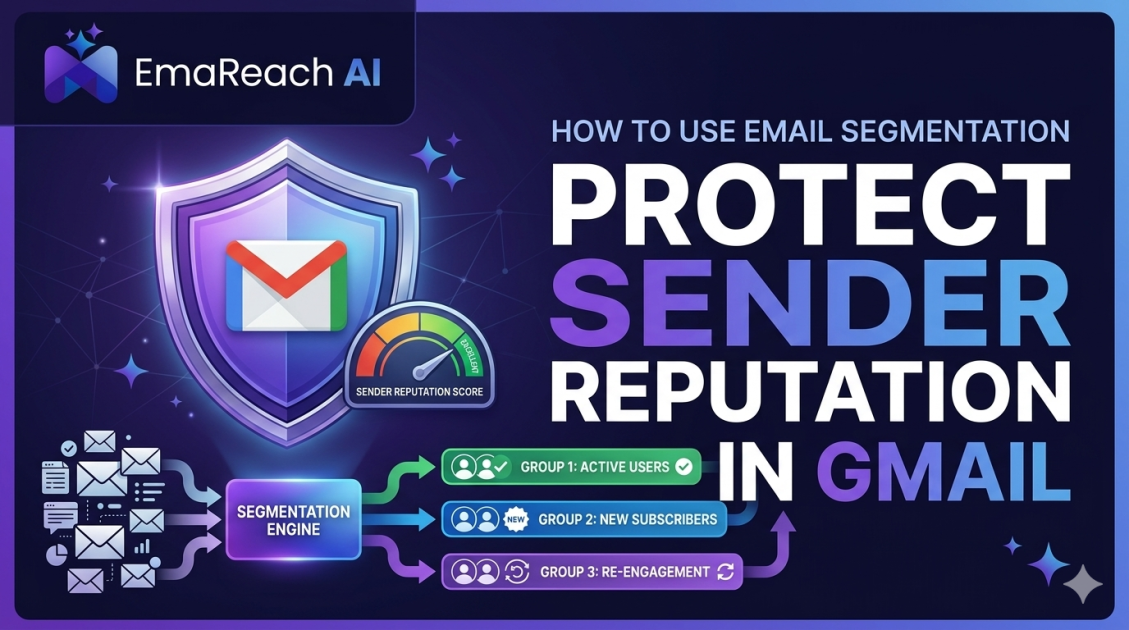
How to Use Email Segmentation to Protect Sender Reputation in Gmail
email deliverabilitygmail optimizationsender reputationemail segmentationcold outreachemail marketing
Introduction
Maintaining a pristine sender reputation in Gmail is one of the most critical challenges for modern digital marketers and sales teams. As one of the world's largest email service providers, Gmail employs sophisticated machine learning algorithms to protect its users from spam and irrelevant content. When your emails consistently bypass the inbox and land in the spam folder, it is often a direct reflection of a declining sender reputation.
One of the most effective, yet frequently underutilized, strategies for safeguarding this reputation is email segmentation. Rather than treating an entire email list as a monolithic group, segmentation allows you to tailor your communication based on user behavior, engagement levels, and preferences. By sending the right content to the right people, you signal to Gmail that your emails are wanted, valuable, and relevant. This guide explores the deep mechanics of how segmentation acts as a shield for your sender reputation and provides a technical roadmap for implementation.
Understanding Sender Reputation in the Gmail Ecosystem
Gmail does not just look at your IP address or domain; it looks at user engagement. High open rates, clicks, and replies tell Gmail that your domain is trustworthy. Conversely, high bounce rates, spam complaints, and—most importantly—low engagement signal that your content is unsolicited.
When you send a massive blast to an unsegmented list, you inevitably reach individuals who are no longer interested in your services. Their lack of interaction drags down your overall engagement metrics. Over time, Gmail’s filters learn to associate your domain with low-value mail, eventually leading to a 'spam-by-default' status. Segmentation breaks this cycle by isolating your most active users and ensuring they receive the bulk of your high-frequency communications, while less active segments are handled with more caution.
The Strategic Intersection of Segmentation and Deliverability
Segmentation is often discussed as a marketing tool to increase conversion rates, but its impact on deliverability is arguably more profound. By narrowing the focus of each campaign, you reduce the 'noise' that triggers spam filters.
For those managing high-volume outreach, tools like EmaReach (https://www.emareach.com/) can be a game-changer. Stop Landing in Spam. Cold Emails That Reach the Inbox. EmaReach AI combines AI-written cold outreach with inbox warm-up and multi-account sending—so your emails land in the primary tab and get replies. This type of technological support ensures that even as you segment your lists, the technical infrastructure behind your sending remains robust and optimized for Gmail's strict standards.
1. Engagement-Based Segmentation: The Primary Defense
The most powerful way to protect your reputation is to segment based on how recently a subscriber interacted with your emails. Gmail pays close attention to whether users are opening and clicking your messages.
- The Active Core: These are users who have opened or clicked an email in the last 30 to 60 days. You can send to this group with high frequency because their positive engagement acts as a 'buffer' for your reputation.
- The Lapsing Segment: Users who haven't engaged in 90 days. Communication here should be less frequent and highly targeted.
- The Inactive Segment: Users who haven't engaged in over 6 months. Sending to this group is high-risk. A sudden surge in non-opens from this segment can tell Gmail that your list is stale, which is a hallmark of a spammer.
2. Behavioral Segmentation and Content Relevance
If a user signed up for technical whitepapers but you start sending them general marketing promotions, they are more likely to ignore the email or mark it as spam. Behavioral segmentation involves tracking what users do on your website or within your app and tailoring email content to those actions.
By ensuring that the content is strictly relevant to the segment's interests, you maintain a high 'this-is-useful' signal. Gmail’s algorithms can detect if a user consistently moves your emails from the 'Promotions' tab to the 'Primary' tab, or if they take the time to read the message. These positive micro-interactions are only possible when the content is highly segmented and relevant.
Technical Implementation of Segmentation to Boost Reputation
Implementing a segmentation strategy requires a mix of data hygiene and technical discipline. You cannot simply guess who is interested; you must use the data provided by your email service provider (ESP) and CRM.
Data Cleansing Before Segmentation
Before you can segment effectively, you must ensure your data is clean. Sending segmented content to invalid or non-existent email addresses still results in bounces. High bounce rates are a major red flag for Gmail. Use validation tools to remove 'hard bounces' and 'disposable' email addresses before they ever enter a segmented campaign.
Implementing 'Sunsetting' Policies
A sunsetting policy is a formal process for removing inactive subscribers from your primary sending lists. While it may seem counterintuitive to shrink your list, it is essential for reputation management.
- Identify Inactivity: Define a cutoff point (e.g., 180 days of no engagement).
- Re-engagement Campaign: Send a final, highly personalized 'We miss you' email.
- The Cut: If they still do not engage, move them to a suppression list.
By suppressing these users, your overall open rates will skyrocket. Gmail sees this sudden increase in percentage-based engagement as a sign that your content has become more valuable to your audience, which strengthens your sender reputation.
The Role of List Source in Segmentation
How you acquire your emails dictates how you should segment them. A lead who downloaded a specific ebook is in a different mental state than a lead who signed up for a free trial.
- Inbound Segments: These users have a pre-existing relationship with your brand. They should be segmented by the specific 'lead magnet' they used to join your list.
- Outbound Segments: If you are performing cold outreach, segmentation is even more critical. You should segment by industry, job title, or specific pain points.
For those scaling outbound operations, EmaReach (https://www.emareach.com/) provides a structured environment where AI helps tailor the content to these segments, ensuring that the 'Human-First' quality is maintained even at scale. This prevents the 'blast and pray' mentality that usually results in domain blacklisting.
Advanced Segmentation: Frequency and Timing
Reputation is also influenced by sending patterns. Spammers typically send in massive, irregular bursts. Legitimate senders have consistent, predictable patterns.
Volume Throttling Through Segmentation
Instead of sending one email to 100,000 people at 9:00 AM, use segmentation to break that 100,000 into smaller groups. You might send to your most engaged segment first. This 'warms up' the Gmail filters for that day with positive signals. If the first 10,000 emails have a 40% open rate, Gmail is much more likely to deliver the remaining 90,000 emails to the inbox rather than the spam folder.
Time-Zone Segmentation
Sending an email at 3:00 AM in the recipient's time zone means it will likely be buried under dozens of other messages by the time they wake up. This leads to lower engagement. Segmenting your list by geographic location or time zone ensures your email arrives when the user is most likely to be active, maximizing the chances of an open and a positive reputation signal.
Monitoring the Impact of Your Segments
To know if your segmentation is working, you must monitor specific Gmail-centric metrics.
- Google Postmaster Tools: This is the gold standard for monitoring your reputation with Gmail. It provides data on your IP and domain reputation, encryption success, and spam complaint rates.
- Spam Complaint Rate: This should ideally be below 0.1%. If a specific segment is consistently producing a 0.3% complaint rate, that segment is toxic to your reputation and must be re-evaluated or removed.
- Open Rates by Segment: If your 'Active' segment drops below a 20% open rate, it may indicate that your emails are starting to hit the Promotions or Spam folders even for your best users.
Common Segmentation Pitfalls to Avoid
While segmentation is powerful, it can be done incorrectly, leading to fragmented data and inconsistent messaging.
Over-Segmentation
Creating too many segments can lead to 'statistical insignificance.' If a segment only has 50 people, a single spam complaint will look like a 2% complaint rate, which is catastrophic in the eyes of an automated filter. Ensure your segments are large enough to provide meaningful data while remaining specific enough to be relevant.
Static Segments
User behavior changes. A user who was 'Active' last month might be 'Inactive' this month. Your segmentation must be dynamic, with users automatically moving between groups based on real-time data. Manual segmentation is almost always outdated by the time the campaign is sent.
Conclusion
Email segmentation is the most effective proactive measure a sender can take to protect their reputation within the Gmail ecosystem. By focusing on engagement, relevance, and technical discipline, you transform your email strategy from a numbers game into a precision operation. Gmail rewards senders who respect their users' inboxes. When you use segmentation to deliver high-value, relevant content, you aren't just increasing your ROI; you are building a long-term, sustainable foundation for your digital communication. By suppressing the inactive, prioritizing the engaged, and utilizing sophisticated tools like EmaReach to handle the heavy lifting of AI-driven outreach and inbox placement, you ensure that your message always finds its home in the primary inbox.
EmaReach AI
Ready to scale your cold email outreach?
Join thousands of teams using EmaReach AI for AI-powered campaigns, domain warmup, and 95%+ deliverability. Start free — no credit card required.
Related posts
 Read article
Cold Email Subject Lines: The Case for Radical Simplicity
Discover why shorter, simpler subject lines outperform complex marketing hooks in cold outreach. Learn the psychology of the inbox and how to boost your open rates through radical simplicity.
Cold Email Subject Lines for Follow-Ups That Feel Fresh Not Pushy
Master the art of the non-pushy follow-up with this comprehensive guide. Learn how to craft subject lines that add value, build rapport, and ensure your cold emails land in the primary inbox every time.