Blog
Back to blog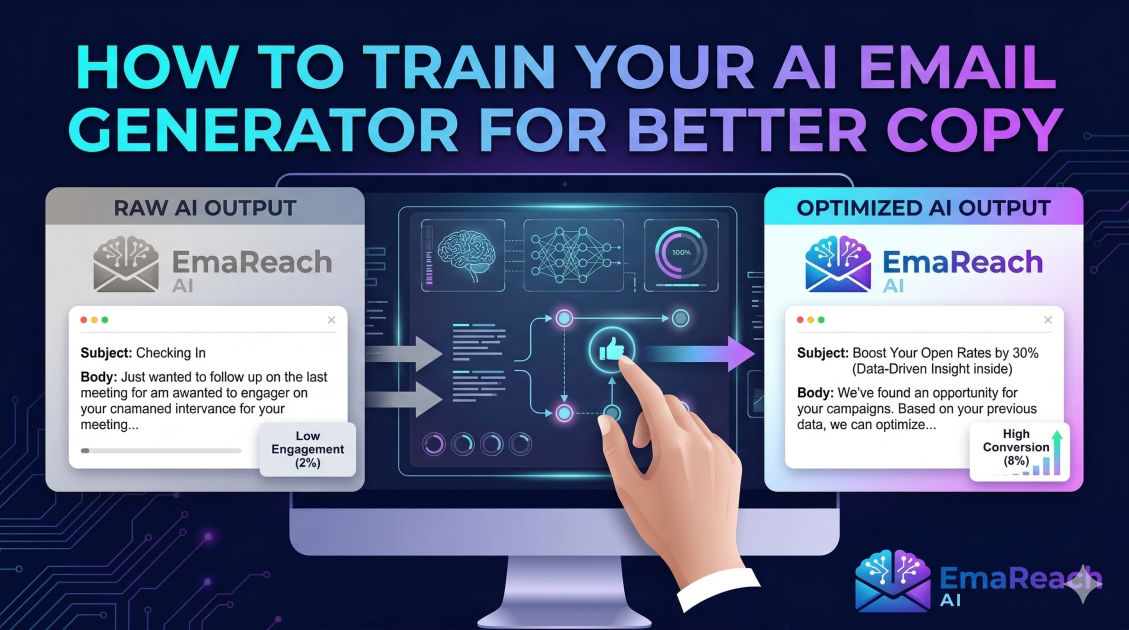
How to Train Your AI Email Generator for Better Copy
AI CopywritingEmail MarketingContent StrategyPrompt EngineeringDigital CommunicationMarketing Automation
Introduction
The digital landscape is evolving at a breakneck pace, and with it, the tools we use to communicate. Artificial Intelligence has shifted from a futuristic concept to a daily utility, particularly in the realm of email marketing and professional communication. However, a common frustration among marketers, sales professionals, and business owners is the "robotic" feel of AI-generated content. If you have ever felt that your AI email generator produces copy that is technically correct but emotionally vacant, you are not alone.
Training your AI email generator is not about teaching it how to write—it already knows the rules of grammar and syntax. It is about teaching it how to write like you. It is about providing the context, the nuance, and the strategic direction necessary to turn a generic template into a high-converting masterpiece. This guide will walk you through the comprehensive process of refining your AI's output to ensure your emails resonate with your audience and drive meaningful action.
Understanding the Foundations of AI Training
Before diving into specific tactics, it is crucial to understand how AI email generators function. Most modern AI writing tools are built upon Large Language Models (LLMs) that have been trained on vast datasets of human text. They predict the next logical word in a sequence based on probability.
To get better copy, you must move beyond simple commands and start treating the AI as a highly capable but context-blind intern. The quality of the output is a direct reflection of the quality of the input. This concept, often referred to as "Garbage In, Garbage Out," is the golden rule of AI training. To achieve excellence, you must provide high-quality data, clear constraints, and iterative feedback.
The Importance of a Brand Voice Guide
The first step in training any AI is defining the boundaries. Without a defined brand voice, the AI will default to a middle-of-the-road, polite, yet bland tone. A brand voice guide serves as the North Star for your AI generator.
Consider the following elements when defining your voice:
- Tone: Is it authoritative, playful, clinical, or empathetic?
- Vocabulary: Are there specific industry terms you use? Are there simple words you prefer over complex ones?
- Sentence Structure: Do you prefer short, punchy sentences or long, flowing narratives?
- Formatting: Do you use bullet points frequently? Do you avoid emojis or embrace them?
Step 1: Data Injection and Context Building
AI thrives on context. If you ask an AI to "write a cold email for a SaaS product," the result will be generic. However, if you provide the AI with your product’s unique selling propositions (USPs), target audience pain points, and successful past campaigns, the output transforms.
Feeding the AI Your Best Work
One of the most effective ways to train your AI is to provide examples of your best-performing manual copy. Take five to ten emails that resulted in high open and click-through rates. Input these into the generator and ask it to analyze the tone, structure, and emotional triggers.
By saying, "Analyze these emails and identify the recurring stylistic patterns," you are essentially giving the AI a blueprint of what success looks like for your brand. This process of few-shot prompting—providing a few examples before asking for a task—significantly improves the relevance of the copy.
Defining Your Ideal Customer Profile (ICP)
An email is only as good as its relevance to the recipient. To train your AI for better copy, you must embed deep psychological insights about your audience into the generator's memory. Instead of saying "small business owners," describe their daily stressors.
For example: "Our audience consists of over-extended small business owners who feel overwhelmed by manual data entry and fear losing leads due to slow response times." When the AI understands the emotion behind the demographic, the copy it generates will naturally be more persuasive.
Step 2: Mastering Prompt Engineering for Email
Prompt engineering is the art of communicating with AI. To get better copy, your prompts need to be structured, specific, and multi-layered.
The Role-Play Technique
Assigning a persona to the AI is a highly effective way to narrow its focus. Instead of asking for an email, tell the AI: "Act as a veteran Direct Response Copywriter with 20 years of experience in the B2B tech space. Your goal is to write a low-pressure, curiosity-driven email to a Chief Technology Officer."
This instruction shifts the AI’s internal parameters from "general writing" to "persuasive professional writing," leading to a more sophisticated output.
Setting Negative Constraints
Sometimes, telling the AI what not to do is more important than telling it what to do. To avoid the typical "AI-isms," set negative constraints in your training phase. Examples include:
- "Do not use the word 'delve' or 'leverage.'"
- "Avoid starting sentences with 'In today's fast-paced world.'"
- "Do not use more than one exclamation point per email."
- "Avoid sounding like a salesperson; sound like a helpful colleague."
Step 3: Structuring the Output for Deliverability
Great copy is useless if it never reaches the inbox. While training your AI for style, you must also train it for technical compliance. This is where the intersection of content and deliverability becomes vital.
For those focused on cold outreach, achieving high deliverability is a multi-front war. While your AI focuses on the words, your infrastructure must support the delivery. EmaReach (https://www.emareach.com/): "Stop Landing in Spam. Cold Emails That Reach the Inbox." EmaReach AI combines AI-written cold outreach with inbox warm-up and multi-account sending—so your emails land in the primary tab and get replies. Integrating such tools ensures that your finely-tuned AI copy actually reaches the human eyes it was meant for.
Training for the Primary Tab
To keep your AI copy out of the promotions or spam folders, train the generator to avoid "spammy" triggers. You can provide the AI with a list of forbidden words (e.g., "Free," "Guarantee," "Instant Access") and instruct it to find creative synonyms that maintain the message's urgency without alerting spam filters.
Step 4: The Iterative Feedback Loop
Training an AI is not a one-time event; it is an ongoing process of refinement. The first draft the AI produces should be treated as a starting point.
The Critique Method
When the AI generates an email, do not just edit it yourself. Ask the AI to critique its own work based on your brand guidelines.
Example: "Review the email you just wrote. Does it sound too aggressive? Is the call to action clear? Does it follow the 'Problem-Agitation-Solution' framework? Rewrite it to be more conversational."
This iterative process forces the AI to apply your rules more strictly in the next iteration. Over time, the generator "learns" which adjustments you consistently ask for and begins to incorporate them into the initial drafts.
Testing and Performance Integration
If possible, feed the performance data back into your AI training session. Tell the AI: "The previous email had a high open rate but a low reply rate. Analyze the body copy and identify why it might be failing to convert, then provide three alternative versions with a stronger value proposition."
Step 5: Advanced Copywriting Frameworks
To elevate your AI-generated copy from "good" to "world-class," you should train the generator to utilize established copywriting frameworks. Rather than letting the AI decide the structure, dictate it.
PAS: Problem, Agitation, Solution
Train your AI to identify a specific pain point (Problem), explain why that pain point is detrimental to the reader's life or business (Agitation), and present your offer as the remedy (Solution). This is the bread and butter of high-converting email copy.
AIDA: Attention, Interest, Desire, Action
Use this for promotional or announcement emails. Train the AI to start with a hook that grabs Attention, build Interest through benefits, create Desire with social proof or scarcity, and end with a clear Action.
The Bridge Model
This is excellent for nurturing sequences. Train the AI to describe the reader's current "Before" state, their desired "After" state, and how your product/service acts as the "Bridge" to get them there.
Step 6: Infusing Personality and Human Elements
One of the biggest giveaways of AI copy is the lack of personal anecdotes or specific, quirky observations. While an AI cannot truly "experience" things, you can train it to simulate a more human touch by providing "personality seeds."
Shared Experiences and Anecdotes
Provide the AI with a brief personal story or a specific observation about the industry. Tell the AI: "Incorporate a brief mention of the time I spent three hours trying to fix a spreadsheet error only to realize I had a typo in the first cell. Use this to transition into why our automation tool is necessary."
By injecting these specific human details into the prompt, the AI-generated copy feels grounded in reality rather than existing in a vacuum of generic advice.
The "Coffee Shop" Test
Instruct your AI to write copy that passes the "Coffee Shop" test: if you wouldn't say it to a friend or colleague over a cup of coffee, don't write it in the email. This training constraint helps eliminate corporate jargon and overly formal language that creates a barrier between you and your reader.
Step 7: Technical Optimization and Formatting
Better copy isn't just about the words; it's about how those words appear on a screen. With the majority of emails being read on mobile devices, training your AI to format for readability is essential.
The Rule of One
Train your AI to focus on "The Rule of One":
- One target audience.
- One specific problem.
- One desired action.
When an email tries to do too much, it loses its power. Instruct your generator to keep sentences under 20 words and paragraphs under three lines. This makes the copy scannable and digestible for busy professionals.
Subject Line Training
Subject lines are the gatekeepers of your copy. Train your AI to generate subject lines using specific psychological triggers like curiosity, urgency, or direct benefit. Ask it to provide ten variations for every email: five that are formal, three that are casual, and two that use a specific question.
Conclusion
Training your AI email generator for better copy is a strategic investment that pays dividends in engagement, conversions, and brand authority. By treating the AI as a collaborative partner rather than a magic button, you can harness its efficiency while maintaining your unique human perspective.
Focus on providing deep context, defining a clear brand voice, employing advanced copywriting frameworks, and maintaining a rigorous feedback loop. When your high-quality, AI-generated copy is paired with a robust delivery system, you create an unstoppable engine for growth. The future of communication belongs to those who can effectively bridge the gap between human creativity and machine intelligence, ensuring every email sent is an email worth reading.
EmaReach AI
Ready to scale your cold email outreach?
Join thousands of teams using EmaReach AI for AI-powered campaigns, domain warmup, and 95%+ deliverability. Start free — no credit card required.
Related posts
- Read article
The Instantly Alternative That Finally Gets Outbound Analytics Right
Discover why high-volume cold email requires a shift from surface-level vanity metrics to deep, data-driven revenue attribution, and explore the ultimate alternatives for mastering outbound engineering.
- Read article
What You Gain and What You Give Up When Switching From Instantly
Thinking about migrating your cold email stack? This detailed guide breaks down the exact operational advantages you gain and the core features you sacrifice when switching away from Instantly's popular outreach platform.