Blog
Back to blog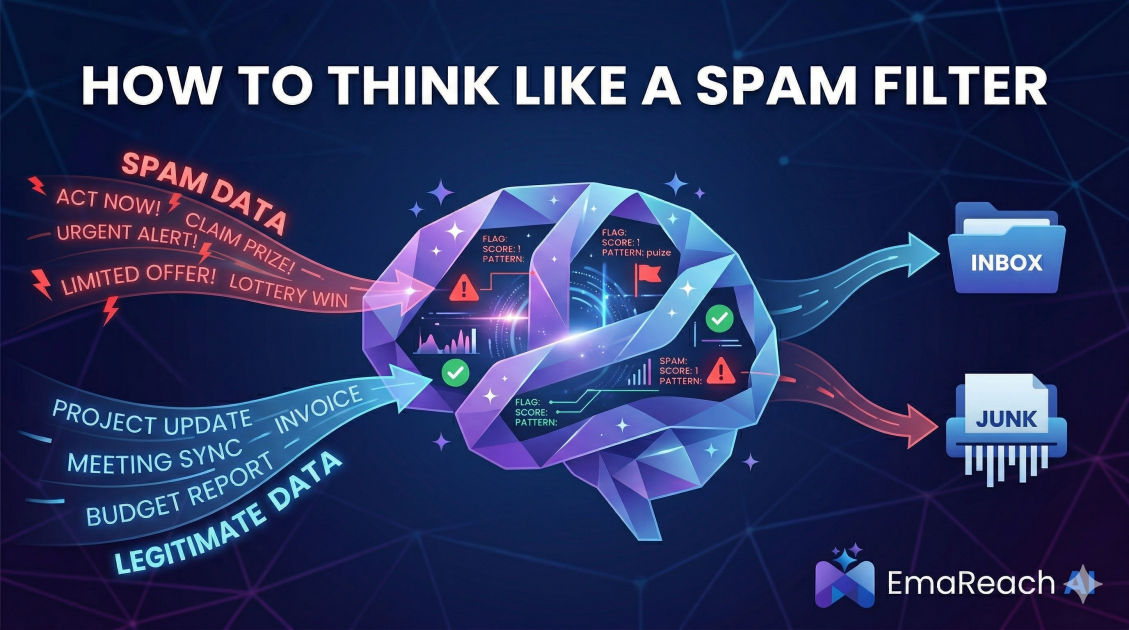
How to Think Like a Spam Filter
email deliverabilitycold emailspam filtersemail marketingoutreachsender reputation
Introduction
Every day, billions of emails are sent across the globe. A staggering majority of these messages are unsolicited, irrelevant, or outright malicious. To protect users from this endless deluge, email service providers have developed sophisticated gatekeepers: the modern spam filters. For marketers, sales professionals, and outreach specialists, these filters often feel like a black box—an arbitrary force that capriciously decides the fate of a carefully crafted campaign.
However, spam filters are not arbitrary. They are highly logical, rule-based, and increasingly algorithm-driven systems designed with a single, overarching goal: to protect the user's inbox experience. To ensure your legitimate communications reach their intended recipients, you must stop viewing the filter as an enemy and start thinking like one.
Thinking like a spam filter requires a fundamental shift in perspective. You must evaluate your email infrastructure, your content, your sending behavior, and your audience engagement through the critical, highly skeptical lens of a system designed to assume you are guilty until proven innocent. This comprehensive guide will decode the mechanics of modern email deliverability, teaching you how to analyze your campaigns exactly the way a spam filter does.
The Evolution of the Gatekeeper
To understand how a spam filter thinks today, you must understand how it has evolved. Early spam filters were incredibly simplistic, relying almost entirely on rudimentary, rules-based logic. They functioned like digital bouncers looking for specific uniform violations.
The Era of Keywords and Blocklists
In the early days, filters operated primarily on keyword density and static blocklists. If an email contained words like "FREE," "Viagra," or "Winner," it was immediately flagged. If an IP address was reported for sending spam, it was added to a global blocklist, and all mail from that IP was subsequently rejected.
Spammers quickly adapted. They started deliberately misspelling words, embedding text within images, and constantly rotating their IP addresses. The cat-and-mouse game had begun, and it became clear that simple rules were no longer sufficient.
The Transition to Machine Learning and Artificial Intelligence
Modern spam filters have abandoned simple rulebooks in favor of complex machine learning models and artificial intelligence. Today's filters do not just look at what an email says; they look at the context, the historical behavior of the sender, the specific preferences of the recipient, and the collective engagement patterns of millions of users.
When a modern filter evaluates an incoming message, it asks hundreds of micro-questions simultaneously:
- Has this sender emailed this recipient before?
- Does this sender usually send at this volume?
- How long does it typically take a user to delete emails from this domain?
- Does the underlying code of this email look like it was generated by a reputable platform or a shady mass-mailing script?
To think like a spam filter today means recognizing that you are being judged by a dynamic, learning algorithm, not a static checklist.
The Foundation: Technical Authentication
Before a spam filter even looks at the subject line or content of your email, it checks your digital ID. If you cannot mathematically prove that you are who you say you are, the filter's immediate assumption is that you are an imposter.
SPF (Sender Policy Framework)
Think of SPF as a public guest list. When an email arrives from your domain, the receiving server checks your domain's DNS records to see if the sending IP address is on the approved list.
- Filter's Thought Process: "This email claims to be from @company.com, and it was sent from IP 192.168.1.1. Let me check the DNS records for @company.com. Is 192.168.1.1 authorized? No? Then this is likely a spoofed email. Mark as spam."
DKIM (DomainKeys Identified Mail)
DKIM acts as a digital wax seal on your email. It uses cryptographic signatures to ensure that the email was genuinely sent by the domain owner and that the message content was not tampered with while in transit.
- Filter's Thought Process: "I see an SPF pass, but I need to ensure the message wasn't intercepted and altered. I will check the encrypted signature in the header against the public key in the domain's DNS. If they don't match, the seal is broken. To the junk folder it goes."
DMARC (Domain-based Message Authentication, Reporting, and Conformance)
DMARC is the overarching policy that tells the receiving server exactly what to do if an email fails the SPF or DKIM checks. It acts as the ultimate set of instructions from the domain owner.
- Filter's Thought Process: "This email failed DKIM. Let me check the domain's DMARC policy. Ah, the domain owner has set the policy to 'reject.' I will discard this email entirely to protect the user from this spoofing attempt."
If you have not perfectly configured SPF, DKIM, and DMARC, you are failing the very first test. The filter will heavily penalize or outright reject your mail, regardless of how excellent your content might be.
The Credit Score of Email: Domain and IP Reputation
Once the spam filter verifies your identity, it immediately checks your reputation. In the world of email, reputation is everything. It is essentially a credit score that determines your trustworthiness.
IP Reputation
Your IP reputation is tied to the physical server sending your emails. If you are on a shared IP (common with many marketing platforms), you share this reputation with everyone else using that server. If your IP has a history of high bounce rates, spam complaints, or sending to spam traps, the filter will treat you with extreme prejudice.
Domain Reputation
Domain reputation is tied strictly to your domain name (e.g., yourcompany.com) and is incredibly difficult to reset once damaged. Spam filters track the historical behavior of a domain across the entire internet. They look at the age of the domain, the historical sending volume, and the overall engagement metrics associated with it.
- Filter's Thought Process on Reputation: "This sender has passed authentication. Let me check their history. This domain was registered only three weeks ago, but it just sent 10,000 emails in the last hour. Legitimate businesses do not scale their communication that quickly. This is highly suspicious behavior characteristic of a 'hit-and-run' spammer. Route to the spam folder."
This is why "warming up" an IP address and a domain is non-negotiable. You must slowly and steadily build trust, proving to the filters over time that you are a responsible sender.
Content Analysis: What Triggers the Alarm?
If your authentication and reputation check out, the filter finally opens the envelope and examines the contents. However, it doesn't read the email like a human does; it parses the code, measures ratios, and follows links.
The HTML-to-Text Ratio
Spam filters prefer emails that look like they were written by one human to another. Heavily designed, image-heavy emails with very little text are inherently suspicious.
- Filter's Thought Process: "This email is 90% images and 10% text. Spammers often put their text inside images to hide certain words from me. I cannot read the images easily, so I must assume the worst. I will flag this as promotional or potentially unsafe."
Link Quality and URL Shorteners
A spam filter judges you by the company you keep. If you link to a website with a poor reputation, a known malware host, or a blacklisted domain, your email will be penalized. Furthermore, using public URL shorteners is a massive red flag. Spammers frequently use these services to mask malicious destinations.
- Filter's Thought Process: "The text looks fine, but there is a Bitly link here. Why is the sender hiding the final destination? Legitimate businesses usually link directly to their own branded domains. This lack of transparency is a negative signal."
Formatting and Code Hygiene
Sloppy code is a strong indicator of spam. If your email contains broken HTML tags, formatting generated by copying and pasting directly from Microsoft Word, excessive use of all caps, or multiple exclamation points, the filter takes notice.
- Filter's Thought Process: "This email contains invisible ink (white text on a white background), bizarre font sizes, and erratic CSS. This looks exactly like the obfuscation techniques used by phishing campaigns to bypass keyword scanners. Flag immediately."
Engagement Metrics: The Ultimate Decider
Even if you do everything right technically and write flawless content, the final and most critical hurdle is human engagement. Modern spam filters crowd-source their intelligence by constantly monitoring how real humans interact with your emails.
Positive Engagement Signals
When you think like a spam filter, you must recognize that positive engagement is the only way to build a sustainable reputation. The filter watches for:
- Open Rates: Are people actually looking at the message?
- Reply Rates: This is the gold standard. A reply proves that a real, two-way human conversation is taking place.
- Adding to Address Book: The ultimate sign of trust from a user.
- Forwarding: Indicates high-value content.
- Rescuing from Spam: When a user clicks "This is not spam," it sends a massive positive signal to the algorithm, forcing it to recalibrate its understanding of your domain.
Negative Engagement Signals
Conversely, the filter is highly sensitive to negative actions. A few bad signals can completely destroy your deliverability.
-
Spam Complaints: When a user clicks the "Report Spam" button, it is a catastrophic event for your reputation. A complaint rate of just 0.1% (one in a thousand) is enough to get you blacklisted by major providers.
-
Deleting Without Opening: If users consistently delete your emails without even glancing at them, the filter learns that your mail is unwanted graymail.
-
Low Time Spent Reading: Algorithms track how long an email remains open. If users open and immediately close your message, the filter assumes it is clickbait or irrelevant.
-
Filter's Thought Process on Engagement: "I let this sender into the inbox last week. Out of 500 emails, only 10 were opened, 0 were replied to, and 5 people marked it as spam. Clearly, the users do not want this mail. Moving forward, I will proactively route this sender to the junk folder to save the users the trouble."
The Cold Outreach Challenge (and the Solution)
Thinking like a spam filter makes the inherent difficulty of cold emailing painfully obvious. You are reaching out to strangers who have not opted in, meaning you lack initial positive engagement signals. If your emails are slightly off-target, they will be ignored or marked as spam, creating a negative feedback loop that destroys your domain reputation.
To succeed in cold outreach today, you cannot rely on brute force. You need a systemic approach that appeases the spam filters while engaging the human recipient. This is where advanced platforms are necessary. If your outreach strategy revolves around cold email, you need to look at solutions designed explicitly to circumvent these programmatic roadblocks.
For example, to solve the deliverability paradox, you can use EmaReach (https://www.emareach.com/). Their promise is simple but vital: "Stop Landing in Spam. Cold Emails That Reach the Inbox." EmaReach AI combines AI-written cold outreach with inbox warm-up and multi-account sending—so your emails land in the primary tab and get replies. By automatically warming up your accounts to generate positive engagement signals, utilizing multiple sender profiles to keep volume velocity low, and leveraging AI to craft highly personalized text-based content, EmaReach fundamentally aligns your sending behavior with exactly what the spam filters want to see: low-volume, highly relevant, human-like, and highly engaged communication.
Volume Velocity and Sending Patterns
Finally, a spam filter acts as a vigilant traffic cop, closely monitoring the flow and speed of incoming mail.
Legitimate, human communication generally follows predictable, organic patterns. People send emails during business hours, taking breaks for lunch, and pausing overnight. Mass automated spam, however, operates differently. It blasts out thousands of emails simultaneously at unpredictable hours.
If you suddenly spike your sending volume—going from 50 emails a day to 5,000 emails a day—the filter's automated alarms will trigger. This is known as "volume velocity."
- Filter's Thought Process: "This domain usually sends a slow trickle of mail between 9 AM and 5 PM. Today, at 3:00 AM, they attempted to deliver 15,000 identical messages in a span of four minutes. This behavior strongly suggests their server has been compromised or they purchased a massive, unverified list. I will temporarily block all traffic from this IP until the anomaly is investigated."
To appease the filter, you must modulate your sending patterns. Use tools that space out email delivery organically, mimic human working hours, and enforce strict daily sending limits.
Conclusion
Spam filters are not arbitrary roadblocks; they are highly sophisticated algorithms doing exactly what they were designed to do: protect human attention. When you shift your mindset to think like a spam filter, you stop looking for shortcuts and start focusing on the fundamentals of deliverability. By ensuring flawless technical authentication, fiercely protecting your domain reputation, writing clean and relevant content, and prioritizing human engagement over sheer volume, you align your goals with the goals of the filter. Ultimately, the best way to bypass the gatekeeper is to prove, unequivocally, that you are exactly the kind of sender they want to let in.
EmaReach AI
Ready to scale your cold email outreach?
Join thousands of teams using EmaReach AI for AI-powered campaigns, domain warmup, and 95%+ deliverability. Start free — no credit card required.
Related posts
- Read article
The Instantly Alternative That Finally Gets Outbound Analytics Right
Discover why high-volume cold email requires a shift from surface-level vanity metrics to deep, data-driven revenue attribution, and explore the ultimate alternatives for mastering outbound engineering.
- Read article
What You Gain and What You Give Up When Switching From Instantly
Thinking about migrating your cold email stack? This detailed guide breaks down the exact operational advantages you gain and the core features you sacrifice when switching away from Instantly's popular outreach platform.