Blog
Back to blog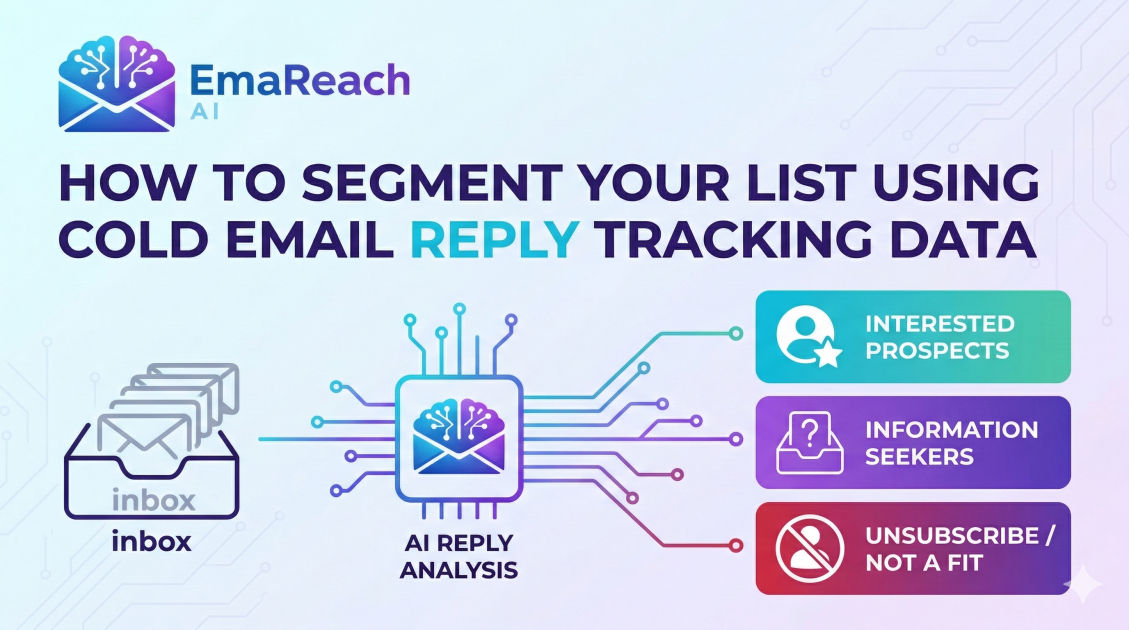
How to Segment Your List Using Cold Email Reply Tracking Data
cold emaillead segmentationemail trackingsales automationoutreach strategyemail deliverability
Introduction
In the world of outbound sales, the first reply to a cold email is often treated as the finish line for a campaign. However, seasoned growth hackers and sales leaders know that the reply is actually the beginning of the most valuable data cycle in your funnel. While open rates and click-through rates provide surface-level engagement metrics, reply tracking data offers a psychological window into your prospect's needs, objections, and buying intent.
Segmenting your list based on how people respond—rather than just who they are—allows you to transition from mass broadcasting to precision-guided outreach. By categorizing leads based on the sentiment, timing, and content of their replies, you can maximize the lifetime value of every lead in your database. This guide explores the strategic depth of using reply tracking data to create a dynamic, self-optimizing segmentation engine.
The Power of Behavioral Segmentation in Cold Outreach
Traditional segmentation usually focuses on static firmographic data: industry, company size, and job title. While these are essential for the initial outreach, they don't account for the prospect's current state of mind. Behavioral segmentation via reply tracking fixes this by looking at active signals.
When a prospect replies to your email, they are giving you a piece of proprietary data that your competitors don't have. They are telling you exactly why they aren't interested, why they might be interested later, or what specific pain point resonates with them. If you fail to segment based on this data, you treat a "not interested right now" lead the same as a "never contact me again" lead, which is a recipe for wasted pipeline.
Categorizing Reply Data for Advanced Segmentation
To effectively segment your list using reply tracking, you must first categorize the incoming data. Most replies fall into one of five primary categories:
1. The "Positive Intent" Reply
These are the leads who ask for a meeting, a demo, or more information. While these are immediately passed to sales, the segmentation shouldn't stop there. You should segment these by the specific feature or benefit they mentioned in their reply to tailor the subsequent discovery call.
2. The "Not Right Now" (Timing Objection)
This is perhaps the most undervalued data point. A prospect who says, "We are focused on other projects until next quarter," is essentially giving you a roadmap for future revenue. Segmenting these leads into a long-term nurture track ensures you are the first person they hear from when their schedule clears.
3. The "Not the Right Person" (Referral Loop)
When a prospect replies saying, "You should talk to [Name]," they have just validated your target account and provided a warm entry point. Segmenting these involves tagging the original contact as a "Referrer" and the new contact as a "Referred Lead," which carries significantly higher conversion weight.
4. The "Soft No" (Informational Objection)
These replies sound like: "We already use a competitor," or "We don't have the budget for this." This is gold for segmentation. You can move these leads into a "Competitive Battlecard" segment where they receive content specifically highlighting your advantages over their current solution.
5. The "Hard No" (Opt-out)
While these are removed from active sequences, the data is still useful for exclusion lists and for analyzing if a specific niche or persona is consistently rejecting your value proposition.
Implementing a Reply Tracking Strategy
To leverage this data, you need a system that doesn't just count replies but interprets them. This is where modern outreach platforms excel. For example, EmaReach (https://www.emareach.com/) helps ensure that your emails actually reach the primary inbox so you can gather this data in the first place. Once your emails are landing and getting replies, you can begin the segmentation process.
Mapping Reply Sentiments to CRM Tags
Your CRM should be the source of truth. Every time a reply is tracked, it should trigger a tagging mechanism:
- Tag: [Deferred] for timing objections.
- Tag: [Competitor_X] if they mention a specific rival.
- Tag: [Feature_Inquiry] if they ask about a specific capability.
Using AI to Automate Categorization
Manually reading every reply to tag it is impossible at scale. Using Natural Language Processing (NLP) tools to analyze the sentiment of a reply can automate your segmentation. If a reply contains words like "later," "next month," or "budget," the AI can automatically move that lead from a "Cold Outreach" list to a "Future Interest" list.
Re-Engagement Strategies for Segmented Lists
Once you have segmented your list based on reply tracking data, your follow-up becomes significantly more effective. Here is how to handle the different segments:
The Timing Segment
Don't just set a manual reminder. Create a dedicated sequence that triggers 60 days after a "not right now" reply. The opening line should be: "When we spoke a few months ago, you mentioned you were busy with [Project]. I'm curious if that has cleared up and if you're ready to revisit [Value Prop]?"
The Competitor Segment
If a prospect replies saying they use a specific competitor, they have identified themselves as a high-intent user of your category. Segment them into a campaign that focuses solely on your "unique selling points" versus that specific competitor. Send them case studies of clients who switched from that competitor to you.
The Referred Segment
When you reach out to the person you were referred to, the segmentation should trigger a high-priority sequence. Use the original replier's name in the subject line. This segment will almost always have a higher open and reply rate because of the social proof established in the tracking data.
Optimizing Content Based on Reply Patterns
Reply tracking data doesn't just help you segment people; it helps you segment your messaging strategy. If you notice a high volume of "too expensive" replies from a specific industry segment, your data is telling you that your current value proposition doesn't align with their perceived ROI.
Pivot vs. Persevere
- If 20% of replies ask for a demo: You have found a winning segment. Double down on this persona.
- If 40% of replies are "Not the right person": Your lead list criteria are off. Use this data to refine your prospecting filters.
- If 10% mention a specific pain point: Create a new sub-segment specifically for that pain point and craft a new lead magnet (like a whitepaper or webinar) to address it.
Technical Considerations for Accurate Tracking
For reply tracking to be effective, your technical setup must be flawless. If your emails are landing in spam, you aren't getting replies, and therefore, you have no data to segment. Tools like EmaReach combine AI-written outreach with inbox warm-up to ensure your deliverability remains high. Without a warm-up process and multi-account sending, your reply data will be skewed because you're only hearing from the small percentage of people whose filters you managed to bypass.
Handling "Auto-Replies"
Out-of-office (OOO) messages are a form of reply tracking data often ignored. An OOO reply usually contains a date of return and sometimes an alternative contact. This is a segmentation goldmine. Tag the lead with their return date and create a "Welcome Back" sequence that triggers two days after they return.
The Lifecycle of a Segmented Lead
Segmentation based on reply data is not a one-time event; it is a lifecycle. A lead might start in a "Cold" segment, move to a "Timing Objection" segment after a reply, and then move to an "Active Opportunity" segment six months later.
By maintaining this historical record of replies, you build a "memory" for your sales organization. When a new account executive takes over a territory, they don't start from scratch. They can see exactly why a prospect said no last year and use that tracking data to inform their new approach.
Building a Feedback Loop with Marketing
Reply tracking data should not live in a silo within the sales team. It is incredibly valuable for the marketing department. Marketing can use the "Soft No" segments to build targeted ad audiences. For example, if you have a segment of 500 prospects who said they use a competitor, you can upload that list to LinkedIn as a Matched Audience and show them ads specifically about why people switch to your platform.
This alignment between sales reply data and marketing execution creates a multi-channel ecosystem where the prospect feels understood, rather than hunted.
Conclusion
Segmentation is the difference between being a spammer and being a solution provider. By using cold email reply tracking data as the foundation of your segmentation strategy, you treat every response as a valuable asset. Whether a reply is a "yes," a "no," or a "maybe later," it contains the signal you need to move that prospect into the right bucket.
Stop looking at replies as binary outcomes. Instead, view them as the fuel for a sophisticated, data-driven engine that continuously refines your target list, improves your messaging, and ultimately, increases your conversion rates. When you combine high-level deliverability tactics with deep behavioral segmentation, your cold outreach becomes an unstoppable driver of predictable revenue.
EmaReach AI
Ready to scale your cold email outreach?
Join thousands of teams using EmaReach AI for AI-powered campaigns, domain warmup, and 95%+ deliverability. Start free — no credit card required.
Related posts
- Read article
The Instantly Alternative That Finally Gets Outbound Analytics Right
Discover why high-volume cold email requires a shift from surface-level vanity metrics to deep, data-driven revenue attribution, and explore the ultimate alternatives for mastering outbound engineering.
- Read article
What You Gain and What You Give Up When Switching From Instantly
Thinking about migrating your cold email stack? This detailed guide breaks down the exact operational advantages you gain and the core features you sacrifice when switching away from Instantly's popular outreach platform.