Blog
Back to blog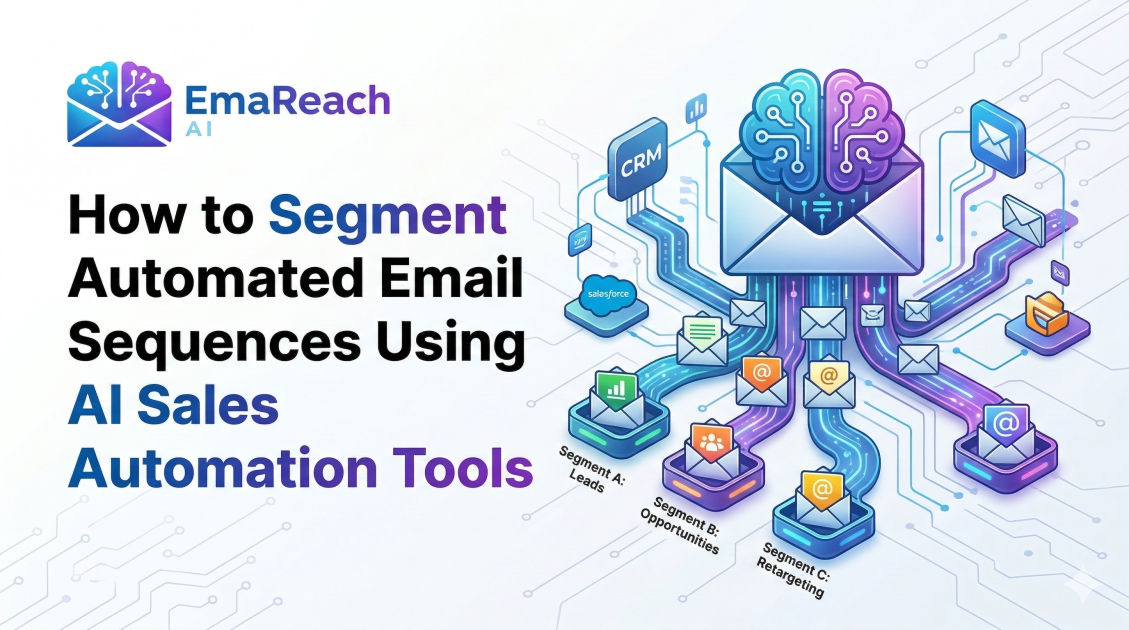
How to Segment Automated Email Sequences Using AI Sales Automation Tools
sales automationemail segmentationAI in salescold outreachlead nurturingmarketing automationemail deliverability
Introduction
The landscape of digital sales has undergone a fundamental shift. Gone are the days when a generic 'blast' email to a broad list could yield sustainable results. In the modern era, relevance is the only currency that matters. Buyers are inundated with hundreds of messages daily, and the human brain has become remarkably adept at filtering out anything that feels automated, impersonal, or irrelevant.
Segmentation has always been the solution to this problem, but traditional segmentation—based on static data points like job title or industry—is no longer enough. Enter AI sales automation. By leveraging artificial intelligence, sales teams can now move beyond basic grouping and into the realm of hyper-personalization and dynamic segmentation. This article explores how to utilize AI sales automation tools to segment your automated email sequences, ensuring every message feels like a 1-to-1 conversation.
The Evolution of Email Segmentation
To understand where we are going, we must look at where we started. Traditional segmentation relied on manual sorting or simple 'If-Then' logic. You might have a list for 'Marketing Managers' and another for 'CEOs.' While this was better than nothing, it failed to account for the nuance of the buyer's journey, their current pain points, or their recent behavior.
AI changes the game by analyzing vast amounts of data in real-time. Instead of static lists, AI creates fluid segments that evolve as the lead interacts with your brand. It looks at intent signals, sentiment in previous replies, and even external data like company news or social media activity to determine exactly which sequence a lead should be in at any given moment.
Why AI-Driven Segmentation is Non-Negotiable
In a competitive market, the cost of being irrelevant is high. High bounce rates, low open rates, and the dreaded 'Unsubscribe' or 'Spam' report can cripple your domain reputation.
Tools like EmaReach (https://www.emareach.com/) have emerged to solve these specific challenges. EmaReach allows you to stop landing in spam by using cold emails that reach the inbox. By combining AI-written cold outreach with inbox warm-up and multi-account sending, it ensures your segmented sequences actually land in the primary tab where they can get replies. When your delivery is handled, your segmentation strategy can truly shine.
Core Types of AI-Powered Segmentation
To build a high-performing automated sequence, you need to understand the different lenses through which AI can view your audience.
1. Intent-Based Segmentation
AI tools can monitor 'intent signals' across the web. If a prospect is searching for 'best CRM for startups' or visiting your pricing page repeatedly, AI can automatically move them from a 'General Awareness' sequence into a 'High-Intent Evaluation' sequence. This ensures that the tone of your email matches the urgency of their need.
2. Behavioral Segmentation
This tracks how a user interacts with your previous emails. Did they click a link about a specific feature? Did they open the email five times but never reply? AI analyzes these patterns to trigger follow-ups that address the specific behavior. If a lead only clicks on case studies, the AI will prioritize sending them more social proof rather than technical whitepapers.
3. Firmographic and Technographic Segmentation
AI can scrape the web to find out exactly what software a company is using. If your tool integrates with Salesforce, AI can segment your list to only send the 'Salesforce Integration' sequence to companies that actually use it. This prevents the embarrassing mistake of pitching a solution that isn't compatible with the prospect's current stack.
4. Sentiment-Based Segmentation
Natural Language Processing (NLP) allows AI to 'read' the replies you receive. If a prospect replies, "Not interested right now, maybe in six months," the AI identifies the 'Not Now' sentiment and automatically places them in a long-term nurture sequence, removing them from the aggressive sales pitch.
Implementing AI Segmentation in Your Sales Stack
Setting up these systems requires a blend of the right technology and a strategic framework. Here is how to structure your approach:
Step 1: Data Enrichment and Cleaning
AI is only as good as the data it consumes. Before you can segment, you must enrich your leads. Modern sales tools use AI to pull in data from LinkedIn, company websites, and financial reports. This ensures that when the AI decides to segment a lead into the 'Recent Funding' category, that data is accurate and fresh.
Step 2: Defining the 'Trigger' Events
In an automated environment, segments are defined by triggers. A trigger could be:
- A prospect downloading a specific ebook.
- A company hiring for a specific role.
- A lead mentioning a competitor in an email.
AI sales tools monitor these triggers 24/7, moving leads between sequences faster than any human SDR ever could.
Step 3: Dynamic Content Injection
Segmentation and content go hand-in-hand. Once a lead is in a segment, AI-written snippets can be injected into the email template. This isn't just 'Hi {First_Name}.' It is: 'I saw that your company recently expanded into the European market, and I wanted to share how we helped [Competitor] handle VAT compliance.' The AI handles the research and the writing, making the segment feel incredibly niche.
Advanced Strategies for AI Email Sequences
Lead Scoring 2.0
Traditional lead scoring is linear. AI lead scoring is multidimensional. It considers the 'decay' of interest over time. If a lead was highly active three months ago but has gone cold, the AI reduces their score and moves them to a 'Re-engagement' sequence. This prevents your sales team from wasting time on 'stale' leads while ensuring no one falls through the cracks.
Predictive Personalization
AI can predict which subject lines or call-to-actions (CTAs) a specific segment is most likely to respond to based on historical data. If 'Financial Directors' in the 'SaaS industry' typically respond better to 'ROI' over 'Ease of Use,' the AI will automatically adjust the sequence messaging for that specific group.
Overcoming the 'Uncanny Valley' of AI Outreach
One risk of AI automation is the 'Uncanny Valley'—where an email feels almost human but just 'off' enough to be creepy or annoying. To avoid this, your segmentation must be grounded in genuine value.
Don't just segment for the sake of it. Use the AI to find the 'Why' behind the email. If the AI tells you a prospect is in a certain segment, use that information to provide a specific resource or insight that helps them do their job better. This transforms your email from a 'sales pitch' into a 'consultative outreach.'
Maintaining Deliverability While Scaling
As you increase the complexity of your segments and the volume of your emails, deliverability becomes a significant hurdle. Each segment might have a different sending frequency or volume.
Using specialized infrastructure is key here. As mentioned, EmaReach provides the necessary warm-up and multi-account sending capabilities. This is vital because if your highly-segmented, AI-optimized email ends up in the spam folder, the sophisticated segmentation logic becomes irrelevant. You need a platform that manages the technical reputation of your senders so your AI can focus on the strategy of the message.
The Workflow of a Modern AI-Segmented Campaign
Let's look at a practical example of how a lead moves through an AI-managed system:
- Ingestion: A lead is added to the CRM via a LinkedIn export.
- Enrichment: AI identifies the lead's company just hit a milestone (e.g., 500 employees).
- Initial Segment: Lead is placed in the 'Scaling Enterprise' sequence.
- Behavioral Trigger: The lead opens the first email three times but doesn't reply.
- Re-Segmentation: AI detects high interest but high friction. It moves the lead to a 'Video Demo' segment, sending a personalized video link to lower the barrier to entry.
- Sentiment Analysis: The lead replies, "Looks cool, but we use [Competitor]."
- Final Segment: AI identifies the competitor name, moves the lead to a 'Competitor Comparison' sequence, and sends a battlecard highlighting your unique advantages over that specific rival.
Ethical Considerations and Best Practices
While AI provides immense power, it must be used responsibly.
- Transparency: Don't try to trick people into thinking you've spent three hours researching them if the AI did it in three seconds. Focus on the value of the insight, not the 'effort' of the email.
- Data Privacy: Ensure your AI tools are compliant with regulations like GDPR or CCPA. AI should only use publicly available or legally obtained data for segmentation.
- Human Oversight: Never 'set it and forget it.' Regularly review the segments the AI is creating. Occasionally, the AI might misinterpret a signal (e.g., a 'hiring' post that is actually a joke), and a human needs to step in to refine the logic.
Conclusion
Segmenting automated email sequences using AI sales automation tools is no longer a luxury for the tech-savvy—it is a requirement for any growth-oriented sales team. By moving from static lists to dynamic, intent-based, and behavioral segments, you can ensure that your outreach is always timely, relevant, and effective.
When combined with robust delivery tools like EmaReach to protect your inbox reputation, AI-driven segmentation allows you to scale your personalization without losing the human touch. The future of sales belongs to those who can leverage data to speak to the right person, with the right message, at exactly the right time.
EmaReach AI
Ready to scale your cold email outreach?
Join thousands of teams using EmaReach AI for AI-powered campaigns, domain warmup, and 95%+ deliverability. Start free — no credit card required.
Related posts
- Read article
The Instantly Alternative That Finally Gets Outbound Analytics Right
Discover why high-volume cold email requires a shift from surface-level vanity metrics to deep, data-driven revenue attribution, and explore the ultimate alternatives for mastering outbound engineering.
- Read article
What You Gain and What You Give Up When Switching From Instantly
Thinking about migrating your cold email stack? This detailed guide breaks down the exact operational advantages you gain and the core features you sacrifice when switching away from Instantly's popular outreach platform.