Blog
Back to blog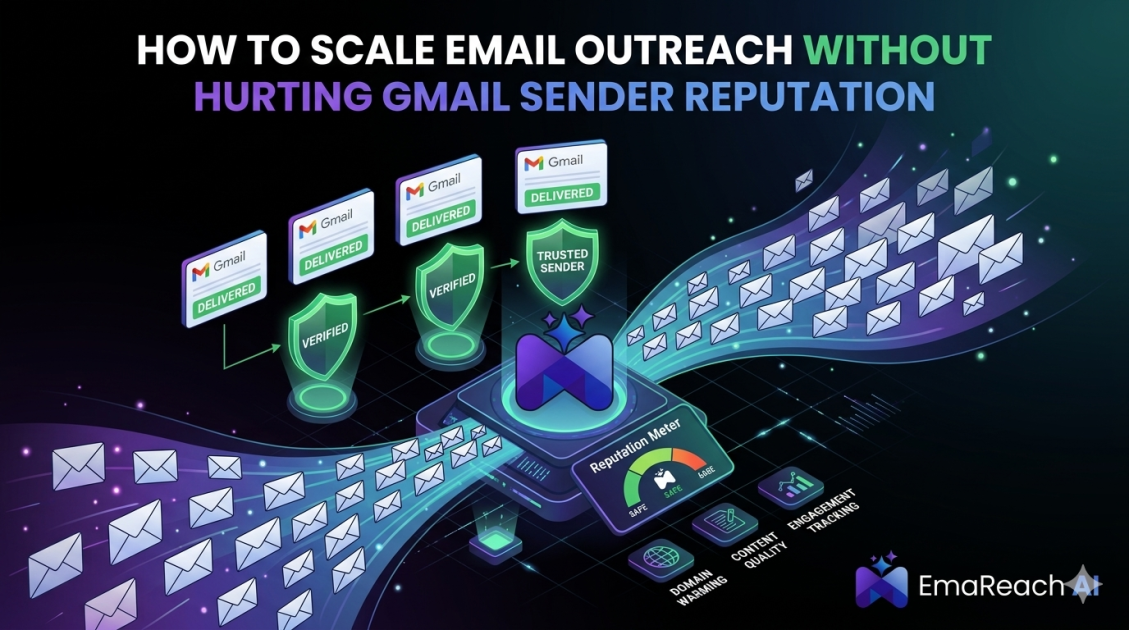
How to Scale Email Outreach Without Hurting Gmail Sender Reputation
email deliverabilitycold emailsender reputationgmail outreachemail marketinglead generationsales automation
Introduction
Scaling email outreach is a double-edged sword. On one side, increasing your volume is the fastest way to grow your pipeline, find new clients, and generate revenue. On the other side, sending too many emails too quickly—especially from a single Gmail account—is the fastest way to get your domain blacklisted and your messages relegated to the dreaded spam folder.
Gmail has become increasingly sophisticated at identifying patterns of mass outreach. Their algorithms look for more than just keywords; they analyze technical configurations, sending patterns, engagement rates, and recipient behavior. If you want to scale your outreach effectively, you cannot simply hit 'send' on 1,000 emails a day. You need a strategic framework that balances volume with deliverability.
This guide explores the technical and strategic nuances of scaling outreach while maintaining a pristine sender reputation. We will cover everything from domain infrastructure to content optimization and the role of specialized tools like EmaReach in modern deliverability management.
Understanding the Gmail Sender Reputation Ecosystem
Before you increase your volume, you must understand what Gmail is actually measuring. Your sender reputation isn't a single number; it is a combination of your Domain Reputation and your IP Reputation.
Domain Reputation
This is tied to your specific web address (e.g., yourcompany.com). If you send high volumes of cold emails from your primary business domain and people mark them as spam, your entire company's email infrastructure—including internal communications and invoices—could suffer. This is why scaling outreach requires a 'disposable' or 'secondary' domain strategy.
IP Reputation
Gmail tracks the reputation of the servers sending the emails. When you use Google Workspace, you share IPs with other users. However, Gmail still monitors the specific 'traffic footprint' your account generates. If your IP starts sending bursts of identical content to thousands of users, it triggers a red flag.
The Technical Foundation: SPF, DKIM, and DMARC
You cannot scale what isn't properly authenticated. Without these three protocols, Gmail will likely view your emails as suspicious before the recipient even sees the subject line.
- SPF (Sender Policy Framework): A DNS record that specifies which mail servers are authorized to send email on behalf of your domain.
- DKIM (DomainKeys Identified Mail): Adds a digital signature to your emails, ensuring the content hasn't been tampered with during transit.
- DMARC (Domain-based Message Authentication, Reporting, and Conformance): A policy that tells receiving servers what to do if an email fails SPF or DKIM checks (e.g., quarantine it or reject it).
When scaling, ensure every secondary domain you use has these records perfectly configured. Neglecting this step is the most common cause of early-stage deliverability failure.
The Strategy of Multi-Inbox Sending
The most significant mistake in scaling is trying to send 500 emails a day from one Gmail account. Gmail’s limits are generous for personal use, but for automated outreach, hitting the 'ceiling' triggers automated reviews.
The 'Horizontal' Scale vs. 'Vertical' Scale
Instead of sending more emails from one account (Vertical), you should send fewer emails from many accounts (Horizontal).
For example, if your goal is 500 emails per day, do not use one account. Instead, use 10 different accounts across 3-5 domains, sending only 50 emails per account. This distributes the load and ensures that if one account is flagged, your entire operation doesn't grind to a halt.
Managing Multiple Accounts with EmaReach
This is where specialized platforms become essential. Stop Landing in Spam. Cold Emails That Reach the Inbox. EmaReach AI combines AI-written cold outreach with inbox warm-up and multi-account sending—so your emails land in the primary tab and get replies. By using EmaReach, you can manage this horizontal scaling complexity without having to manually log into dozens of different Gmail accounts.
The Critical Role of Email Warm-up
You cannot buy a new domain and start sending outreach the same day. Gmail’s filters are highly suspicious of 'cold' domains that suddenly spike in activity. This is known as a lack of 'warmth.'
How Warm-up Works
Email warm-up is the process of gradually increasing your sending volume while ensuring those emails receive positive engagement (opens, clicks, and replies).
- Phase 1 (Days 1-7): Send 5-10 emails per day to known 'safe' addresses that will definitely open and reply.
- Phase 2 (Days 8-14): Increase to 20-30 emails per day.
- Phase 3 (Day 15+): Gradually reach your target daily limit.
Manual warm-up is nearly impossible to do at scale. An automated warm-up tool simulates human-like conversations, moving your emails out of the spam folder and marking them as 'important' to tell Gmail's algorithm that you are a legitimate sender.
Content Optimization: Avoiding the 'Spam Filter' Trap
Even with a warm domain and perfect technical records, your content can still sink your reputation. Gmail scans the body of your email for patterns associated with low-quality bulk mail.
1. Personalization at Scale
If you send 1,000 identical emails, you will be caught. Use dynamic variables beyond just the first name. Reference the prospect’s company, a recent LinkedIn post, or a specific pain point relevant to their industry. AI-driven personalization is now a requirement for high-volume outreach.
2. The Link-to-Text Ratio
Too many links or images in an initial cold email are red flags. Keep your first touchpoint text-heavy. Avoid tracking pixels if your deliverability is struggling, as these are often hosted on shared domains that might have poor reputations.
3. Avoiding 'Spam' Triggers
Words like "Free," "Winner," "Cash," "Act Now," or excessive exclamation marks are basic triggers. However, modern filters are smarter. They look for aggressive sales language and a lack of a clear opt-out mechanism.
List Hygiene and Verification
Your sender reputation is heavily influenced by your Bounce Rate. If you send emails to addresses that don't exist, Gmail assumes you are using a scraped, low-quality list.
- Hard Bounces: Permanent failures (invalid email). Keep this below 2%.
- Soft Bounces: Temporary failures (inbox full). Monitor these closely.
Before any campaign goes live, run your list through a verification service to remove 'catch-all' addresses and invalid emails. High-quality data is the bedrock of safe scaling.
Monitoring Sender Reputation Metrics
You cannot manage what you do not measure. To scale safely, you must monitor several key metrics daily:
Google Postmaster Tools
This is a free tool provided by Google that shows you exactly how Gmail perceives your domain. It provides data on:
- Spam rate (as reported by users).
- Domain reputation (Low, Medium, High).
- Encryption success.
- Delivery errors.
Open Rates as a Proxy for Deliverability
While open rates can be skewed by privacy protections, a sudden drop from 60% to 10% is a clear indicator that your emails are landing in the spam folder. Monitoring these trends allows you to pause campaigns before the damage to your domain becomes permanent.
Transitioning to AI-Powered Outreach
As the volume of outreach increases, the manual effort required to keep emails 'human' becomes unsustainable. This is where AI changes the game. AI can rewrite subject lines, vary the sentence structure of your templates, and even research prospects to insert unique facts into every message.
By leveraging EmaReach, you aren't just sending emails; you are deploying an intelligent system designed to protect your reputation. It handles the rotation of accounts, the warm-up cycles, and the AI-driven content generation that makes mass outreach feel like a 1-to-1 conversation. This level of sophistication is what separates successful growth teams from those who get banned by Gmail within a month.
Best Practices for Long-Term Success
To maintain your Gmail sender reputation over months and years, adopt these 'evergreen' habits:
- Use Spintax: Use {Hello|Hi|Hey} tags in your templates to ensure no two emails are exactly alike.
- Set Sending Windows: Don't send 100 emails at 9:00 AM. Spread them out over the course of a business day to mimic natural human behavior.
- Respect the 'Unsubscribe': Make it incredibly easy for people to opt-out. A 'Report Spam' click is a heavy penalty; an 'Unsubscribe' click is neutral.
- Niche Down: Instead of one massive list, break your outreach into smaller, highly targeted segments. This naturally leads to higher engagement and better reputation.
Conclusion
Scaling email outreach without hurting your Gmail sender reputation is a balancing act between volume and quality. It requires a solid technical foundation (SPF/DKIM/DMARC), a strategic approach to account management (horizontal scaling), and a relentless focus on engagement (warm-up and personalization).
By diversifying your sending across multiple domains and accounts, and using advanced tools like EmaReach to automate the complexities of warm-up and AI personalization, you can reach more prospects than ever before without risking your digital infrastructure. Remember: in the world of email, slow and steady growth leads to the highest long-term volume. Protect your reputation first, and the results will follow.
EmaReach AI
Ready to scale your cold email outreach?
Join thousands of teams using EmaReach AI for AI-powered campaigns, domain warmup, and 95%+ deliverability. Start free — no credit card required.
Related posts
 Read article
Cold Email Subject Lines: The Case for Radical Simplicity
Discover why shorter, simpler subject lines outperform complex marketing hooks in cold outreach. Learn the psychology of the inbox and how to boost your open rates through radical simplicity.
Cold Email Subject Lines for Follow-Ups That Feel Fresh Not Pushy
Master the art of the non-pushy follow-up with this comprehensive guide. Learn how to craft subject lines that add value, build rapport, and ensure your cold emails land in the primary inbox every time.