Blog
Back to blog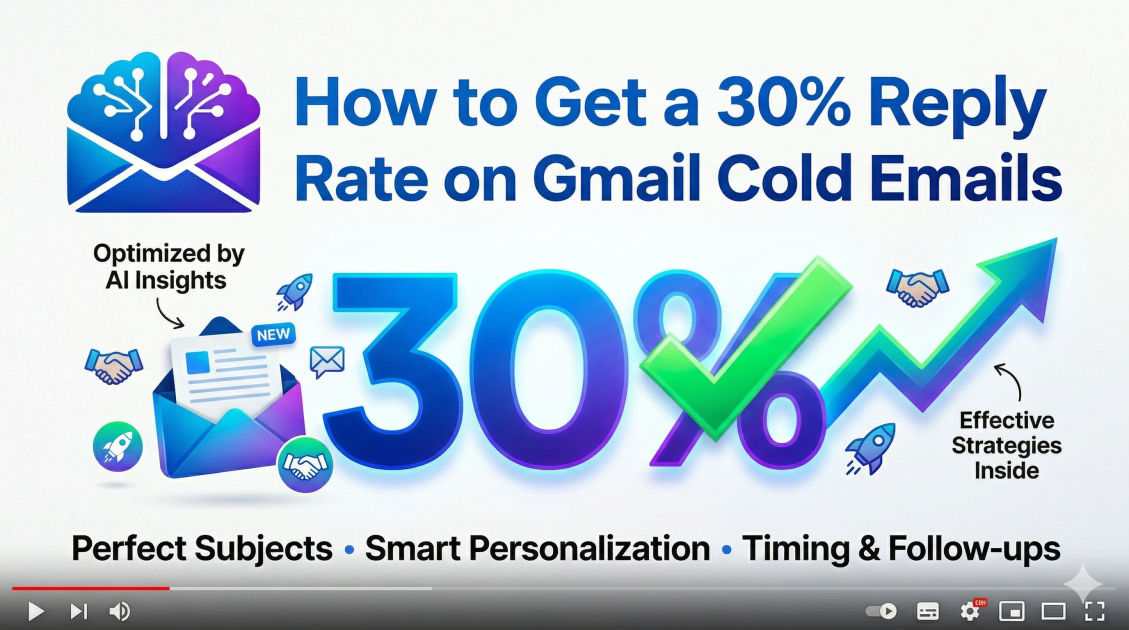
How to Get a 30% Reply Rate on Gmail Cold Emails
cold emailoutreachdeliverabilitylead generationemail marketingsales strategygmail tips
The Science of the 30% Reply Rate
In the world of digital outreach, a 30% reply rate is often considered the 'holy grail.' Most cold email campaigns struggle to break past the 5% mark, often falling victim to spam filters, poor targeting, or uninspiring copy. However, achieving a high response rate isn't about luck; it is a systematic process of technical setup, psychological triggers, and relentless optimization.
To reach a 30% reply rate using Gmail, you must transition from a 'bulk sender' mindset to a 'strategic partner' mindset. This guide explores the foundational pillars and advanced tactics required to turn a cold inbox into a source of consistent, high-quality opportunities.
Phase 1: Mastering Technical Deliverability
Before a single word of your email is read, it must first land in the primary inbox. Gmail’s algorithms are incredibly sophisticated, designed to protect users from unsolicited noise. If your technical foundation is weak, your reply rate will be 0% because your emails will be buried in the spam folder.
The Holy Trinity: SPF, DKIM, and DMARC
These three records are the 'ID cards' of your email domain.
- SPF (Sender Policy Framework): Specifies which mail servers are authorized to send email on behalf of your domain.
- DKIM (DomainKeys Identified Mail): Adds a digital signature to your emails, ensuring the content hasn't been tampered with in transit.
- DMARC (Domain-based Message Authentication, Reporting, and Conformance): Tells receiving servers what to do if an email fails SPF or DKIM checks.
Inbox Warm-up and Reputation
Sending 100 emails suddenly from a fresh Gmail account is a red flag. You must gradually increase your volume through a process known as 'warming up.' This involves sending small batches of emails and ensuring they are opened and replied to. For those looking to automate this complex process, EmaReach offers a solution where 'Cold Emails That Reach the Inbox' is the standard, combining AI-written outreach with automated inbox warm-up to ensure you land in the primary tab.
Custom Tracking Domains
Default tracking links provided by some software can hurt your deliverability because they are shared by thousands of other users. Setting up a custom tracking domain ensures that your engagement metrics (opens and clicks) are tied exclusively to your own domain's reputation.
Phase 2: Hyper-Segmented Prospecting
A 30% reply rate is impossible if you are messaging the wrong people. The difference between a 'good' list and a 'great' list is the level of segmentation.
Defining the Ideal Customer Profile (ICP)
Generic targeting leads to generic results. You must define your ICP with surgical precision. Instead of 'Marketing Managers,' aim for 'Marketing Managers at SaaS companies with 50-200 employees who have recently raised Series B funding.'
Finding 'Trigger Events'
Trigger events are changes in a prospect’s environment that make them more likely to need your solution. Examples include:
- New leadership hires.
- Company expansions or office openings.
- Negative news about a competitor.
- Recent technology stack changes.
When your email references a specific, timely event, the prospect no longer sees you as a cold caller—they see you as someone who has done their homework.
Phase 3: The Anatomy of a High-Converting Email
Once the email reaches the inbox, the copy does the heavy lifting. A high-converting cold email follows a specific structure designed to minimize friction and maximize curiosity.
The Subject Line: Curiosity over Clickbait
Your subject line has one job: get the email opened. Avoid 'salesy' language like 'Urgent' or 'Special Offer.' Instead, use short, informal subject lines that look like they came from a colleague:
- Question about [Project Name]
- Ideas for [Company Name]
- Found you through [Mutual Connection]
The First Line: The 'No-Fluff' Personalization
Do not waste the first sentence on 'I hope this email finds you well.' Use this space to prove you aren't a bot. Mention a specific podcast they spoke on, an article they wrote, or a specific achievement of their company.
The Value Proposition: Solve, Don't Sell
Instead of listing features, focus on the 'Transformation.' How does their life or business change after using your service? Use the formula: 'We help [Target Audience] achieve [Desired Result] without [Common Pain Point].'
The Call to Action (CTA): Low Friction is Key
Asking for a 30-minute demo is a huge 'ask' for someone who doesn't know you. Instead, use a 'Soft CTA' to start a conversation:
- 'Would you be opposed to seeing a short video on how we did this?'
- 'Is this something that is currently on your radar?'
- 'Mind if I send over a two-sentence breakdown of the strategy?'
Phase 4: The Power of the Multi-Touch Follow-Up
Statistics consistently show that the majority of replies come from the 3rd to 6th follow-up. Most senders stop after two. To hit a 30% reply rate, you must be persistent without being a nuisance.
The Follow-Up Schedule
- Day 1: Initial Outreach
- Day 3: The 'Context' Follow-up (Adding a new piece of value or a relevant case study)
- Day 7: The 'Gentle Nudge' (Briefly bumping the thread to the top of their inbox)
- Day 14: The 'Alternative Contact' (Asking if there is someone else on the team better suited for the conversation)
- Day 21: The 'Break-up' Email (Politely letting them know you won't be reaching out again, which often triggers a 'wait, don't go' response)
Adding Value in Every Step
Never send a follow-up that just says 'Just checking in.' Each touchpoint should provide a new reason to reply. Share an industry report, a relevant blog post, or a quick tip that the prospect can implement immediately.
Phase 5: Optimization Through Data
You cannot improve what you do not measure. To maintain a high reply rate, you must treat your campaigns as experiments.
A/B Testing Everything
Test one variable at a time. Run 500 emails with Subject Line A and 500 with Subject Line B. Once you find a winner, move on to testing the CTA, then the personalization hook. Continuous iteration is the only way to stay ahead of declining engagement rates.
Managing Your 'Lead Health'
Monitor your bounce rates closely. If your bounce rate exceeds 3%, stop sending immediately. High bounce rates signal to Gmail that you are using low-quality lists, which will lead to your account being throttled or banned. Use verification tools to ensure every email address on your list is active and valid.
Reply Handling and Speed
When a prospect does reply, the clock starts ticking. Lead response time is a critical factor in conversion. Replying within the hour while the context of your email is still fresh in their mind can significantly increase the chances of booking a meeting.
Advanced Gmail Strategies for High Volume
If you are sending from a standard Gmail or Google Workspace account, you are limited by daily sending quotas. To scale to a 30% reply rate across a larger volume, consider these advanced strategies:
Multi-Inbox Infrastructure
Instead of sending 200 emails from one account, send 40 emails from five different accounts. This distributes the load and protects your primary domain. Each account should have its own warm-up protocol and unique sending signature.
Spin-tax and Content Variation
Using 'Spin-tax' allows you to create variations of your email body so that Gmail doesn't see you sending the exact same string of text to hundreds of people. For example:
- {Hi|Hello|Hey} [Name], I {noticed|saw|observed} your recent post... This subtle variation makes each email appear unique to automated filters.
Leveraging AI for Personalization
AI has revolutionized cold outreach by allowing for 'Personalization at Scale.' Tools can now scan a prospect's LinkedIn profile or website and generate a unique opening line that feels human-written. However, remember that AI is a tool, not a replacement. Always review AI-generated content to ensure it aligns with your brand's voice and tone.
Common Mistakes That Kill Reply Rates
- Using Too Many Links: More than one or two links can trigger spam filters and distract the reader from the main CTA.
- Attached Files: Never send attachments in a first-touch cold email. They are a massive red flag for security filters.
- Being Too Formal: Cold email is a one-to-one communication. Writing like a corporate brochure makes you easy to ignore. Use a conversational, peer-to-peer tone.
- Focusing on Yourself: Your prospect doesn't care about your company's history or your awards. They care about their problems. Keep the focus entirely on them.
Conclusion
Achieving a 30% reply rate on Gmail cold emails is a marathon, not a sprint. It requires a meticulous blend of technical excellence, deep psychological understanding, and a commitment to providing genuine value to your prospects. By securing your technical deliverability, hyper-segmenting your audience, and refining your message through constant testing, you move beyond the noise and into the primary inbox where real business relationships begin.
Success in cold outreach is found in the details. From the specific wording of your subject line to the timing of your fifth follow-up, every element plays a role in earning that reply. Start small, optimize relentlessly, and remember that behind every email address is a human being looking for solutions to their challenges.
EmaReach AI
Ready to scale your cold email outreach?
Join thousands of teams using EmaReach AI for AI-powered campaigns, domain warmup, and 95%+ deliverability. Start free — no credit card required.
Related posts
- Read article
The Instantly Alternative That Finally Gets Outbound Analytics Right
Discover why high-volume cold email requires a shift from surface-level vanity metrics to deep, data-driven revenue attribution, and explore the ultimate alternatives for mastering outbound engineering.
- Read article
What You Gain and What You Give Up When Switching From Instantly
Thinking about migrating your cold email stack? This detailed guide breaks down the exact operational advantages you gain and the core features you sacrifice when switching away from Instantly's popular outreach platform.