Blog
Back to blog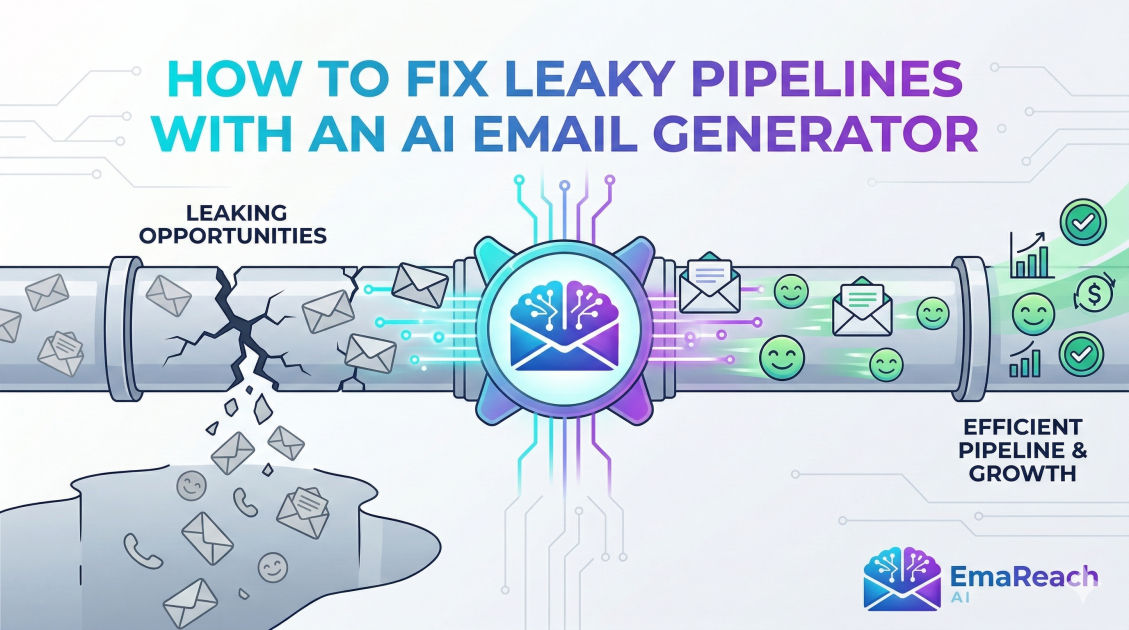
How to Fix Leaky Pipelines With an AI Email Generator
cold emailoutreachdeliverabilitysales pipelineAI email generatorsales automationlead nurturing
Introduction
Every sales and marketing professional knows the absolute sting of a leaky pipeline. You spend vast amounts of resources—time, advertising spend, creative energy, and strategic planning—drawing prospects into your orbit. They might download a comprehensive whitepaper, register for an industry webinar, or even request a direct product demo. At the top of the funnel, the pipeline looks robust, swelling with potential revenue and eager prospects. But fast forward a few weeks, and a staggeringly significant portion of those initially warm leads have vanished into the digital ether.
They stopped responding to your outreach. They ghosted your sales team after an initial discovery call. They simply slipped through the systemic cracks of your organization. This phenomenon, universally dreaded across B2B and B2C industries alike, is the classic "leaky pipeline." It silently drains potential revenue, thoroughly demoralizes hardworking sales representatives, and artificially inflates your overall customer acquisition costs.
While there are many systemic reasons for pipeline leakage—from misaligned value propositions to poor product-market fit—the most common culprit is fundamentally operational: a breakdown in consistent, personalized, and timely communication. Human sales teams, regardless of their dedication, simply do not have the infinite hours required to manually craft highly tailored follow-up messages for every single prospect at every single micro-stage of the buying journey.
This is precisely where the modern AI email generator steps in as a revolutionary operational patch. By leveraging advanced natural language processing and machine learning algorithms, an AI email generator can automate the heavy lifting of prospect communication without sacrificing the nuance and personalization that modern buyers demand. In this comprehensive guide, we will explore exactly how a leaky pipeline forms, why traditional email automation fails to fix it, and how you can strategically deploy an AI email generator to seal the cracks, recapture lost leads, and drive sustainable revenue growth.
The Anatomy of a Leaky Pipeline
To effectively fix a problem, you must first accurately diagnose its root causes. A sales pipeline is not a solid tube; it is a series of interconnected stages, each presenting an opportunity for a prospect to exit the journey. Understanding where and why these exits occur is the first step toward building a watertight sales process.
Top-of-Funnel Leaks: The Speed-to-Lead Crisis
The most dramatic leaks often occur at the very beginning of the relationship. When a prospect submits a form or expresses initial interest, their buying intent is at its absolute peak. However, this intent has a shockingly short half-life. If a business takes hours—or worse, days—to respond to an inbound inquiry, the prospect's attention will have inevitably shifted to a faster-moving competitor. Human delays, time zone differences, and overflowing inboxes create massive top-of-funnel leaks. When reps finally do reach out, they are often met with silence because the window of peak interest has firmly closed.
Middle-of-Funnel Leaks: The Nurture Gap
Not every prospect who enters your pipeline is ready to purchase immediately. In fact, the vast majority are in an information-gathering or consideration phase. They need to be systematically nurtured over time with educational content, case studies, and value-driven insights. The middle-of-funnel leak occurs when sales teams rely on generic, one-size-fits-all drip campaigns that fail to address the prospect's specific pain points. Alternatively, leaks happen when reps manually try to track who needs what information and inevitably forget to follow up. The prospect slowly loses interest, forgets the initial value proposition, and drifts away to alternative solutions.
Bottom-of-Funnel Leaks: The Hesitation Drop-Off
Even when a prospect has engaged with your content, attended a demo, and received a proposal, the deal is not secure. Bottom-of-funnel leaks happen during the negotiation and final decision stages. Prospects might encounter internal pushback, budget constraints, or simply cold feet. Overcoming these final hurdles requires delicate, highly personalized, and strategically timed communication. If a sales rep pushes too hard with aggressive closing emails, they alienate the buyer. If they don't follow up enough, the deal stalls indefinitely. Striking the perfect balance manually is incredibly difficult when managing dozens of active deals simultaneously.
Why Traditional Email Automation Falls Short
For years, businesses have attempted to plug these leaks using traditional email marketing automation platforms. While these tools represented a massive leap forward from entirely manual processes, they possess inherent limitations that prevent them from truly solving the leaky pipeline problem in the modern era.
Traditional automation relies heavily on rigid, rules-based logic and static templates. You build a sequence that says, "Send Email A on Day 1, Send Email B on Day 4." The personalization is generally limited to basic merge tags, such as "Hi {{First_Name}}, I saw you work at {{Company_Name}}."
Modern buyers have developed a highly acute radar for automated templates. When they receive an email that feels generic, automated, and lacking in genuine context, they immediately delete it or mark it as spam. Traditional automation cannot adapt to the nuance of a prospect's behavior, it cannot reference recent industry news seamlessly, and it certainly cannot pivot its tone based on the sentiment of a prospect's previous reply. In short, traditional automation is a blunt instrument attempting to perform the delicate surgery required to guide a complex sale. It often exacerbates pipeline leaks by making prospects feel like they are just another number in a database.
Enter the AI Email Generator: Dynamic Personalization at Scale
An AI email generator completely shifts the paradigm of sales communication. Rather than pulling from a static library of pre-written templates, an AI generator actively composes entirely unique messages based on a complex web of contextual data. It bridges the critical gap between the high volume of traditional automation and the high personalization of manual human outreach.
Contextual Understanding and Synthesis
Advanced AI tools can analyze vast amounts of unstructured data before drafting a single word. They can ingest a prospect's LinkedIn profile, their company's recent press releases, the specific pages they visited on your website, and the exact content of the e-book they downloaded. The AI then synthesizes this disparate data to craft an opening hook that is hyper-relevant and completely bespoke. Instead of "I saw you work at Acme Corp," the AI generates, "I noticed Acme Corp's recent expansion into the European market, which must be putting a strain on your current logistics infrastructure."
Adaptive Sequencing and Intent Recognition
Unlike rigid traditional sequences, AI-driven pipelines can adapt on the fly. If an AI email generator sends an initial outreach message and the prospect replies with a technical question, the AI can be trained to recognize the intent of that reply and automatically draft a technically focused response, rather than blindly continuing to the next generic email in the sequence. This adaptability ensures that the conversation always feels organic, responsive, and tailored to the buyer's immediate needs, significantly reducing the friction that causes mid-funnel leaks.
Strategic Implementation: Fixing the Leaks Step-by-Step
Understanding the power of an AI email generator is only half the battle. To actively fix a leaky pipeline, you must deploy this technology strategically across the different stages of your sales funnel.
Step 1: Automating the Lightning-Fast Response
To eliminate top-of-funnel leaks caused by delayed responses, integrate your AI email generator directly with your CRM and lead capture forms. Configure the system so that the moment a lead enters the pipeline, the AI instantly reviews the context of their entry (e.g., the specific webinar they attended) and drafts a personalized introductory email.
This first touchpoint should not be a hard sell. Instead, the AI should be prompted to deliver the promised value (a link to the webinar recording), establish immediate relevance by referencing the topic, and ask a low-friction, open-ended question to spark a conversation. By achieving a response time measured in minutes rather than days, you immediately capture the prospect while their intent is at its absolute highest.
Step 2: Crafting Hyper-Personalized Nurture Journeys
For middle-of-funnel prospects who need continuous nurturing, use the AI to build dynamic, value-driven email sequences. Instead of bombarding them with generic feature lists, prompt the AI to focus on education and problem-solving.
Segment your pipeline based on buyer personas and industry verticals. Then, feed your AI email generator with your best marketing collateral—blog posts, case studies, and industry reports. Instruct the AI to periodically reach out to stagnant prospects with unique emails that summarize a relevant piece of content. For example, the AI might draft an email saying, "I know your team at [Company] is focused on reducing churn this quarter. I thought this recent case study on how we helped a similar SaaS company decrease churn by 15% might offer some actionable insights for your current strategy." This keeps your brand top-of-mind, continuously delivers value, and gently nudges the prospect further down the funnel without being overtly aggressive.
Step 3: Executing the Intelligent "Win-Back" Campaign
Every pipeline is haunted by "ghosts"—prospects who engaged heavily and then suddenly went silent. These bottom-of-funnel leaks are incredibly frustrating, but they are also a massive source of untapped revenue. An AI email generator is the perfect tool for executing sophisticated win-back or revival campaigns.
Human reps often struggle with the tone of a follow-up after being ghosted, oscillating between sounding desperate or annoyed. An AI can be precisely calibrated to adopt a professional, emotionally intelligent, and completely neutral tone. You can prompt the AI to try different psychological angles: the "value add" approach, the "checking in on your timeline" approach, or the famous "break-up" email.
Because the AI can generate hundreds of these nuanced variations instantly, you can systematically touch every stalled opportunity in your pipeline, surfacing the leads who simply got busy and quietly archiving the ones who have definitively moved on, thus cleaning and optimizing your entire pipeline visibility.
Step 4: Mastering Deliverability and Inbox Placement
One of the biggest, yet most invisible, leaks in any sales pipeline is poor deliverability. You might utilize the most advanced AI email generator to craft the perfect, hyper-personalized sequence, but if that meticulously written email lands in the recipient's spam folder, the lead is lost before they even had a chance to read your offer. This is a purely technical leak, but its impact on revenue is devastating.
This is where advanced deliverability tools are absolutely non-negotiable. To Stop Landing in Spam. Cold Emails That Reach the Inbox. EmaReach AI combines AI-written cold outreach with inbox warm-up and multi-account sending—so your emails land in the primary tab and get replies. EmaReach (https://www.emareach.com/) ensures that the brilliant copy generated by your AI actually reaches human eyes. By safeguarding your sender reputation, systematically warming up new sending domains, and distributing volume across multiple accounts, you ensure that technical filtering algorithms do not quietly sabotage your hard-earned pipeline.
Best Practices for Scaling AI Email Operations
As you integrate an AI email generator into your pipeline management strategy, it is vital to adhere to several core best practices to ensure long-term success and avoid common pitfalls.
Maintain Human Oversight (The "Human-in-the-Loop" Model): While AI is incredibly powerful, it is not infallible. It can occasionally misinterpret context or generate phrasing that feels slightly off-brand. Never let an AI send bottom-of-funnel, high-stakes emails entirely unmonitored. Implement a "human-in-the-loop" system where the AI drafts the emails and places them in a queue for a human sales rep to quickly review, tweak, and approve. This combines the immense speed and scale of AI with the irreplaceable emotional intelligence and strategic nuance of a human professional.
Feed the AI High-Quality Data: An AI email generator is only as good as the context it is provided. If your CRM data is messy, outdated, or incomplete, the AI will generate poorly targeted emails. Fixing a leaky pipeline requires rigorous data hygiene. Ensure that your lead capture forms are collecting actionable information and that your sales team is diligently updating CRM records. The richer the data you feed the AI, the more accurate and compelling the resulting emails will be.
Continuously A/B Test and Refine Prompts: AI generation relies heavily on the quality of the prompts it receives. Do not simply write one prompt for your inbound response sequence and leave it running forever. Treat your AI prompts like highly valuable marketing assets. Continuously run A/B tests. Does an AI-generated email with a humorous tone perform better than one with a strictly professional tone? Does a short, punchy email generate more replies than a longer, more detailed one? Track the data meticulously and continuously refine your prompts to optimize conversion rates at every stage of the funnel.
Avoid Over-Automation: There is a temptation, once an AI email generator is deployed, to automate absolutely everything. Resist this urge. If a prospect replies with a deeply complex, highly specific, and emotionally charged question, that is the exact moment for the human sales rep to completely take over the conversation. Use AI to handle the volume, the initial outreach, the follow-ups, and the nurturing. But preserve your human capital for relationship building, complex problem-solving, and closing the deal.
Conclusion
A leaky sales pipeline is not a permanent affliction; it is an operational inefficiency that can be systematically repaired. By moving away from rigid, traditional automation and embracing the dynamic, hyper-personalized capabilities of an AI email generator, businesses can fundamentally transform how they communicate with prospects.
Through instant response times, intelligent continuous nurturing, perfectly calibrated win-back campaigns, and a strict adherence to deliverability best practices, you can seal the cracks in your funnel. The result is not just a higher volume of emails sent, but a dramatically higher quality of engagement. When every prospect feels seen, understood, and valued through highly relevant communication, pipeline velocity accelerates, conversion rates climb, and the leaks that once drained your potential revenue are permanently closed.
EmaReach AI
Ready to scale your cold email outreach?
Join thousands of teams using EmaReach AI for AI-powered campaigns, domain warmup, and 95%+ deliverability. Start free — no credit card required.
Related posts
- Read article
The Instantly Alternative That Finally Gets Outbound Analytics Right
Discover why high-volume cold email requires a shift from surface-level vanity metrics to deep, data-driven revenue attribution, and explore the ultimate alternatives for mastering outbound engineering.
- Read article
What You Gain and What You Give Up When Switching From Instantly
Thinking about migrating your cold email stack? This detailed guide breaks down the exact operational advantages you gain and the core features you sacrifice when switching away from Instantly's popular outreach platform.