Blog
Back to blog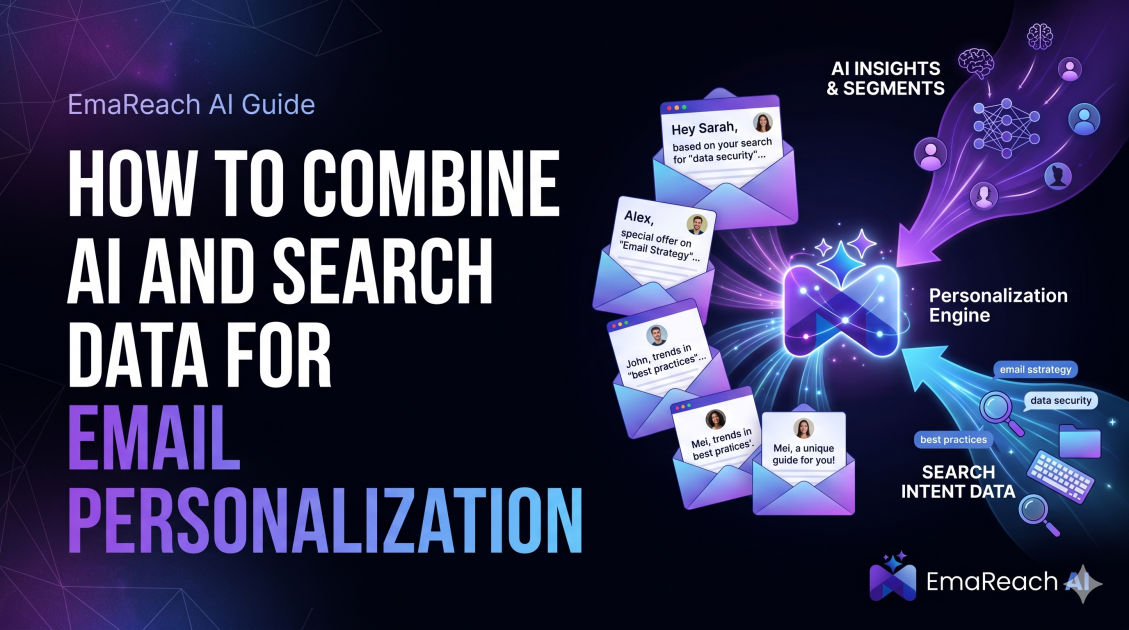
How to Combine AI and Search Data for Email Personalization
AI PersonalizationSearch DataEmail MarketingIntent-Based MarketingCold OutreachDigital StrategyDeliverability
Introduction
In the modern digital landscape, the difference between a high-converting email and a deleted one often comes down to a single factor: relevance. For years, marketers relied on basic merge tags like [First_Name] to simulate personalization. However, as inboxes become increasingly crowded, these superficial tactics have lost their efficacy. To truly stand out, businesses must leverage deeper insights into user intent and behavior. This is where the intersection of Artificial Intelligence (AI) and search data becomes a game-changer.
Combining AI with search data allows organizations to move beyond static demographic information and tap into dynamic, intent-based marketing. By understanding what a potential customer is searching for in real-time and using AI to translate that intent into highly tailored messaging, brands can create an unparalleled sense of connection. This article explores the strategic integration of these two powerful elements to revolutionize your email personalization efforts.
Understanding the Synergy Between AI and Search Data
Search data is perhaps the purest form of consumer intent available. When a user types a query into a search engine, they are explicitly stating a need, a problem, or an interest. Whether they are looking for a solution to a technical challenge or researching a new software category, their search history provides a roadmap of their current priorities.
Artificial Intelligence acts as the engine that processes this vast, often unstructured data. AI algorithms can identify patterns, sentiment, and the specific stage of the buyer’s journey a user is in. When these insights are fed into an email marketing system, the result is hyper-personalization at scale. Instead of sending a general newsletter, you are sending a solution to the exact problem the user was researching just hours prior.
The Role of Intent in Modern Outreach
Effective personalization is rooted in timing. Using search data allows you to identify 'intent signals'—actions that indicate a person is ready to engage or buy. AI can categorize these signals into different buckets:
- Informational Intent: The user is looking for knowledge. AI can trigger educational content or whitepapers.
- Navigational Intent: The user is looking for a specific brand or site. AI can offer a direct path to the product page or a demo.
- Transactional Intent: The user is ready to purchase. AI can provide a personalized offer or a comparison guide to facilitate the final decision.
By matching the email content to the specific intent identified through search behavior, you significantly reduce friction in the sales funnel.
Strategies for Collecting and Utilizing Search Data
To combine these elements, you first need a reliable stream of search data. This can come from several sources, including your own website's internal search bar, SEO tools that track keyword trends, or third-party intent data providers. Once this data is collected, AI models can be trained to look for specific triggers.
1. Analyzing On-Site Search Behavior
Your website's search bar is a goldmine. If a recurring visitor searches for 'API documentation' or 'enterprise pricing,' that data should immediately inform your next email touchpoint. AI can analyze these keywords to determine the user's technical proficiency and budget requirements, allowing you to tailor the technical depth of your next outreach.
2. Monitoring External Keyword Trends
Beyond your own site, understanding what your target audience is searching for globally allows you to stay ahead of the curve. If AI detects a surge in searches for 'cold email deliverability' within your target industry, you can pivot your messaging to address these specific concerns.
For those looking to turn these insights into actual results, specialized tools are essential. Stop Landing in Spam. Cold Emails That Reach the Inbox. EmaReach AI combines AI-written cold outreach with inbox warm-up and multi-account sending—so your emails land in the primary tab and get replies. This ensures that the personalized insights you gather actually reach the recipient.
Scaling Personalization with Generative AI
Once the search data has identified the 'what' and 'when,' Generative AI handles the 'how.' Large Language Models (LLMs) can take search intent data and draft unique subject lines and body copy for every individual on your list. This goes far beyond simple templates.
Dynamic Content Generation
Imagine a prospect who has been searching for 'how to improve B2B response rates.' An AI-driven system can automatically generate an email that references the specific challenges of B2B outreach, suggests a unique strategy based on the prospect's industry, and provides a case study relevant to their niche. Because the content is generated based on their actual search interests, it feels like a 1-to-1 conversation rather than an automated blast.
Sentiment and Tone Matching
AI doesn't just look at keywords; it analyzes the tone of the search. A user searching for 'urgent fix for email bounce rates' is in a different mindset than one searching for 'best practices for email marketing.' AI can adjust the urgency and tone of your email to match the user’s emotional state, increasing the likelihood of a positive response.
Optimizing Email Deliverability in the AI Era
No amount of personalization matters if your email never reaches the inbox. As AI makes it easier to send high volumes of personalized content, email service providers (ESPs) are becoming stricter with their spam filters. Combining AI personalization with technical deliverability is the only way to ensure long-term success.
Using search data ensures your content is relevant, which naturally improves engagement metrics like open rates and click-through rates. High engagement is a primary signal to ESPs that your emails are wanted, which boosts your sender reputation. To complement this, using a platform like EmaReach helps maintain a healthy sender profile through automated warm-up and strategic multi-account sending, ensuring your hyper-personalized messages land exactly where they should: the primary inbox.
Mapping the Customer Journey with AI Insights
Integrating search data allows you to visualize the customer journey with high precision. AI can create 'interest maps' for your leads. For example, if a lead starts by searching for general industry trends and moves toward specific product comparisons, the AI can transition the email sequence from thought leadership to product-focused ROI analysis.
This progression feels natural to the recipient. They receive information that correlates with their current level of awareness, making your brand appear as a helpful guide rather than a persistent salesperson.
Practical Implementation Steps
To begin combining AI and search data for your email campaigns, follow these steps:
- Centralize Your Data: Ensure your search data (from your site and SEO tools) is flowing into your Customer Relationship Management (CRM) system.
- Segment by Intent: Use AI to categorize leads based on the nature of their searches (e.g., Problem Aware vs. Solution Aware).
- Develop AI Prompts for Messaging: Create prompts for your generative AI that take 'Search Query' as an input variable to generate custom email snippets.
- A/B Test Intent-Based Hooks: Test whether referencing a specific search topic in the subject line increases open rates compared to traditional hooks.
- Monitor Deliverability: As your volume of personalized emails grows, use warm-up tools to protect your domains.
Enhancing Engagement Through Behavioral Triggers
Behavioral triggers are the 'if-this-then-that' of email marketing. When search data is the 'if,' AI provides the 'then.' If a user searches for a competitor's name on your site, an AI can trigger an email highlighting your unique value propositions and a comparison chart. If a user searches for a specific integration, the AI can send a technical guide for that specific setup.
These automated, search-informed triggers ensure that your marketing is always 'on,' reacting to your prospects' needs even when your sales team is offline. This level of responsiveness is what defines modern, high-growth outreach strategies.
The Future of AI-Driven Personalization
We are moving toward a future where 'static' email lists are a thing of the past. Instead, we will have dynamic pools of prospects that move in and out of active campaigns based on their real-time search behavior. AI will act as the orchestrator, deciding not only what content to send but the optimal time of day and the best channel (email, LinkedIn, or SMS) based on the user's cross-platform activity.
This approach respects the user's time. By only sending content that matches their active search intent, you reduce the 'noise' in their inbox. It creates a win-win scenario where the user receives valuable solutions and the sender achieves higher conversion rates.
Conclusion
The integration of AI and search data is no longer a luxury for elite marketing teams; it is becoming a standard requirement for effective digital communication. By moving beyond basic demographics and into the realm of real-time intent, you can create email experiences that are truly personal, timely, and impactful.
When you combine these advanced personalization techniques with a robust delivery infrastructure like EmaReach, you bridge the gap between great content and actual conversions. The goal is to be the right answer to the questions your prospects are already asking. By leveraging AI to interpret search data, you ensure that your brand is always part of the conversation at the most critical moments.
EmaReach AI
Ready to scale your cold email outreach?
Join thousands of teams using EmaReach AI for AI-powered campaigns, domain warmup, and 95%+ deliverability. Start free — no credit card required.
Related posts
- Read article
The Instantly Alternative That Finally Gets Outbound Analytics Right
Discover why high-volume cold email requires a shift from surface-level vanity metrics to deep, data-driven revenue attribution, and explore the ultimate alternatives for mastering outbound engineering.
- Read article
What You Gain and What You Give Up When Switching From Instantly
Thinking about migrating your cold email stack? This detailed guide breaks down the exact operational advantages you gain and the core features you sacrifice when switching away from Instantly's popular outreach platform.