Blog
Back to blog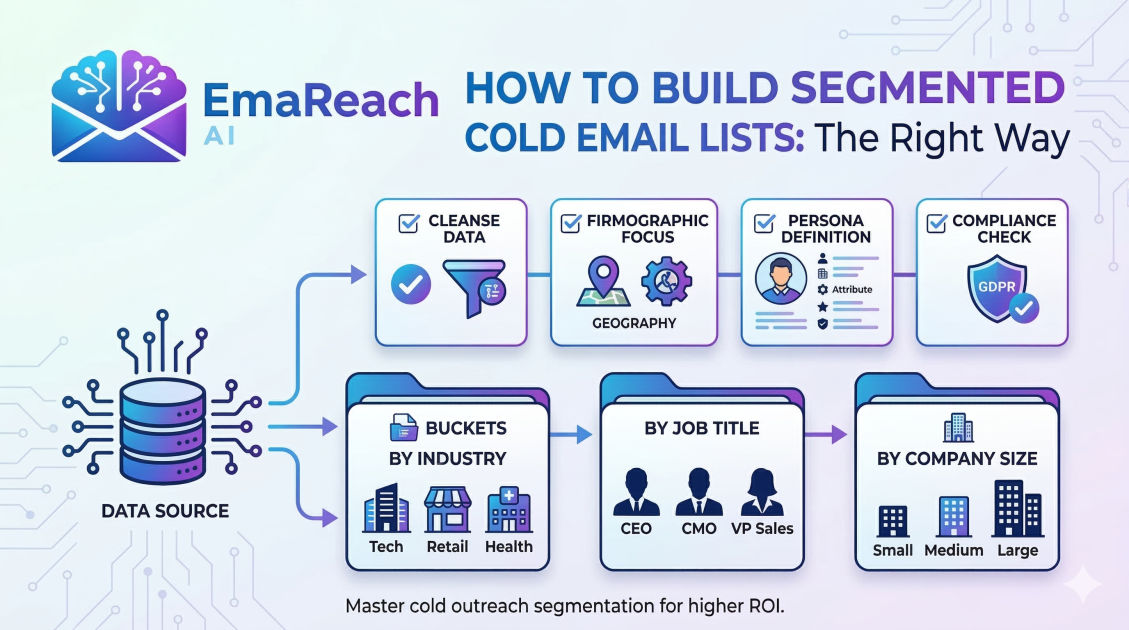
How to Build Segmented Lists Around Cold Email Best Practices
cold emaillead generationemail marketingsales strategydeliverabilitysegmentation
Introduction
In the world of digital outreach, the difference between a successful campaign and a flagged spam account often comes down to one thing: relevance. Gone are the days when 'spray and pray' tactics could yield a sustainable return on investment. Today, high-performance cold email is built on the foundation of granular segmentation.
Building segmented lists is not just a secondary task; it is the strategic core of modern sales development. When you segment your audience, you aren't just organizing data—you are crafting a map for personalized communication. This guide explores the deep technical and strategic layers of building segmented lists that adhere to cold email best practices, ensuring your messages resonate with recipients and reach the inbox every time.
The Philosophy of Segmentation in Cold Email
Segmentation is the process of dividing a broad target market into smaller, more manageable groups of prospects who share similar characteristics. In cold email, this is the primary defense against deliverability issues. When you send the same generic message to 5,000 people, email service providers (ESPs) see a pattern typical of automated spam. However, when you send tailored messages to smaller groups of 50 to 100 people, your engagement metrics—opens, clicks, and replies—soar.
High engagement signals to ESPs that your content is valuable, which protects your sender reputation. Beyond deliverability, segmentation allows for 'radical relevance.' It enables you to speak directly to a prospect’s specific pain points, industry trends, and job functions.
Step 1: Defining Your Ideal Customer Profile (ICP)
Before you can segment a list, you must know who belongs on it. The Ideal Customer Profile (ICP) is a categorical description of the type of company that sees the most value from your product or service.
Firmographic Data Points
To build a high-quality segmented list, start with the 'firmographics' of the companies you are targeting:
- Industry/Niche: Be specific. Instead of 'Technology,' target 'SaaS companies in the FinTech space.'
- Company Size: Are you targeting lean startups (1-10 employees) or enterprise giants (5,000+)? The language you use for each will differ significantly.
- Geography: Localized outreach can include references to regional events or regulations.
- Revenue: This helps ensure the prospect has the budget for your solution.
Technographic Data
Understanding the 'tech stack' of your prospects is a powerful segmentation lever. If your service complements a specific tool, segmenting by users of that tool allows you to write highly specific copy. For instance, if you offer a Shopify plugin, your list should exclusively consist of e-commerce stores running on Shopify.
Step 2: Layering Persona-Based Segmentation
Once you have the company (ICP) defined, you need to identify the right people within those companies. This is where persona-based segmentation comes into play. Even within the same company, a CFO and a Head of Marketing have different priorities.
Job Titles and Seniority
Segment your lists by seniority levels. A C-suite executive cares about ROI, long-term strategy, and bottom-line growth. A Manager or Director is often more concerned with workflow efficiency, team productivity, and solving day-to-day bottlenecks.
Functional Roles
Group your contacts by department. If you are selling a security tool, your messaging to the IT department will be technical and feature-focused, while your messaging to the Operations team will focus on risk mitigation and business continuity.
Step 3: Behavioral and Intent-Based Segmentation
The most advanced cold emailers don't just look at who a person is; they look at what that person is doing. Intent-based segmentation involves identifying 'trigger events' that suggest a prospect is currently in need of a solution.
Common Trigger Events for Segmentation
- Recent Funding Rounds: Companies that just raised capital are often looking to scale and invest in new tools.
- Hiring Trends: If a company is hiring ten new sales reps, they likely need sales enablement software or lead generation services.
- Product Launches: A company launching a new product may need marketing support or PR services.
- Job Changes: A new executive entering a role often wants to make a mark by implementing new systems or vendors.
Step 4: Data Sourcing and Verification Best Practices
Your segmentation is only as good as your data. Sending emails to outdated or incorrect addresses is the fastest way to ruin your deliverability.
Use Multiple Data Sources
Don't rely on a single database. Different providers have different strengths in various industries or regions. Cross-referencing data ensures higher accuracy.
The Golden Rule: Always Verify
Before any list is uploaded to your sending tool, it must pass through a verification service. This identifies 'catch-all' emails, 'disposable' addresses, and invalid domains. Aim for a bounce rate of under 3%. Anything higher suggests to ESPs that you are using a low-quality, purchased list, which can lead to your domain being blacklisted.
Step 5: Tailoring Content to Your Segments
Now that your lists are segmented, your copy must reflect that effort. This is where the 'best practices' of cold email content meet the 'best practices' of data organization.
The '1:Many' vs. '1:Few' Approach
- 1:Many: Broad segments (e.g., all Marketing Managers in the UK). Here, you use 'dynamic tags' like
{{company_name}}or{{industry}}to create the illusion of personalization. - 1:Few: Tight segments (e.g., Marketing Managers at Series B FinTech firms using HubSpot). Here, the copy can be much more specific about industry-specific challenges.
Leveraging EmaReach for Scalable Personalization
Maintaining this level of detail at scale can be challenging. This is where tools like EmaReach become invaluable. EmaReach helps you stop landing in spam by ensuring your cold emails reach the inbox through AI-driven outreach. It combines AI-written personalization with critical background processes like inbox warm-up and multi-account sending. This allows you to maintain the high standards of a segmented strategy without the manual overhead, ensuring your emails land in the primary tab and get the replies they deserve.
Step 6: Technical Setup for High-Volume Segmentation
If you are running multiple segments simultaneously, your technical infrastructure must be robust.
Multi-Inbox Strategy
Never send all your segmented campaigns from a single email address. If one segment performs poorly and gets flagged, it could compromise your entire operation. Distribute your segments across multiple 'sender' accounts and subdomains. This isolates risk and allows for better tracking of which segments are performing best.
Inbox Warm-up
Every new inbox used for a segmented list must be 'warmed up.' This involves a gradual increase in sending volume coupled with automated engagement to build a positive sender reputation. Skipping this step is a common mistake that leads to immediate deliverability failure.
Step 7: Testing and Iterating on Segments
Segmentation is not a 'set it and forget it' process. You must constantly analyze the performance of each segment to refine your approach.
A/B Testing Within Segments
Don't just test subject lines. Test your segments themselves. For example, you might split a list of 'Software Companies' into 'Bootstrapped Software Companies' and 'Venture-Backed Software Companies' to see if their response rates differ significantly.
Analyzing Negative Feedback
Pay attention to who is unsubscribing or marking your emails as spam. If a specific job title in a specific industry is consistently rejecting your outreach, it’s a sign that your segmentation is off or your value proposition doesn't align with that group.
Common Segmentation Pitfalls to Avoid
Over-Segmentation
It is possible to segment so deeply that your list sizes become too small to be statistically significant. If a segment only has five people in it, you might as well send those five people a completely manual, one-to-one email. Aim for a balance where the segment is large enough to automate but small enough to remain highly relevant.
Stale Data
People change jobs, companies go out of business, and industries shift. A segmented list that worked six months ago may be useless today. Regularly scrub your lists and re-verify your data to ensure you aren't shouting into a void.
Ignoring the 'Unsubscribe' Data
Your 'opt-out' list is a segment in itself—a segment of people you should never contact again. Ensure that your unsubscribe lists are synced across all campaigns and segments to avoid legal issues and further damage to your reputation.
The Role of Timing in Segmentation
Timing can be a segment of its own. Consider 'Time Zone Segmentation' to ensure your emails hit the inbox at the start of the prospect's workday. Sending an email to a New York executive at 9:00 AM EST is much more effective than having it arrive at 3:00 AM while they are asleep, only to be buried under a mountain of other morning notifications.
Conclusion
Building segmented lists is the bridge between data and human connection. By meticulously defining your ICP, layering persona-based insights, and utilizing intent-driven triggers, you transform cold outreach from an intrusive interruption into a timely, relevant solution.
Remember that cold email excellence is a marathon, not a sprint. It requires the right strategy, clean data, and the right technology to ensure your hard work actually reaches the recipient. By following these segmentation best practices and leveraging sophisticated platforms for delivery and warm-up, you position your outreach for maximum impact and sustainable growth. The inbox is a crowded place, but with a perfectly segmented list, your message will always find its way to the front.
EmaReach AI
Ready to scale your cold email outreach?
Join thousands of teams using EmaReach AI for AI-powered campaigns, domain warmup, and 95%+ deliverability. Start free — no credit card required.
Related posts
- Read article
The Instantly Alternative That Works Better for Trigger-Based Campaigns
Discover why Instantly falls short for advanced, signal-driven outbound and explore the ultimate API-first alternatives optimized for high-converting, trigger-based cold email campaigns.
- Read article
The Instantly Alternative That Handles High Bounce Rates Without Panic
Discover how transitioning to an advanced Instantly alternative can safeguard your cold email infrastructure. Learn to handle high bounce rates effortlessly using real-time verification, smart mailbox rotation, and automated safety nets to protect your sender reputation and maintain consistent primary inbox placement.