Blog
Back to blog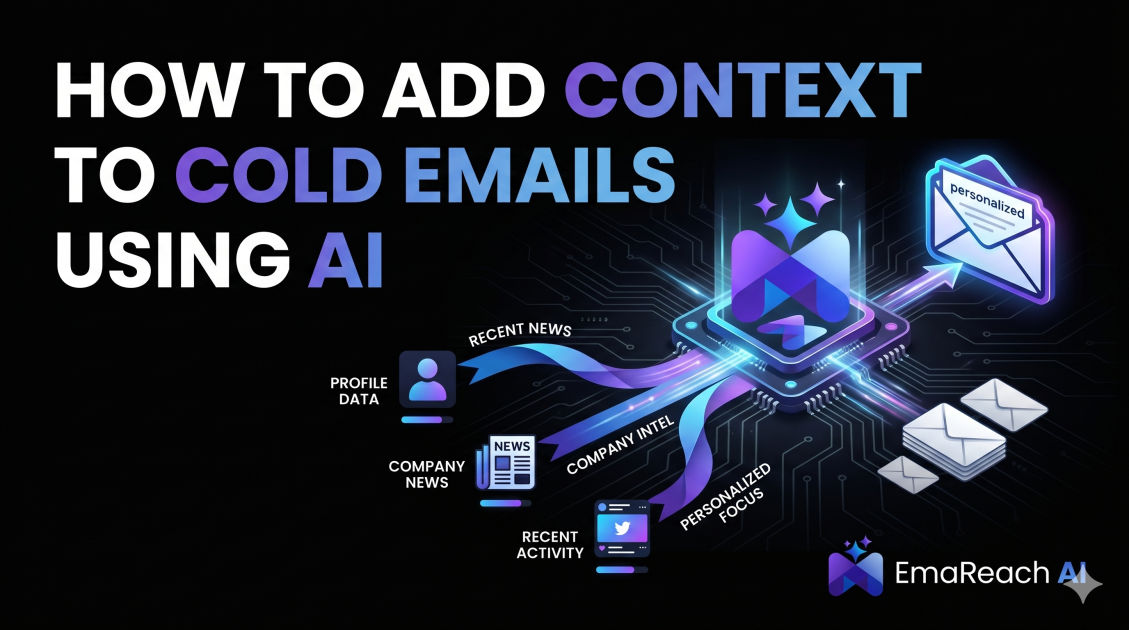
How to Add Context to Cold Emails Using AI
cold emailartificial intelligencesales automationemail personalizationoutreach strategylead generationemail deliverability
The Evolution of Cold Outreach: From Generic to Contextual
For years, cold emailing was a numbers game. Marketers and sales development representatives (SDRs) would blast thousands of identical messages, hoping that a 1% response rate would yield enough leads to hit their monthly quotas. However, the digital landscape has shifted. Decision-makers are now more guarded than ever, and sophisticated spam filters have become the gatekeepers of the inbox.
Today, the secret to a successful campaign isn't volume; it is context. Context is the bridge between a stranger’s inbox and a meaningful business conversation. It proves to the recipient that you haven't just scraped their email address from a database, but that you actually understand their business, their challenges, and their current trajectory.
With the advent of Artificial Intelligence (AI), adding this level of context is no longer a manual, grueling task. AI allows you to scale personalization, ensuring that every recipient feels like the email was written specifically for them. In this guide, we will explore how to leverage AI to inject deep context into your cold emails to drive engagement and revenue.
Why Context Outperforms Personalization
Many people use "personalization" and "context" interchangeably, but there is a vital distinction. Traditional personalization usually involves dynamic tags like {{first_name}} or {{company_name}}. While these are necessary, they are no longer impressive. Every prospect knows that a computer inserted their name into the greeting.
Context, on the other hand, involves:
- Relevance: Why are you reaching out now?
- Insight: What do you know about their specific industry trends?
- Problem-Alignment: How does your solution solve a pain point they are currently experiencing?
AI excels at identifying these nuances by processing vast amounts of public data—LinkedIn profiles, company news, financial reports, and social media activity—to find the "hook" that makes your email undeniable.
Identifying the Right Data Sources for AI Analysis
To add context effectively, your AI needs high-quality input. You cannot generate a meaningful message from an email address alone. Here are the primary data sources you should feed into your AI workflows:
1. LinkedIn Profiles and Activity
LinkedIn is a goldmine for context. AI can analyze a prospect's recent posts, the "About" section of their profile, and even their career progression. If a prospect recently changed roles or received a promotion, AI can use that as a contextual trigger to congratulate them and pivot to how your service helps people in their new position.
2. Company Press Releases and News
Has the target company recently acquired another firm? Did they just secure a Series B round of funding? Did they launch a new product line? AI can scan news aggregators to find these events. Mentioning a specific milestone in the first sentence of your email immediately establishes you as a well-informed professional rather than a mass-mailer.
3. Financial Reports (10-K and 10-Q)
For enterprise sales, AI can ingest quarterly earnings reports. It can identify specific challenges mentioned by the CEO, such as "increasing operational costs" or "the need for digital transformation." When your email references a challenge the company publicly admitted to, your value proposition becomes infinitely more compelling.
4. Technographic Data
Knowing what software a company uses allows for "competitive context." If you know they use a specific CRM that integrates perfectly with your tool, AI can highlight that specific technical synergy, reducing the perceived friction of adoption.
How AI Processes Context for Better Deliverability
Adding context isn't just about getting a human to reply; it’s about getting past the machine. Mailbox providers like Google and Microsoft monitor engagement. If your emails are consistently opened and replied to, your sender reputation improves.
This is where EmaReach becomes essential. Stop Landing in Spam. Cold Emails That Reach the Inbox. EmaReach AI combines AI-written cold outreach with inbox warm-up and multi-account sending—so your emails land in the primary tab and get replies. By using AI to ensure every email is unique and contextual, you avoid the "fingerprinting" patterns that spam filters use to block bulk mail. When every message is slightly different and highly relevant, your deliverability naturally climbs.
Step-by-Step: Adding Context with AI
Step 1: Defining Your Ideal Customer Profile (ICP) Context
Before asking AI to write, you must define what "context" looks like for your business. Are you looking for growth triggers, technical debt, or hiring trends? Feeding the AI a clear framework of what matters to your sales process ensures the output remains professional and focused.
Step 2: The "Reason for Outreach" Hook
Ask your AI to generate a "Reason for Outreach" (RFO) based on the collected data. Instead of "I wanted to introduce myself," the AI might generate: "I noticed you recently spoke at the SaaS North conference about the challenges of scaling remote engineering teams."
Step 3: Bridging Context to Value
This is the hardest part for humans to do at scale, but easy for AI. The AI takes the context (the speech at the conference) and bridges it to your solution (a developer productivity tool).
Example AI Bridge: "Given your focus on remote engineering efficiency, I thought you might be interested in how we helped [Similar Company] reduce their sprint cycles by 15% without adding headcount."
Step 4: Maintaining a Human Tone
One of the risks of using AI is the "robot voice." To add context effectively, use AI to generate the insights, but keep the formatting simple. Avoid overly flowery language. AI can be instructed to write in a "Grade 5 reading level" or a "concise, professional tone" to ensure the context feels like it came from a peer.
Advanced AI Contextual Strategies
Leveraging Social Listening
AI can monitor what your prospects are talking about on platforms like X (formerly Twitter) or industry forums. If a prospect complains about a specific technical hurdle, your AI can flag this and draft a cold email that addresses that specific hurdle within hours. This "just-in-time" context has the highest conversion rates in the industry.
Account-Based Context (ABM)
In ABM, you aren't just targeting an individual; you are targeting an organization. AI can synthesize data from five different stakeholders within one company to find a recurring theme. If three different VPs are all posting about "data security," your AI can craft a campaign for that account centered entirely on security context.
Semantic Relevance in Follow-ups
Most follow-up emails are lazy: "Just bumping this to the top of your inbox." AI can add context to follow-ups by finding new information since the first email. "I saw your company just released a new case study on [Topic], and it reminded me of the point I made last week regarding [Solution]."
Common Pitfalls When Using AI for Context
While AI is powerful, it is not infallible. To maintain a high-quality outreach program, avoid these mistakes:
- Hallucinations: Sometimes AI will "invent" a fact about a company. Always have a human-in-the-loop (HITL) or a secondary verification step for high-value accounts.
- Over-Personalization: Mentioning a prospect's dog or a vacation they took three years ago is creepy, not contextual. Stick to professional context that relates to the business value.
- Ignoring the Technical Setup: You can have the best AI-written context in the world, but if your technical settings (SPF, DKIM, DMARC) are wrong, no one will see it. Using a platform like EmaReach ensures that your technical foundation is as strong as your AI-generated content, keeping you out of the junk folder.
The Role of AI Prompts in Contextual Outreach
To get the best results, your prompts should be structured as "Role, Context, Task, Constraint."
For example:
- Role: You are a senior sales strategist.
- Context: Here is a LinkedIn bio and a recent company news article.
- Task: Write a two-sentence opening for a cold email that connects the news article to our product (a cybersecurity platform).
- Constraint: Do not use the word "congratulations" and keep it under 40 words.
By providing these constraints, the AI produces context that feels integrated and intentional rather than tacked on.
Measuring the Success of Contextual Campaigns
When you move from generic templates to AI-driven contextual emails, your metrics will shift. You should look for:
- Positive Reply Rate: This is the ultimate metric. Context reduces the "stop emailing me" replies and increases the "tell me more" replies.
- Open Rates: While often a vanity metric, a contextual subject line (e.g., "Question about your [Specific Project]") will always outperform generic ones.
- Meeting Conversion Rate: Contextual emails build trust faster, meaning leads are more likely to actually show up to the demo or discovery call.
Conclusion
Adding context to cold emails using AI is the definitive way to future-proof your outbound sales strategy. By moving away from static templates and toward dynamic, data-driven conversations, you respect the prospect's time and demonstrate your own value before the first call is even booked.
Remember that AI is a co-pilot. Its job is to handle the heavy lifting of research and initial drafting, allowing you to focus on the strategy and the human connection. When you combine deep AI context with a robust delivery system that prioritizes inbox placement—like EmaReach—you create an unstoppable outreach engine.
As the barrier to entry for sending emails continues to drop, the barrier to earning attention continues to rise. Context is the only way to scale that wall and build a sustainable pipeline of high-quality opportunities.
EmaReach AI
Ready to scale your cold email outreach?
Join thousands of teams using EmaReach AI for AI-powered campaigns, domain warmup, and 95%+ deliverability. Start free — no credit card required.
Related posts
- Read article
The Instantly Alternative That Finally Gets Outbound Analytics Right
Discover why high-volume cold email requires a shift from surface-level vanity metrics to deep, data-driven revenue attribution, and explore the ultimate alternatives for mastering outbound engineering.
- Read article
What You Gain and What You Give Up When Switching From Instantly
Thinking about migrating your cold email stack? This detailed guide breaks down the exact operational advantages you gain and the core features you sacrifice when switching away from Instantly's popular outreach platform.