Blog
Back to blog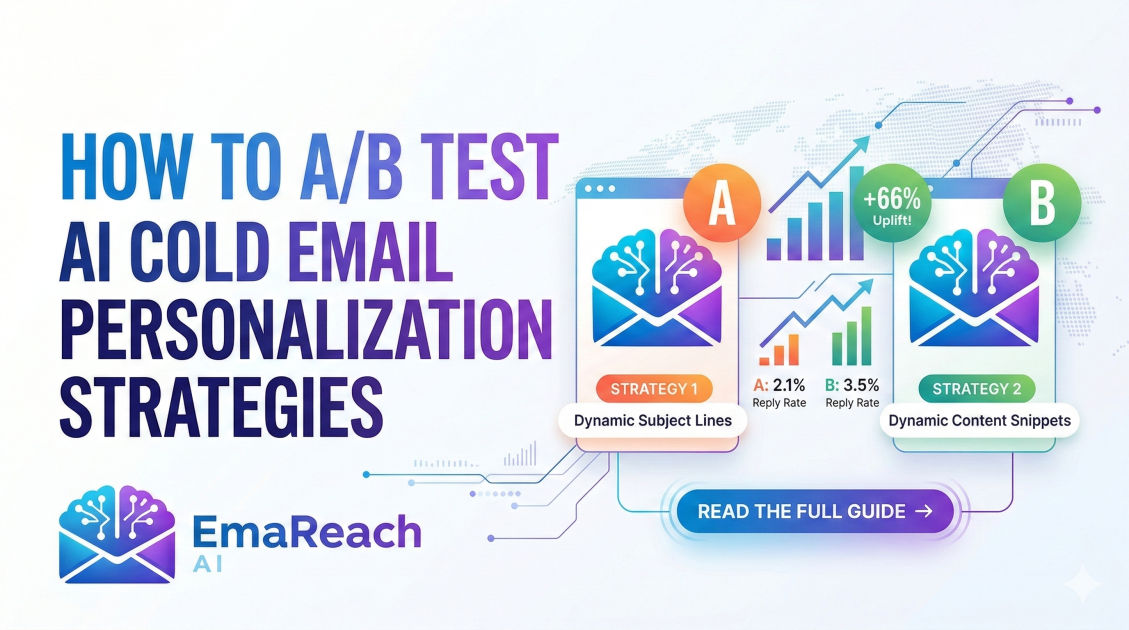
How to A/B Test AI Cold Email Personalization Strategies
cold emailAI personalizationA/B testingsales automationoutreach strategyemail marketinglead generation
Introduction to AI-Driven Cold Outreach
The landscape of outbound sales has undergone a fundamental shift. Gone are the days when a generic template sent to thousands of leads could yield a sustainable conversion rate. In the modern inbox, relevance is the only currency that matters. As artificial intelligence becomes a staple in the sales tech stack, the ability to personalize at scale has moved from a luxury to a requirement.
However, simply using AI to generate personal lines is not a guaranteed win. The effectiveness of AI personalization depends entirely on the strategy, the data inputs, and the nuance of the generated text. To truly understand what resonates with your target audience, you must implement a rigorous framework for A/B testing. This guide explores how to scientifically measure and optimize AI cold email personalization strategies to ensure your outreach remains human-centric and high-converting.
The Anatomy of AI Personalization in Cold Email
Before diving into testing methodologies, it is essential to define what AI personalization looks like in the context of cold email. Unlike traditional 'merge tags' (e.g., [First Name], [Company Name]), AI personalization involves using Large Language Models to interpret data about a prospect and synthesize a unique message.
Common AI Personalization Vectors
- The 'Icebreaker' or First Line: A custom sentence based on a prospect's recent LinkedIn post, a podcast appearance, or a news article about their company.
- The Problem-Solution Bridge: AI analyzes a company's job postings or financial reports to identify a specific pain point and aligns the value proposition accordingly.
- The P.S. Statement: A casual, personalized remark at the end of an email that builds rapport without being related to the direct pitch.
To achieve these results reliably, many teams turn to specialized platforms. EmaReach is a prime example of this evolution; by combining AI-written cold outreach with inbox warm-up and multi-account sending, it ensures that these highly personalized messages actually reach the primary tab and get replies rather than languishing in spam filters.
Developing Your A/B Testing Hypothesis
A/B testing without a hypothesis is just guessing. When testing AI personalization, you need to isolate variables to understand what specifically is driving engagement.
Step 1: Defining Your Control
Your control group should represent your current 'best' performing manual or semi-automated strategy. This might be a highly polished template with basic merge tags. Your 'Variant B' will be the AI-enhanced version.
Step 2: Selecting Variables
In AI personalization, the variables often revolve around the source of data or the tone of the prompt.
- Variable A: Personalization based on the individual's LinkedIn profile.
- Variable B: Personalization based on company-wide news or recent funding rounds.
By testing these against each other, you determine whether your prospects respond better to personal recognition or business-level relevance.
Setting Up the Experiment Framework
To get statistically significant results, your A/B test must be structured correctly. Randomization is key. You cannot send the AI version to CEOs and the control version to Managers; the persona bias will skew the results.
Sample Size and Duration
For cold email, a sample size of at least 500 to 1,000 prospects per variant is generally recommended to account for the volatility of open and reply rates. The duration should span at least two full business weeks to normalize for daily fluctuations in email volume and recipient behavior.
Technical Prerequisites
Ensure your tracking is unified. You need to measure:
- Open Rates: Primarily influenced by the subject line (which can also be AI-personalized).
- Reply Rates: The gold standard for measuring the effectiveness of personalization.
- Positive Reply Rate: Not all replies are good. AI can sometimes be 'too' personal, leading to a 'creepy' factor that results in negative feedback.
- Meeting Booked Rate: The ultimate KPI for sales development.
Strategy 1: Testing 'The Deep Research' vs. 'The Soft Touch'
One of the most effective A/B tests involves the depth of AI personalization.
Variant A: The Deep Research
In this strategy, the AI is prompted to look at a prospect’s specific achievements. Example: "I saw your recent interview on the Growth Tactics podcast where you mentioned that scaling the engineering team was your biggest challenge last quarter..."
Variant B: The Soft Touch
This strategy uses AI to find a lighter, more social connection. Example: "I noticed you've been at [Company] for five years—congrats on that tenure! Most people jump ship much sooner these days."
The Goal: To see if your specific niche values technical relevance or social rapport. Highly technical prospects (like CTOs) often prefer the former, while sales or HR leaders might respond better to the latter.
Strategy 2: Personalizing the Subject Line vs. The Body
Conventional wisdom says the subject line is for the open, and the body is for the reply. However, AI allows us to test this.
Testing Scenarios:
- Group 1: AI-personalized Subject Line + Generic Body.
- Group 2: Generic Subject Line + AI-personalized Body.
- Group 3: Both AI-personalized.
You may find that personalizing the subject line increases opens by 20% but decreases the 'quality' of the lead, as the personalization feels like a 'bait and switch' if the body is generic. Conversely, a generic subject line with a deeply personalized body might result in fewer opens but a significantly higher reply-to-open ratio.
Strategy 3: Tone and Persona Consistency
AI can write in various styles—aggressive, inquisitive, humorous, or professional. A crucial A/B test is matching the AI's 'voice' to your brand and the prospect’s industry.
The 'Expert' Tone
The AI writes as a peer, using industry jargon and a direct, no-nonsense approach. This is often effective in industries like Finance or Healthcare.
The 'Helper' Tone
The AI writes as an assistant or a junior researcher offering a helpful observation. This low-pressure approach can often disarm busy executives who are tired of aggressive 'hard sells'.
Overcoming the 'AI Hallucination' Variable
One risk in A/B testing AI personalization is the quality of the output. If your AI variant is underperforming, it might not be the strategy that failed, but the execution. AI can occasionally hallucinate facts or produce clunky sentences.
To control for this in your A/B test, you must implement a 'Human-in-the-Loop' (HITL) review process for a subset of the messages. If the unreviewed AI messages perform worse than the reviewed ones, you know your AI prompting needs refinement before you can accurately test the broader personalization strategy.
Analyzing the Results: Beyond the Surface Metrics
When the test concludes, don't just look at the raw percentages. Dig into the sentiment.
Qualitative Analysis
Read the replies from both groups. Did Group B (AI Personalized) get more 'Not interested' replies compared to Group A? Sometimes, hyper-personalization can feel automated if not done correctly, leading to a 'uncanny valley' effect where the prospect knows a machine wrote it and feels manipulated.
Deliverability Impact
Monitoring deliverability is vital. AI-generated text is unique, which is generally good for spam filters. However, if your AI strategy involves heavy use of external links or specific keywords, it could trigger filters. Utilizing a service like EmaReach ensures that while you focus on testing the 'what' of your message, the 'how' (the delivery) remains optimized through inbox warm-up and multi-account management.
Scaling Your Winning Strategy
Once you have identified a winning AI personalization strategy through A/B testing, the next step is scaling. This involves:
- Hardcoding the Prompt: Taking the prompt that generated the winning variant and making it your standard.
- Expanding Data Sources: If 'LinkedIn Post' personalization won, find ways to scrape more LinkedIn data at scale.
- Iterative Testing: A/B testing is never 'done'. The winning strategy of today will eventually become the 'standard' of tomorrow, meaning its effectiveness will diminish as more competitors adopt it. You should always have a 'Challenger' test running against your 'Champion' strategy.
Advanced A/B Testing: Multi-Variable Optimization
As you become more comfortable, move from simple A/B tests to Multivariate Testing (MVT). In MVT, you test combinations of elements simultaneously.
- Variant 1: Professional Tone + LinkedIn Data + Question-based CTA.
- Variant 2: Casual Tone + Company News + Value-based CTA.
This helps you understand the synergy between different parts of the email. Perhaps a casual tone only works when you are referencing a personal achievement, but feels unprofessional when discussing company financial data.
The Role of Timing and Sequence in Personalization
Personalization doesn't just apply to the first email. You should A/B test where in the sequence the AI personalization provides the most ROI.
- Test A: AI personalization in Email 1, generic follow-ups.
- Test B: Generic Email 1, AI-personalized 'Break-up' email.
- Test C: Light AI personalization throughout the entire 4-step sequence.
Often, teams find that a generic first email followed by a highly personalized 'I noticed you didn't reply to my last note, and I realized I didn't mention [Specific Personal Detail]' works surprisingly well as a pattern-interrupt.
Ethics and Privacy in AI Personalization
When testing strategies, always consider the ethical implications. Using AI to scrape deeply personal, non-professional information (like a prospect's family photos or private hobbies) can backfire. Your A/B tests should focus on professional relevance. The goal of AI personalization is to show the prospect that you have done your homework and that you genuinely believe your solution can help their business.
Conclusion
A/B testing AI cold email personalization is the only way to move beyond hype and into measurable revenue growth. By treating your outreach as a scientific experiment—defining clear hypotheses, isolating variables, and analyzing both quantitative and qualitative data—you can craft a strategy that cuts through the noise.
Remember that the technology is a tool, not a replacement for a sound sales strategy. The most successful AI personalization feels human, adds value, and respects the recipient's time. By continuously testing and refining your approach, and ensuring your technical foundation is solid with tools that prioritize deliverability and inbox placement, you will stay ahead of the curve in an increasingly automated world.
EmaReach AI
Ready to scale your cold email outreach?
Join thousands of teams using EmaReach AI for AI-powered campaigns, domain warmup, and 95%+ deliverability. Start free — no credit card required.
Related posts
- Read article
The Instantly Alternative That Finally Gets Outbound Analytics Right
Discover why high-volume cold email requires a shift from surface-level vanity metrics to deep, data-driven revenue attribution, and explore the ultimate alternatives for mastering outbound engineering.
- Read article
What You Gain and What You Give Up When Switching From Instantly
Thinking about migrating your cold email stack? This detailed guide breaks down the exact operational advantages you gain and the core features you sacrifice when switching away from Instantly's popular outreach platform.