Blog
Back to blog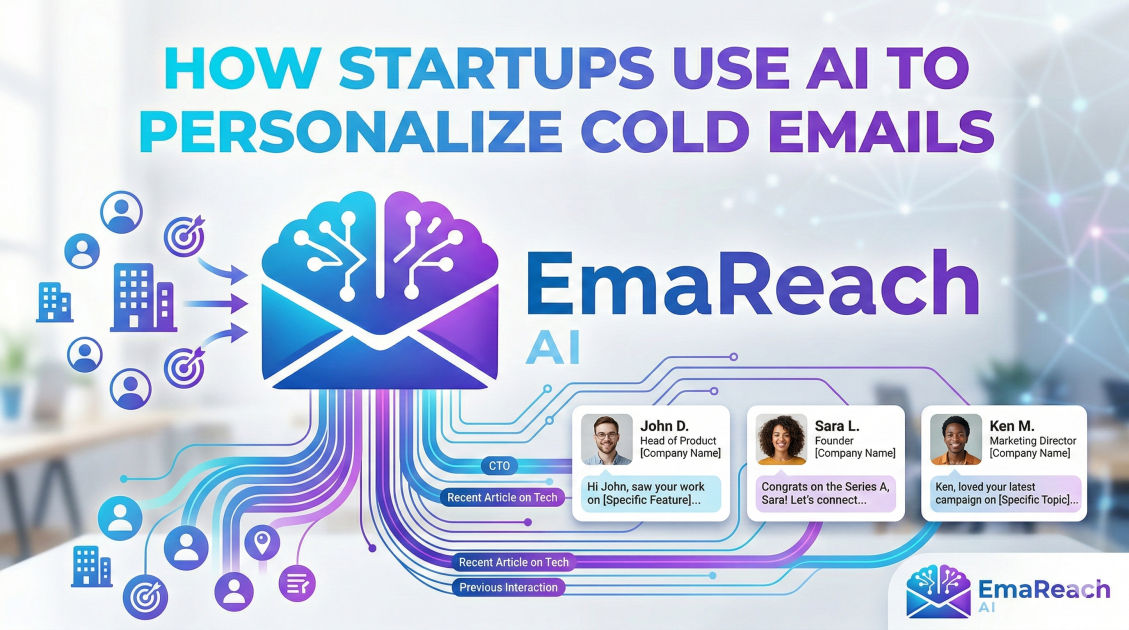
How Startups Use AI to Personalize Cold Emails
cold emailstartup growthAI personalizationsales automationemail deliverabilityoutreach strategy
Introduction
In the high-stakes world of startup growth, the cold email remains one of the most cost-effective yet challenging channels for customer acquisition. Historically, founders and sales teams faced a binary choice: send a massive volume of generic templates and pray for a 1% response rate, or spend hours researching individual prospects to write a handful of bespoke messages. Today, Artificial Intelligence has shattered this trade-off.
Modern startups are leveraging AI to achieve 'personalization at scale.' By integrating Large Language Models (LLMs) and machine learning into their outreach workflows, they are crafting messages that feel deeply personal while reaching thousands of leads. This guide explores the sophisticated strategies startups use to weaponize AI in their cold email campaigns, ensuring every message resonates with its recipient.
The Evolution of Cold Outreach
To understand where we are, we must look at where we started. Traditional cold emailing relied on 'merge tags'—simple placeholders like {{first_name}} or {{company_name}}. While these were revolutionary a decade ago, modern prospects have developed a filter for them. A subject line that says "Quick question for [Company Name]" is now a psychological trigger for the 'Delete' button.
Startups today are moving beyond these surface-level variables. They are using AI to analyze a prospect’s digital footprint, including their latest LinkedIn posts, recent company news, podcast appearances, and even their specific writing style. The goal is to create an email that doesn't just look like it was written for them, but one that actually addresses their current pain points and business context.
Why Personalization Matters More Than Ever
Inboxes are more crowded than ever. Decision-makers receive dozens, if not hundreds, of unsolicited pitches every week. In this environment, relevance is the only currency. AI allows startups to establish instant credibility by proving they have done their homework. When a recipient sees a highly specific observation about their recent career move or a challenge their industry is facing, the 'cold' nature of the email thaws instantly.
Deep Research: The Foundation of AI Personalization
The most successful AI-driven campaigns don't start with writing; they start with data. Startups use AI agents to scrape and synthesize information from across the web.
Social Media Synthesis
Instead of a human scrolling through a prospect’s LinkedIn profile, AI can analyze their last five posts and identify recurring themes. If a prospect frequently discusses 'sustainable supply chains,' the AI can flag this as a key interest. Startups then use this data to bridge the gap between their product and the prospect's values.
Analyzing Financial Reports and News
For B2B startups targeting enterprise clients, AI can ingest quarterly earnings reports or recent press releases. If a target company mentions they are prioritizing 'operational efficiency' in their annual report, the AI can tailor the cold email to highlight how the startup’s software specifically boosts efficiency. This level of alignment was previously impossible at scale.
Identifying 'Intent Signals'
AI doesn't just look at who a person is, but what they are doing. Startups use AI to monitor 'intent signals'—such as a company hiring for a specific role (indicating a need for a certain tool) or a prospect asking a question in a specialized forum. By timing the email to these signals, startups ensure their message is not just personal, but timely.
The Anatomy of an AI-Personalized Cold Email
When a startup uses AI to construct an email, they typically focus on four key components: the subject line, the 'icebreaker,' the value proposition, and the call to action.
1. The Dynamic Subject Line
AI can generate hundreds of variations of a subject line based on the recipient's specific background. Instead of "Software for Marketing Teams," an AI might generate "Ideas for [Prospect Name]’s next campaign at [Company]." By analyzing historical open rates, AI can also predict which subject line structures are most likely to grab attention for specific personas.
2. The Hyper-Personalized Icebreaker
The first sentence is the most critical part of the email. Startups use AI to write unique opening lines that reference a specific achievement. For example: "I saw your recent interview on the 'Growth Hackers' podcast where you mentioned the shift toward product-led growth—it really changed how I think about our own onboarding."
3. Tailored Value Propositions
A product might have ten different benefits, but only two might matter to a specific lead. AI analyzes the lead's job title and company size to select the most relevant value prop. A CTO cares about security and scalability, while a Marketing Manager cares about conversion rates and ease of use. AI ensures the right message reaches the right ears.
4. Context-Aware Calls to Action (CTAs)
Even the CTA can be personalized. If the AI detects that a prospect is currently at a major industry conference, it might suggest a quick meeting at the event rather than a standard Zoom link. This level of nuance makes the outreach feel human and thoughtful.
Overcoming the 'Spam' Hurdle: Deliverability and Reputation
No amount of personalization matters if the email never reaches the inbox. This is where startups must be strategic about their technical setup. High-volume sending from a single account is a recipe for disaster.
To ensure success, many startups turn to specialized solutions like EmaReach. Their platform helps businesses stop landing in spam by ensuring cold emails reach the primary inbox. EmaReach AI combines AI-written cold outreach with critical features like inbox warm-up and multi-account sending. This ensures that even as you scale your personalized outreach, your sender reputation remains pristine, and your emails consistently land where they are seen—in the primary tab.
The Technical Workflow: How Startups Build the Stack
Implementing AI personalization isn't just about using one tool; it’s about building a cohesive workflow.
- Data Extraction: Tools are used to pull lead data from LinkedIn, Apollo, or Crunchbase.
- Enrichment: AI agents (like GPT-based models) process the raw data. They might take a LinkedIn URL and return a 3-sentence summary of the person's professional focus.
- Drafting: The summarized data is fed into a prompt that includes the startup's brand voice and value proposition. The AI then generates the draft.
- Review and Iteration: While AI is powerful, many startups keep a 'human-in-the-loop' for high-value leads to polish the final output.
- Sending and Warm-up: The emails are sent through a platform that manages deliverability and tracks engagement.
Common Pitfalls and How to Avoid Them
While AI is a force multiplier, it is not infallible. Startups often make a few key mistakes when first adopting these technologies.
The 'Uncanny Valley' of Personalization
Sometimes, AI can be too specific, making the email feel 'creepy' rather than personal. If an email mentions a prospect's vacation photos from three years ago, it crosses a line. Startups must train their AI to stick to professional context and public-facing business data.
Lack of Brand Voice
If the AI is not properly prompted, the emails can sound generic or overly formal. Successful startups create a 'Style Guide' for their AI, ensuring that every personalized email reflects the company’s unique tone—whether that’s irreverent and bold or professional and authoritative.
Ignoring the Feedback Loop
AI personalization is a continuous experiment. Startups must track not just open rates, but response quality. If an AI-generated angle is getting a lot of 'not interested' replies, the prompt needs to be adjusted. Machine learning models can actually help analyze these responses to suggest better messaging for the next round.
The Role of AI in Multi-Channel Outreach
Cold email doesn't exist in a vacuum. Startups are increasingly using AI to coordinate personalization across multiple channels.
If a prospect doesn't respond to a personalized email, the AI might suggest a specific LinkedIn comment or a personalized video message. This 'omni-channel' approach ensures that the startup stays top-of-mind without being annoying. By maintaining a consistent, AI-informed narrative across all platforms, startups build a cohesive brand experience even before the first discovery call.
Future Trends: What’s Next for AI Outreach?
As AI models become more sophisticated, we are moving toward 'predictive personalization.' Instead of reacting to what a prospect has done, AI will predict what they are likely to need next based on macro-economic trends and industry shifts.
We are also seeing the rise of 'AI-to-AI' communication. In the future, a startup’s AI might pitch a prospect’s AI assistant, which will then vet the offer based on the prospect's priorities. In this world, the quality of the data and the precision of the personalization will be the only things that matter.
Actionable Steps for Startups Starting Today
If you are a founder or sales leader looking to implement these strategies, here is a roadmap:
- Clean Your Data: AI is only as good as the input. Ensure your CRM is updated and your lead lists are segmented by persona.
- Start Small: Don't automate your entire outbound process overnight. Start by using AI to generate icebreakers for your top 50 high-value targets.
- Invest in Deliverability: Use a service like EmaReach to ensure your technical foundation is solid. Warm up your domains and distribute your sending volume to protect your reach.
- Test and Learn: Run A/B tests between AI-personalized emails and your best-performing manual templates. Measure the ROI of the time saved versus the increase in response rates.
- Maintain Authenticity: Remember that the goal of AI is to facilitate a human connection. If an email feels like it was written by a robot, it has failed, no matter how 'personalized' it is.
Conclusion
AI has fundamentally changed the rules of cold outreach. Startups are no longer forced to choose between scale and quality. By using AI to perform deep research, craft tailored messages, and optimize deliverability, they can reach the right people with the right message at the right time.
As these tools become more accessible, the barrier to entry for effective outbound sales will continue to drop. However, the advantage will go to those who use AI not just as a shortcut, but as a way to be more thoughtful, more relevant, and more human in their communication. The era of the mass-blast 'spray and pray' email is over. The era of hyper-personalized, AI-driven growth is just beginning.
EmaReach AI
Ready to scale your cold email outreach?
Join thousands of teams using EmaReach AI for AI-powered campaigns, domain warmup, and 95%+ deliverability. Start free — no credit card required.
Related posts
- Read article
The Instantly Alternative That Finally Gets Outbound Analytics Right
Discover why high-volume cold email requires a shift from surface-level vanity metrics to deep, data-driven revenue attribution, and explore the ultimate alternatives for mastering outbound engineering.
- Read article
What You Gain and What You Give Up When Switching From Instantly
Thinking about migrating your cold email stack? This detailed guide breaks down the exact operational advantages you gain and the core features you sacrifice when switching away from Instantly's popular outreach platform.