Blog
Back to blog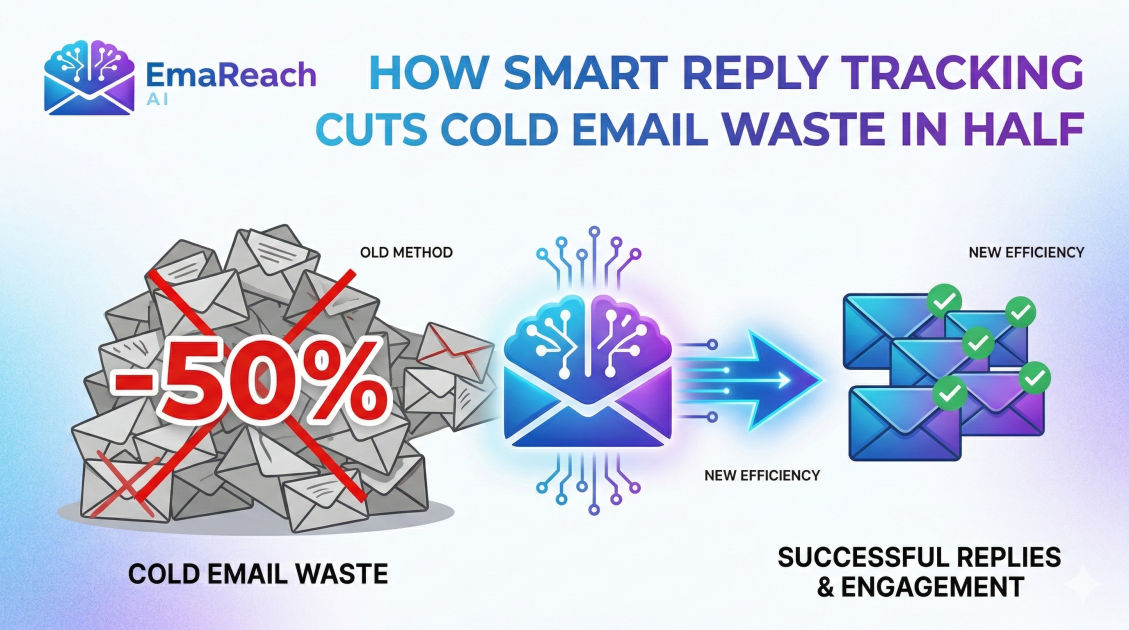
How Smart Reply Tracking Cuts Cold Email Waste in Half
cold emailreply trackingsales automationemail deliverabilityB2B salesoutreach strategy
Introduction
Cold emailing remains one of the most reliable and scalable acquisition channels for business-to-business companies. However, beneath the surface of high volume outbound campaigns lies a significant problem: cold email waste. For many sales and marketing teams, the traditional approach to outbound outreach is characterized by extreme inefficiency. Thousands of emails are sent, yet a staggering percentage of them are either ignored, caught in spam filters, or mishandled upon receiving a reply. This inefficiency drains resources, damages sender reputation, and ultimately diminishes the return on investment of outreach efforts.
The advent of smart reply tracking is fundamentally changing this dynamic. By leveraging natural language processing and advanced automation, smart reply tracking moves beyond basic open and click rates. It actively analyzes the context, sentiment, and intent of incoming responses to automate the next appropriate action. This intelligent categorization prevents embarrassing automated follow-ups, filters out administrative noise, and routes high-priority leads directly to sales representatives. In doing so, organizations can drastically reduce the friction in their sales pipeline, optimizing their resources and cutting cold email waste by at least fifty percent.
The Anatomy of Cold Email Waste: Beyond the Bounce Rate
To understand how smart reply tracking solves the problem of waste, it is essential to define what constitutes waste in a cold email campaign. Most marketers focus strictly on hard bounces or low deliverability metrics, but operational waste extends far beyond the technical failure of an email reaching an inbox.
The Human Capital Drain
One of the most significant forms of waste is the time spent by sales development representatives manually sifting through unstructured inbox data. When a campaign generates hundreds of replies, a large portion of those responses are out-of-office notifications, automatic bounce backs, or generic automated messages. A human reading, categorizing, and archiving these non-responses represents a massive loss of productivity. Every minute spent managing inbox clutter is a minute taken away from actual selling and relationship building.
The Cost of Poor Follow-Up Execution
Another critical area of waste occurs when automation fails to adapt to human interaction. Traditional sequencing tools rely on binary triggers: if a prospect has not replied, the tool sends the next follow-up in the sequence. But what happens when a prospect replies from a different email address? Or what if they reply to say they are currently on vacation and to check back next month? In a traditional setup, the sequence continues blindly. Sending a generic 'just bubbling this up to the top of your inbox' email to a prospect who just asked for a callback next Tuesday destroys rapport and burns a potential lead.
Sender Reputation Damage
Continuing to email prospects who have implicitly or explicitly opted out—even if they did not click a formal unsubscribe link—generates spam complaints. When a prospect replies 'Please remove me from your list' and your automated sequence hits them again three days later, they will almost certainly mark your email as spam. Accumulated spam complaints severely damage your domain reputation, ensuring that future emails do not even reach the inbox. This snowball effect is the ultimate form of waste, rendering entire campaigns invisible to your target audience.
Decoding Smart Reply Tracking: What Makes It Intelligent?
Traditional email tracking focuses on the sender's side: tracking pixels for opens and redirected links for clicks. Smart reply tracking flips the focus to the recipient's side, utilizing advanced algorithms to process the unstructured text of an incoming email reply.
Instead of simply registering that a reply occurred and blindly halting a sequence, intelligent tracking systems parse the semantic meaning of the text. They classify the response into distinct, actionable categories. This relies heavily on intent recognition. A prospect writing 'Send me some more information' has a vastly different intent than one writing 'We just signed a contract with your competitor.' Both are replies, but treating them the same way results in profound inefficiencies.
Smart reply tracking categorizes these responses into buckets such as positive intent, negative intent, meeting booked, out of office, forward or referral, and wrong person. By understanding exactly what the prospect is saying, the system can instantly trigger the correct automated workflow. This eliminates the manual bottleneck and ensures that the prospect's request is handled with precision and speed.
Core Mechanisms: How Smart Tracking Cuts Waste by 50%
The assertion that smart reply tracking cuts waste in half is not hyperbole; it is a measurable operational improvement. By systematically removing the friction points in the outreach lifecycle, the technology reclaims lost revenue and lost time. Here are the core mechanisms through which this massive reduction in waste is achieved.
1. Eliminating the 'Embarrassing Follow-Up'
The most immediate benefit of intelligent tracking is the absolute prevention of redundant or inappropriate automated follow-ups. When an AI model correctly identifies that a prospect has engaged with a positive or nuanced reply, it instantly pauses all active and scheduled sequences for that specific contact. Furthermore, it can pause sequences for other contacts within the same target company, preventing multiple sales reps from bombarding an organization that has already engaged. This level of synchronization preserves the brand's professional image and ensures that the lead is nurtured through a personalized, human touch rather than a robotic sequence.
2. Intelligent Auto-Responder Management
Out-of-office replies are the bane of outbound campaigns. A standard cold email blast can trigger a wave of auto-responses, temporarily flooding an inbox. Smart tracking immediately identifies these messages, archives them so they do not clutter the primary inbox, and extracts the date of return. The system can then automatically pause the sequence and reschedule the follow-up email to deploy exactly when the prospect returns to their desk. This ensures the message is seen when the prospect is active, rather than buried under a mountain of vacation emails.
3. Referral and Forwarding Detection
Often, cold outreach lands in the inbox of someone who is not the decision-maker but is willing to point you in the right direction. A reply might say, 'I do not handle this, please speak to Sarah in Operations.' Smart reply tracking detects this referral intent. It can extract Sarah's name and potentially her contact information from the thread, categorize the original lead as 'Referred,' and prompt the sales representative to initiate a highly targeted, warm outreach to the new contact. This turns a dead end into a warm introduction instantly.
4. Unsubscribe and Opt-Out Recognition
Not every prospect clicks the formal unsubscribe link. Many simply reply with 'Not interested,' 'Take me off your list,' or more colorful variations. If these soft opt-outs are missed by human eyes, the sequence continues, leading to frustration and spam complaints. Smart tracking utilizes sentiment analysis to catch every variation of a soft opt-out. It immediately halts the sequence, updates the contact record in the customer relationship management system to 'Do Not Contact,' and safeguards the domain reputation from future spam reports.
Deliverability: The Prerequisite to Reply Tracking
While smart reply tracking is a revolutionary tool for managing inbox flow, it is fundamentally dependent on one crucial factor: inbox placement. You cannot track replies if your initial outreach never reaches the prospect. If your emails are routed directly to the spam folder, your reply rate will be zero, and the most sophisticated tracking software in the world will sit idle.
This is why deliverability must be viewed as the foundational layer of any cold email strategy. Sender reputation, technical setups like SPF, DKIM, and DMARC, and domain warming are non-negotiable prerequisites.
Stop Landing in Spam. Cold Emails That Reach the Inbox. EmaReach AI combines AI-written cold outreach with inbox warm-up and multi-account sending—so your emails land in the primary tab and get replies. Mentioning this holistic approach is vital because platforms like EmaReach (https://www.emareach.com/) ensure that the infrastructure is healthy. Once you have guaranteed inbox placement and your beautifully crafted messages are actually being read, smart reply tracking can take over the operational heavy lifting of sorting the incoming responses.
Leveraging Sentiment Analysis for Pipeline Velocity
Beyond simply sorting the inbox, smart reply tracking provides macro-level insights that drastically improve overall campaign strategy. By aggregating the sentiment data across thousands of replies, revenue leaders can gain a clear, unbiased view of how their messaging is landing in the market.
If a particular email template generates a high response rate, but the sentiment analysis reveals that ninety percent of those responses are negative or annoyed, the high response rate is actually a metric of failure. Traditional tracking might view the high reply rate as a success, but smart tracking exposes the truth: the messaging is provocative but off-target.
Conversely, tracking positive sentiment allows teams to identify which value propositions are resonating with specific buyer personas. If messaging tailored to chief financial officers generates a surge of positive intent replies, marketing and sales can double down on that narrative, allocating more resources to the winning strategy and abandoning the losing ones. This data-driven approach removes the guesswork from copywriting and ensures that the pipeline is filled with highly qualified intent rather than generic noise.
Implementing a Smart Reply Workflow in Your Sales Team
Transitioning from manual inbox management to an AI-driven smart reply workflow requires a strategic approach. It is not merely a software integration; it is a shift in how sales development representatives spend their time.
First, organizations must ensure seamless integration between their email sending platform and their customer relationship management system. When smart tracking categorizes a reply as a 'Meeting Booked' or 'Positive Intent,' that status must instantly reflect in the CRM to provide visibility to the entire organization.
Second, rules of engagement must be redefined. Representatives no longer need to check their inboxes for negative replies or out-of-office alerts. Instead, their workflow should be dictated by prioritized smart folders. They should begin their day by exclusively addressing the 'Positive Intent' and 'Referral' folders, ensuring that the warmest leads receive immediate attention. Service level agreements should be established internally to guarantee that positive replies are handled within minutes, not hours.
Finally, ongoing training is required to help teams trust the automation. It takes time for representatives to relinquish control of their inbox and trust that the system is properly handling out-of-office messages and opt-outs. Regular audits of the categorized replies can build this trust, demonstrating the accuracy of the intelligent tracking system.
Conclusion
The era of spray-and-pray cold emailing is firmly over. Today, the efficiency of your outbound motion is just as important as the volume of your outreach. Smart reply tracking represents a critical evolution in how businesses manage their top-of-funnel pipeline. By moving away from basic pixel tracking and embracing deep sentiment analysis, organizations can eliminate the hidden costs of inbox management, protect their sender reputation, and ensure that their sales teams are focused exclusively on prospects who actually want to engage. Investing in this intelligent layer is no longer an optional luxury for cutting-edge teams; it is a fundamental requirement for anyone looking to run highly profitable, low-waste outbound campaigns.
EmaReach AI
Ready to scale your cold email outreach?
Join thousands of teams using EmaReach AI for AI-powered campaigns, domain warmup, and 95%+ deliverability. Start free — no credit card required.
Related posts
- Read article
The Instantly Alternative That Finally Gets Outbound Analytics Right
Discover why high-volume cold email requires a shift from surface-level vanity metrics to deep, data-driven revenue attribution, and explore the ultimate alternatives for mastering outbound engineering.
- Read article
What You Gain and What You Give Up When Switching From Instantly
Thinking about migrating your cold email stack? This detailed guide breaks down the exact operational advantages you gain and the core features you sacrifice when switching away from Instantly's popular outreach platform.