Blog
Back to blog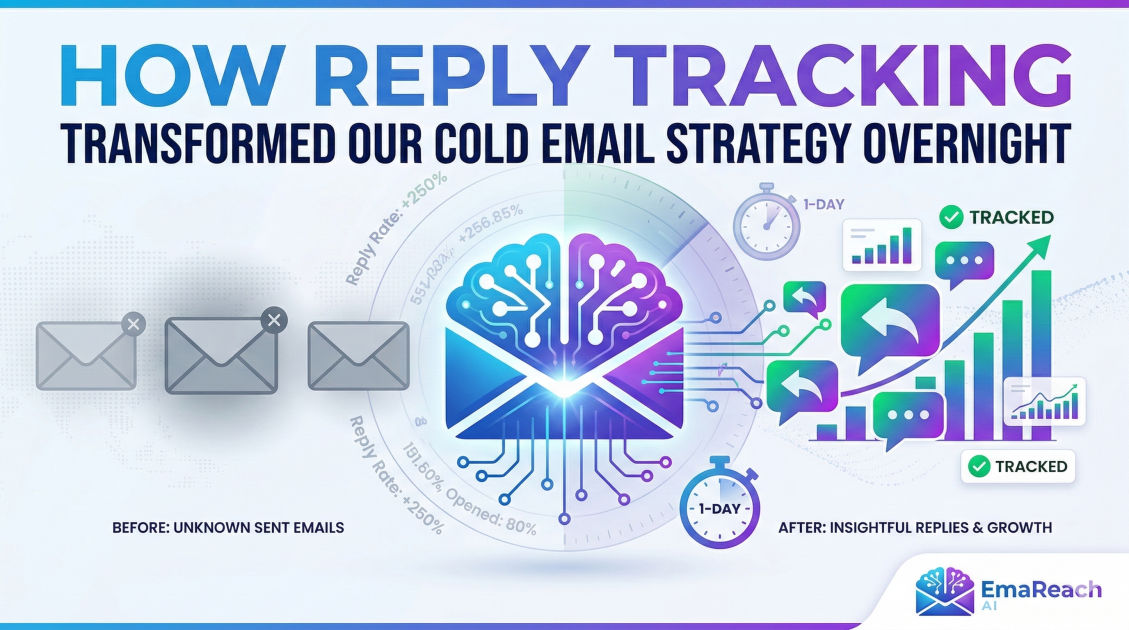
How Reply Tracking Transformed Our Cold Email Strategy Overnight
cold emailoutreach strategylead generationsales automationemail deliverabilityreply tracking
Introduction
For years, the gold standard of cold email success was the open rate. Marketers and sales development representatives (SDRs) would obsess over subject lines, checking their dashboards to see if 40%, 50%, or 60% of their prospects were clicking into their messages. But a hard truth eventually surfaced: opens are a vanity metric. You cannot deposit an open rate into a bank account.
The real needle-mover in outbound sales is the reply. More specifically, the positive reply. However, many organizations treat reply management as an afterthought, a manual task relegated to a messy inbox. When we made the pivot to rigorous, automated reply tracking, our entire outbound philosophy shifted. It wasn't just a minor improvement; it was an overnight transformation of our efficiency, our messaging, and our bottom line.
In this guide, we will explore why reply tracking is the missing link in most cold email strategies and how implementing it can revolutionize your lead generation efforts.
The Fundamental Shift: From Volume to Value
Historically, cold email was a numbers game. The logic was simple: if you send 1,000 emails and get a 1% response rate, you get 10 leads. To get 20 leads, you simply send 2,000 emails. This 'spray and pray' methodology is dying. Modern spam filters are smarter, and prospects are more fatigued than ever.
When we integrated reply tracking, we stopped looking at how many emails were going out and started obsessing over what was coming back. Reply tracking allows you to categorize responses instantly. Is it an 'OOTO' (Out of Office)? A 'Not Interested'? A 'Wrong Person'? Or a 'Let’s Chat'?
By quantifying these categories, we realized that our high open rates were masking a low-quality response rate. We were reaching people, but we weren't resonating. Reply tracking gave us the data to realize we needed to pivot our messaging immediately, rather than waiting weeks for a 'gut feeling' to kick in.
The Technical Infrastructure of Reply Tracking
To understand the transformation, one must understand the mechanics. Reply tracking isn't just seeing an email in your inbox; it is the programmatic detection of a response linked to a specific campaign, lead, and sequence step.
1. Threading and Sentiment Analysis
Modern reply tracking uses threading to ensure that when a prospect responds to the third follow-up, the system knows exactly which initial hook prompted the interest. Furthermore, advanced systems now employ sentiment analysis. This identifies the 'mood' of the reply. This is crucial because a 10% reply rate looks great on paper, but if 9% of those are 'Remove me from your list,' your strategy is actually failing.
2. Automatic Sequence Unsubscription
One of the biggest 'strategy killers' in cold email is sending a follow-up to someone who has already replied. It looks unprofessional, robotic, and desperate. Overnight, reply tracking eliminated this friction. The moment a reply is detected, the prospect is pulled from the automated sequence, allowing a human to take over the conversation with a personalized touch.
3. Deliverability and Inbox Health
Reply tracking is also a silent guardian of your sender reputation. High engagement (replies) signals to email service providers (ESPs) that your content is valuable. Tools like EmaReach help ensure that you stop landing in spam by combining AI-written outreach with inbox warm-up. By focusing on reaching the primary tab, EmaReach ensures that your tracking data is based on actual human interaction rather than filtered noise. When your emails land in the primary tab, your reply tracking data becomes a true reflection of your market resonance.
Data-Driven Iteration: The 'Overnight' Effect
How does this change things 'overnight'? It comes down to the speed of the feedback loop. Without reply tracking, you might run a campaign for a month before deciding it didn't work. With it, you can see within 48 hours that a specific call-to-action (CTA) is generating 'Not Interested' replies while another is generating booked meetings.
Identifying the Winning Hook
We once ran an A/B test on two different value propositions.
- Option A: Focused on cost savings.
- Option B: Focused on time efficiency.
Both had identical open rates (around 55%). However, reply tracking showed that Option A generated a 0.5% positive reply rate, while Option B generated a 4% positive reply rate. Without tracking the type of reply, we might have continued using both, or worse, picked the one that felt more 'on brand' despite it being less effective.
Managing the 'Chaos' of Success
As your reply rates climb, a new problem emerges: managing the volume. This is where the 'strategy' part of cold email truly evolves.
The Lead Triage System
Reply tracking allowed us to build a triage system.
- Positive Replies: Immediately pushed to the CRM and assigned to an account executive.
- Objections: Routed to a specific folder for 'objection handling' templates.
- Referrals: Tracked to see which companies are most likely to point us to the right stakeholder.
By categorizing these replies, our sales team saved hours every day. They no longer had to sift through 'Out of Office' messages to find the gold. The gold was delivered to them on a silver platter.
Improving Deliverability Through Engagement
It is a little-known fact that the ratio of sent emails to received replies is a major factor in how Google and Outlook treat your domain. If you send 5,000 emails and get zero replies, you look like a spammer. If you get 500 replies, you look like a legitimate communicator.
By tracking replies and optimizing for them, you naturally improve your deliverability. You begin to focus on smaller, highly targeted lists where you know the reply probability is higher. This 'quality over quantity' approach, supported by reply tracking data, creates a virtuous cycle: better engagement leads to better deliverability, which leads to more visibility, which leads to more replies.
The Psychology of the Reply
Why do people reply to cold emails? Usually, it's because the sender solved a problem or peaked curiosity at exactly the right time. Reply tracking helped us map the 'Buyer’s Journey' in a way we never could before.
We discovered that certain industries replied faster to short, punchy emails, while others (like legal or medical fields) preferred detailed, evidence-based outreach. We adjusted our strategy to match the 'Reply Persona' of each niche. This level of granularity is impossible if you are only tracking opens and clicks.
Integration with the Sales Stack
Transforming a strategy overnight requires more than just a new metric; it requires integration. When reply tracking is synced with your CRM, it creates a 'Single Source of Truth.'
Imagine a scenario where a prospect replies 'Check back in six months.' Without automated tracking, that lead might be forgotten. With it, the reply triggers a task in the CRM for a follow-up exactly 180 days later. This ensures that the effort put into cold email today pays dividends months down the line. It turns a one-off campaign into a long-term revenue pipeline.
Common Pitfalls to Avoid
While reply tracking is transformative, it is not a magic wand. There are several mistakes teams make when first implementing it:
- Ignoring the Negative: Some teams only track 'Yes' replies. You must track 'No' replies to understand why you are being rejected. Is it price? Is it a competitor? Is it bad timing?
- Slow Response Times: Tracking a reply is useless if you don't respond to it within the hour. Lead response time is a critical factor in conversion.
- Over-Automation: Don't use AI to reply to a reply unless it’s incredibly sophisticated. Once a prospect engages, they deserve a human interaction.
Case Study: From 0 to 15 Meetings a Week
Before we revamped our strategy, our outreach was stagnant. We were sending 200 emails a day and lucky to get one meeting a week. Our 'tracking' consisted of an intern looking at a shared inbox every few hours.
We implemented a system centered on reply tracking and deliverability optimization. We used EmaReach to ensure our emails were actually hitting the primary inbox and not the promotions or spam folders. Once we were visible, we used reply tracking to identify which specific segments were responding.
We discovered that 'Head of Operations' was replying 3x more often than 'COOs.' We immediately shifted all resources to the Operations segment. Within a week, our calendar was full. The 'transformation' wasn't just in the tech—it was in the data-backed decision-making that the tech enabled.
The Future of Cold Email Strategy
The future of outbound sales is hyper-personalized and data-centric. We are moving toward a world where 'intent data' and 'reply tracking' merge. Imagine knowing exactly when a prospect is looking for a solution and then having the system track their reply to see if your timing was perfect.
As AI continues to evolve, the ability to analyze the nuances of a reply—detecting sarcasm, urgency, or specific pain points—will become standard. Organizations that adopt these tracking methodologies now will be miles ahead of those still clinging to open rates.
Actionable Steps to Implement Reply Tracking Today
If you want to transform your strategy, start with these steps:
- Audit Your Tech Stack: Ensure your current email tool supports reply detection and automatic sequence pausing.
- Define Your Categories: Create a simple system for categorizing replies (e.g., Positive, Neutral, Negative, Referral).
- Focus on Deliverability: Use a service like EmaReach to ensure your 'repliable' emails are actually being seen. Remember: no inbox, no reply.
- Set Up Alerts: Create Slack or email notifications for positive replies so your sales team can jump on them immediately.
- Review Weekly: Sit down with your team every week to look at the reply data. What was the 'Reply of the Week'? Why did it work?
Conclusion
Moving from open-rate obsession to reply-tracking mastery is the single most impactful change you can make in your cold email strategy. It forces a shift in mindset from 'How many people can I reach?' to 'How many people can I help?'
By focusing on the reply, you humanize your sales process. You begin to treat prospects as individuals with specific needs and responses rather than just lines in a spreadsheet. The data provided by reply tracking offers a roadmap for your entire business, highlighting what the market wants, what it doesn't want, and how you can best serve it. When you stop guessing and start tracking, your strategy doesn't just improve—it transforms.
EmaReach AI
Ready to scale your cold email outreach?
Join thousands of teams using EmaReach AI for AI-powered campaigns, domain warmup, and 95%+ deliverability. Start free — no credit card required.
Related posts
- Read article
The Instantly Alternative That Finally Gets Outbound Analytics Right
Discover why high-volume cold email requires a shift from surface-level vanity metrics to deep, data-driven revenue attribution, and explore the ultimate alternatives for mastering outbound engineering.
- Read article
What You Gain and What You Give Up When Switching From Instantly
Thinking about migrating your cold email stack? This detailed guide breaks down the exact operational advantages you gain and the core features you sacrifice when switching away from Instantly's popular outreach platform.