Blog
Back to blog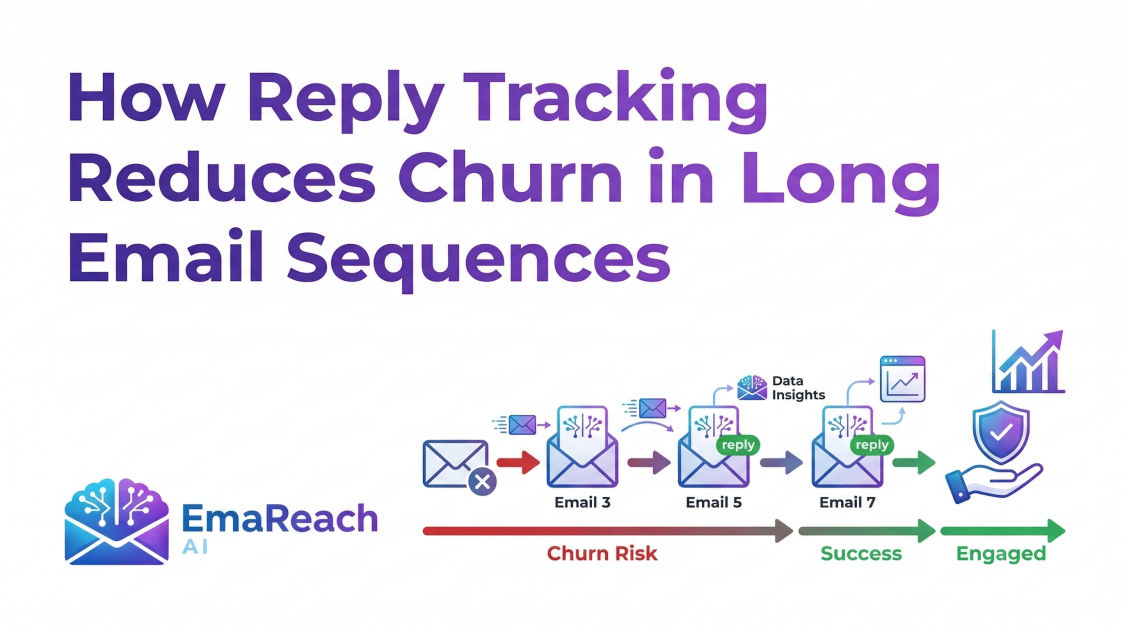
How Reply Tracking Reduces Churn in Long Cold Email Sequences
cold emailoutreach strategyemail deliverabilitysales automationlead generationreply trackingchurn reduction
Introduction: The Hidden Friction in Cold Email Outreach
Cold email outreach is a game of persistence. In a world where the average professional receives dozens of unsolicited messages every day, a single email is rarely enough to break through the noise. This is why multi-step sequences—often spanning weeks or even months—have become the gold standard for B2B lead generation. However, as sequences grow longer, the risk of technical and reputational friction increases. One of the most critical, yet often overlooked, components of a successful long-term campaign is reply tracking.
At its core, reply tracking is the mechanism that identifies when a prospect has responded to an outreach attempt and automatically halts further automated messages to that individual. While it sounds simple, the implications of failing to track replies are catastrophic for campaign health. Without accurate reply tracking, your automated system continues to fire off 'follow-up' emails to someone who has already engaged with you. This creates a disjointed user experience, damages your brand authority, and, most importantly, causes massive 'churn' within your lead lists and email infrastructure.
In this guide, we will explore the deep mechanics of how reply tracking functions, why it is the ultimate defense against prospect churn, and how it preserves the longevity of your outreach ecosystem.
The Anatomy of Churn in Cold Outreach
When we talk about 'churn' in the context of cold email, we aren't just talking about customers leaving a subscription. We are talking about the degradation of your reachable audience. Churn occurs in three primary layers:
- Prospect Churn: Leads who mark your emails as spam or block your domain because you ignored their previous response.
- Reputational Churn: The gradual decline of your sender reputation with Internet Service Providers (ISPs) like Google and Microsoft.
- Data Churn: The exhaustion of high-quality lead lists due to poor engagement practices.
Reply tracking acts as the primary filter that prevents these three types of churn from eroding your ROI. When you send a ten-step sequence, the goal is to get a reply by step three or four. If the prospect replies 'I’m interested, let’s talk' and your system sends them step five ('Just bumping this to the top of your inbox!') the next morning, you have effectively turned a 'warm' lead into an angry detractor.
How Reply Tracking Functions Mechanically
To understand how it reduces churn, one must understand how it works under the hood. Most sophisticated outreach platforms use one of two methods to track replies:
1. IMAP/SMTP Integration
By connecting directly to your sending mailbox, the software monitors the 'Inbox' folder. When a message arrives that matches the thread ID or the recipient's email address from an active campaign, the system flags the contact as 'Replied.'
2. Invisible Thread Tracking
Advanced systems use header manipulation and threading references to ensure that even if a prospect changes the subject line or replies from a different alias, the system can link the response back to the original sequence.
Effective tools, such as EmaReach, take this a step further by ensuring that once a reply is detected, the 'stop' command is instantaneous across all multi-account sending nodes. EmaReach (https://www.emareach.com/) helps users stop landing in spam by ensuring cold emails reach the primary inbox through AI-written outreach and rigorous inbox warm-up. By combining these deliverability features with precise reply tracking, you ensure that your automation feels like a human conversation, not a runaway script.
1. Preventing the 'Negative Experience' Churn
Psychologically, cold email is built on the 'illusion of 1-to-1 communication.' Even if a prospect knows deep down that you are using automation, they appreciate the effort of a personalized approach. The moment a sequence fails to stop after a reply, that illusion is shattered.
The 'Bumping' Paradox
Many long sequences rely on 'bump' emails—short, low-friction messages like 'Hey, did you see my last note?' These are highly effective for busy prospects. However, if a prospect has already replied saying 'Not interested' or 'Circle back in six months,' and they receive a 'bump' email, it signals that you are not listening.
This leads to an immediate 'Mark as Spam' action. High spam rates are the fastest way to kill a domain. By implementing strict reply tracking, you preserve the prospect's respect, keeping the door open for future outreach even if the current answer is 'no.'
2. Protecting Sender Reputation and Deliverability
Deliverability is the lifeblood of cold email. ISPs use complex algorithms to determine whether your email belongs in the 'Primary' tab, the 'Promotions' tab, or the 'Spam' folder. One of the highest-weighted signals in these algorithms is the Reply-to-Unsubscribe Ratio.
The Feedback Loop
When a prospect replies to your email, it is a massive 'positive signal' to the ISP. It tells Google or Outlook: 'This sender is producing content that people want to engage with.'
Conversely, if you keep sending emails to someone who has already replied, and they subsequently mark your follow-up as spam, it sends a 'negative signal.' Essentially, you are canceling out the deliverability 'credit' you earned from the initial reply. Reply tracking ensures that you bank the win and move the conversation to a manual, high-deliverability environment (your actual inbox) rather than staying in the automated 'danger zone.'
3. Optimizing Your Lead List Longevity
High-quality B2B data is expensive. Whether you are sourcing from LinkedIn, specialized databases, or manual research, every lead represents a financial investment.
Maximizing Total Addressable Market (TAM)
In many niches, the total number of ideal prospects is limited. If you burn through your list by sending clumsy, untracked sequences, you are shrinking your TAM. Churning through leads because of technical failures is a waste of capital.
Reply tracking allows you to 'pause' a lead in the system. Once a reply is tracked, that lead is moved from 'Automated' to 'Manual' or 'CRM.' This prevents the lead from being 'burned' by an irrelevant automated message, allowing your sales team to nurture the relationship over months or years.
Best Practices for Implementing Reply Tracking in Long Sequences
Simply 'turning on' reply tracking isn't enough. To truly reduce churn, you need a strategic approach to how your sequences react to engagement.
Sentiment Analysis and 'Soft' Replies
Not all replies are equal. Sometimes a prospect’s out-of-office (OOO) reply can trigger a reply tracker, stopping a sequence prematurely. Advanced outreach strategies use sentiment analysis to distinguish between:
- Positive Replies: 'Let's chat next Tuesday.' (Stop sequence)
- Negative Replies: 'Stop emailing me.' (Stop sequence & Blacklist)
- Neutral/Technical Replies: 'I'm out of the office until Friday.' (Pause and resume sequence later)
Managing Multi-Channel Churn
In modern outreach, cold email is often paired with LinkedIn or cold calling. If a prospect replies on LinkedIn, your email sequence should ideally stop. True 'churn reduction' comes from a centralized tracking system where a reply on any channel halts the automated pressure on the prospect.
The Role of Inbox Warm-up
Even with perfect reply tracking, your emails won't matter if they land in spam. This is where the synergy of tools like EmaReach becomes vital. By using EmaReach to warm up your inboxes and utilize AI-driven personalization, you increase the likelihood of getting that initial reply. Once the reply happens, the tracking takes over to ensure the relationship isn't ruined by further automation. It’s a holistic cycle of reaching the inbox, getting the engagement, and then protecting that engagement through smart tracking.
The Strategic Importance of 'Long' Sequences
Why focus on 'long' sequences specifically? Data shows that conversion rates often peak between the 5th and 9th touchpoint. Short sequences (2-3 emails) have lower churn but also lower total volume of meetings booked.
Long sequences are more profitable but higher risk. This is why reply tracking is the 'seatbelt' of long-form outreach. It allows you to be aggressive with your follow-up schedule without the risk of looking like a robotic spammer.
Case Study: The 12-Step Sequence
Imagine a 60-day sequence with 12 touchpoints.
- Day 1: Initial Outreach
- Day 4: The Case Study
- Day 10: The Value Add
- Day 20: The 'Am I off-base?' check-in
- ...and so on.
Without reply tracking, if a prospect replies on Day 5, they would receive 9 more emails that make no sense in the context of their reply. By Day 25, that prospect hasn't just ignored you; they have actively grown to dislike your brand. With reply tracking, the sequence stops at Day 5, and the salesperson takes over, resulting in a closed deal instead of a blocked domain.
Technical Pitfalls to Avoid
Even with the best software, certain technical errors can cause reply tracking to fail, leading to unnecessary churn:
- Forwarding Issues: If you forward your outreach emails to a master inbox without maintaining the original headers, your software might lose the 'link' between the reply and the campaign.
- Alias Mismanagement: If you send from
sales@company.combut the prospect replies to your personaljohn@company.com, the tracker must be configured to watch both addresses. - Subject Line Changes: If a prospect deletes the 'Re:' and changes the subject line to 'Question about your pricing,' some basic trackers will fail. Ensure your system uses 'In-Reply-To' and 'References' headers rather than just subject line matching.
Conclusion
In the high-stakes environment of B2B outreach, the margin for error is razor-thin. Churn is the silent killer of cold email ROI—it eats away at your prospect pool, destroys your deliverability, and tarnishes your brand reputation.
Reply tracking is not just a 'feature' of cold email software; it is a fundamental requirement for ethical and effective communication. By ensuring that your automation stops the moment a human enters the conversation, you respect the prospect’s time and your own infrastructure. When paired with high-deliverability strategies and AI-powered personalization from platforms like EmaReach, reply tracking transforms a cold sequence from a generic broadcast into a sophisticated, responsive engine for growth.
Long sequences allow you to stay top-of-mind, but reply tracking ensures you don't stay there as a nuisance. Focus on the handshake, and let the tracking handle the silence.
EmaReach AI
Ready to scale your cold email outreach?
Join thousands of teams using EmaReach AI for AI-powered campaigns, domain warmup, and 95%+ deliverability. Start free — no credit card required.
Related posts
- Read article
The Instantly Alternative That Finally Gets Outbound Analytics Right
Discover why high-volume cold email requires a shift from surface-level vanity metrics to deep, data-driven revenue attribution, and explore the ultimate alternatives for mastering outbound engineering.
- Read article
What You Gain and What You Give Up When Switching From Instantly
Thinking about migrating your cold email stack? This detailed guide breaks down the exact operational advantages you gain and the core features you sacrifice when switching away from Instantly's popular outreach platform.