Blog
Back to blog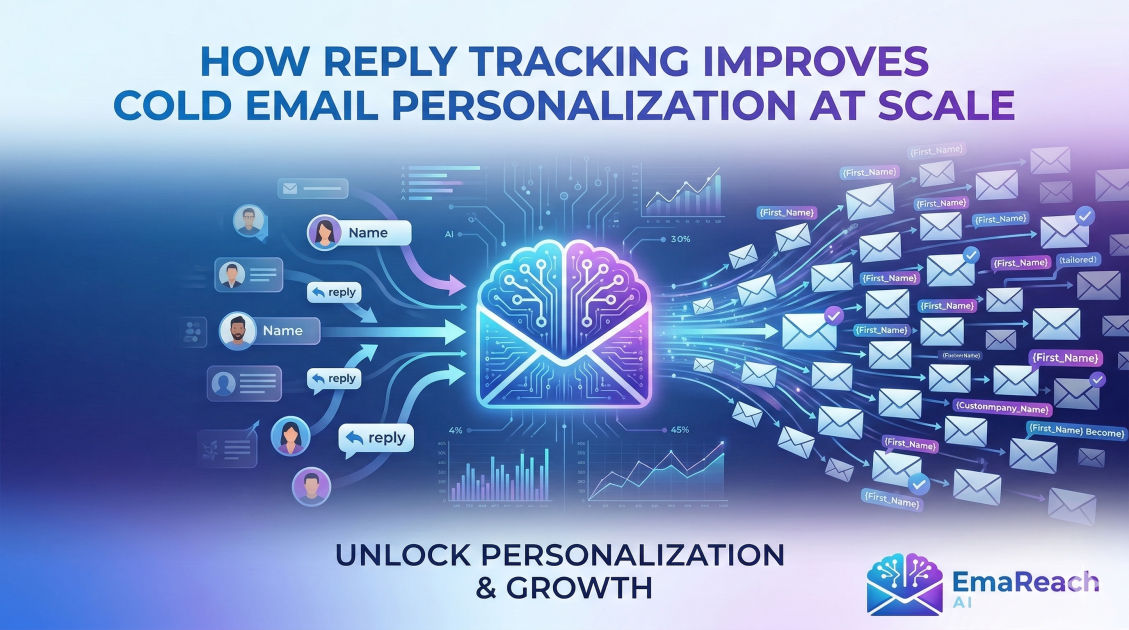
How Reply Tracking Improves Cold Email Personalization at Scale
cold emailoutreach automationsales strategyemail personalizationlead generationemail deliverability
Introduction
In the modern landscape of digital sales and business development, the challenge is no longer just sending emails—it is sending the right email to the right person at the right moment. High-volume cold outreach has historically suffered from a 'spray and pray' reputation, where personalization was sacrificed at the altar of efficiency. However, a significant shift has occurred with the advent of advanced reply tracking mechanisms.
Reply tracking is the backbone of intelligent automation. It isn’t just about knowing when someone said 'yes' or 'no'; it is about capturing the data necessary to refine every subsequent interaction across an entire campaign. When managed effectively, reply tracking allows sales teams to maintain the intimacy of a one-on-one conversation while operating at a scale that was previously impossible. This article explores the intricate ways reply tracking transforms cold email personalization from a manual chore into a data-driven powerhouse.
The Mechanics of Reply Tracking
To understand how reply tracking fuels personalization, we must first look at how it functions within an outreach ecosystem. Reply tracking involves monitoring incoming mail folders via IMAP/SMTP protocols or API integrations to identify when a prospect responds to a specific sequence.
Detection and Categorization
Sophisticated systems do more than just flag an email as 'replied.' They use Natural Language Processing (NLP) to categorize the intent of the reply. Is it a hard 'unsubscribe'? A 'not interested'? Or a 'circle back in six months'? By categorizing these responses automatically, the system provides a feedback loop that informs the personalization of the next step.
Preventing Overlap
One of the biggest 'personalization killers' is sending a scheduled follow-up to a prospect who has already replied. Nothing screams 'automated bot' louder than a 'Just checking in!' email sent three hours after a prospect agreed to a demo. Reply tracking provides the real-time 'kill switch' for automated sequences, ensuring that the human touch takes over exactly when it needs to.
Enhancing Relevance Through Feedback Loops
Personalization is often misunderstood as simply inserting a {First_Name} or {Company_Name} tag. True personalization is about relevance. Reply tracking enables a macro-level feedback loop that tells you what content is resonating with which segments.
A/B Testing at Scale
When you track replies meticulously, you can see which personalized hooks are actually driving engagement. If a sequence personalized around 'Recent News' is getting a 2% reply rate, but a sequence personalized around 'Mutual Connections' is getting 8%, reply tracking allows you to pivot your entire strategy in real-time. This iterative personalization ensures that your 'at scale' efforts are always leaning into the most effective messaging.
Managing Sentiment
By tracking the sentiment of replies across thousands of leads, companies can adjust their tone. If reply tracking shows a high volume of 'too aggressive' feedback, the personalization parameters can be dialed back to a more consultative approach. This high-level adjustment ensures that the 'personality' of your automated outreach remains aligned with market expectations.
The Role of Timing and Context
Personalization is deeply tied to the prospect's current context. Reply tracking provides the chronological data points needed to map out a prospect's journey.
The 'Not Now' Goldmine
A common response in cold outreach is the 'Not right now, check back in Q3.' Without robust reply tracking and CRM integration, these prospects are often lost in the shuffle. However, tracking this reply allows for 'Delayed Personalization.' The system can automatically schedule a task for Q3 that references the specific previous conversation: 'Hi John, following up as you suggested back in March regarding your budget cycle...' This level of historical personalization at scale is only possible when every reply is logged and actionable.
Trigger-Based Personalization
When a reply is tracked, it can trigger different sub-sequences. For example, if a prospect replies asking for a case study, the system can automatically transition them from a 'General Awareness' sequence to a 'Product Deep-Dive' sequence. The personalization here isn't just in the text, but in the logic of the journey.
Solving the Deliverability Puzzle
Personalization and deliverability are two sides of the same coin. Mailbox providers like Google and Outlook prioritize emails that generate engagement. This is where tools like EmaReach become vital. By combining AI-written personalization with inbox warm-up and multi-account sending, EmaReach ensures that your carefully crafted messages actually land in the primary tab.
Reply tracking plays a role here by proving to ISP algorithms that your emails are 'wanted.' When a system tracks a high reply-to-send ratio, it signals high domain authority. Furthermore, by using reply tracking to immediately stop sequences for uninterested parties, you reduce the risk of being marked as spam, which preserves your ability to personalize at scale for the long term.
Scalable Personalization Strategies Powered by Tracking
1. The 'Referral' Pivot
Often, a reply will say, 'I'm not the right person, talk to Sarah.' Reply tracking allows you to immediately tag that lead, stop their sequence, and start a new, highly personalized sequence for Sarah. The opener for Sarah—'I was just speaking with [Original Contact] who suggested I reach out to you'—is the gold standard of cold email personalization. Tracking makes this transition seamless across hundreds of accounts.
2. Segment Refinement
If you send a campaign to 1,000 Marketing Managers and the reply tracking shows that only those in the 'SaaS' sub-vertical are responding positively, you can use that data to narrow your focus. You then personalize future 'at scale' batches specifically for SaaS Marketing Managers, using industry-specific jargon that you now know resonates.
3. Dynamic Content Injection
Advanced outreach platforms use reply data to feed back into their AI engines. If a prospect mentions a specific pain point in their reply (e.g., 'We are struggling with churn'), the tracking system can categorize this. The next time you reach out to a similar profile, your AI can prioritize 'churn' as the primary personalization hook for that specific segment.
Avoiding the Pitfalls of Automated Personalization
While reply tracking empowers scale, it requires a human-in-the-loop strategy to avoid 'uncanny valley' interactions.
- The False Positive: Sometimes a reply is an out-of-office (OOO) notification. Advanced reply tracking must distinguish between a human response and an automated one. If your system treats an OOO as a 'reply' and stops the sequence, you lose the lead. If it treats it as a 'positive lead' and alerts sales, you waste time.
- The Intent Gap: A reply that says 'Stop' needs to be handled differently than a reply that says 'Interesting, but no.' Reply tracking must be sophisticated enough to update 'Do Not Contact' lists globally to ensure you never accidentally 'personalize' an email to someone who has explicitly opted out.
Conclusion
Reply tracking is the bridge between the quantity of cold outreach and the quality of personalized sales. It transforms a static list of names into a dynamic, living conversation. By providing the data needed to stop irrelevant sequences, pivot to new decision-makers, and refine messaging based on real-world feedback, reply tracking ensures that 'scaling' doesn't mean 'degrading.'
In an era where prospects are inundated with generic noise, the ability to track, analyze, and act upon every response is the ultimate competitive advantage. It allows businesses to reach the primary inbox, stay relevant, and build genuine relationships—one tracked reply at a time.
EmaReach AI
Ready to scale your cold email outreach?
Join thousands of teams using EmaReach AI for AI-powered campaigns, domain warmup, and 95%+ deliverability. Start free — no credit card required.
Related posts
- Read article
The Instantly Alternative That Finally Gets Outbound Analytics Right
Discover why high-volume cold email requires a shift from surface-level vanity metrics to deep, data-driven revenue attribution, and explore the ultimate alternatives for mastering outbound engineering.
- Read article
What You Gain and What You Give Up When Switching From Instantly
Thinking about migrating your cold email stack? This detailed guide breaks down the exact operational advantages you gain and the core features you sacrifice when switching away from Instantly's popular outreach platform.