Blog
Back to blog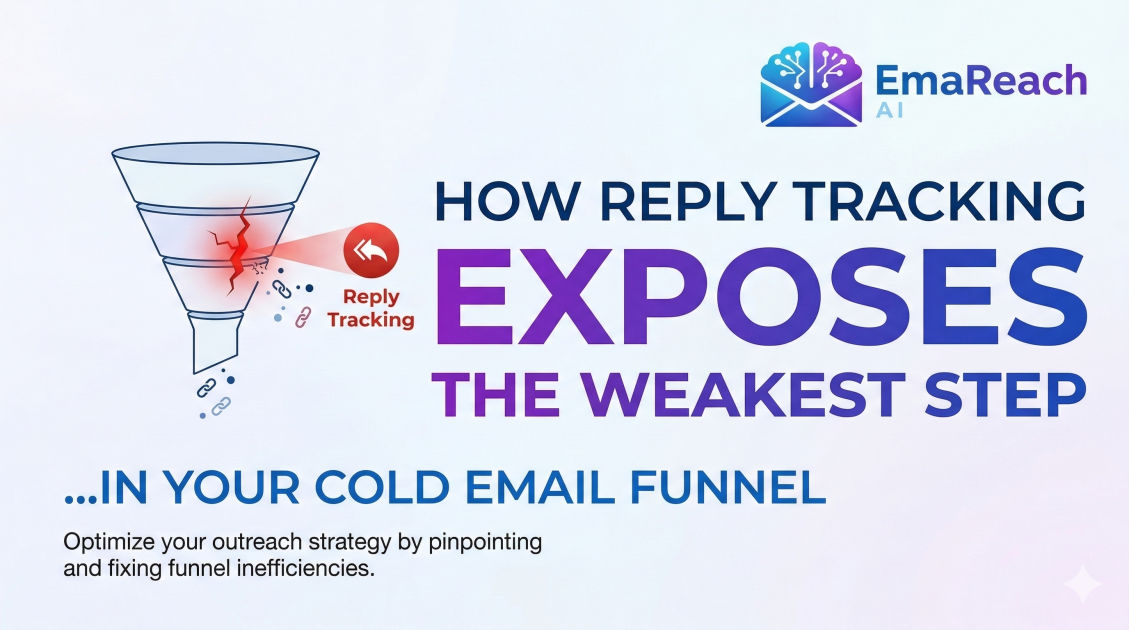
How Reply Tracking Exposes the Weakest Step in Your Cold Email Funnel
cold emailsales funneloutreach strategyemail marketinglead generationsales optimization
Introduction: The Invisible Leak in Your Outreach Strategy
In the world of outbound sales, data is the compass that guides every decision. Most marketers and sales development representatives (SDRs) obsess over open rates and click-through rates. While these metrics offer a glimpse into the initial engagement, they often mask the deeper, more systemic issues within a cold email funnel. The true diagnostic tool for any high-performing outreach campaign isn't how many people opened the email, but how, why, and when they replied.
Reply tracking is more than just a notification that someone wrote back. It is a forensic analysis of your funnel's health. By meticulously monitoring reply data, you can pinpoint exactly where your messaging loses its grip, where your targeting misses the mark, and where your value proposition falls flat. This post explores how reply tracking serves as the ultimate diagnostic tool to expose the weakest link in your cold email process.
The Anatomy of a Cold Email Funnel
Before we can identify the weak points, we must understand the standard progression of a cold email funnel. Generally, it follows this path:
- Prospecting and List Building: Identifying the right personas.
- Deliverability: Ensuring the email actually reaches the inbox.
- The Hook (Subject Line): Getting the recipient to open the email.
- The Body (Value Proposition): Holding their attention and building interest.
- The Call to Action (CTA): Prompting a response.
- The Reply: The transition from a cold lead to an active conversation.
Many funnels break down at the transition between the CTA and the Reply. When you track replies effectively, you aren't just looking for a 'Yes.' You are looking for patterns in the 'No,' the 'Not right now,' and the dreaded silence.
Why Open Rates Are a Vanity Metric
For years, open rates were the gold standard. However, in the modern landscape of email privacy and automated security filters, open rates have become increasingly unreliable. Many email clients 'pre-fetch' images or use proxy servers that trigger open tracking pixels, leading to inflated numbers that don't reflect actual human interest.
Furthermore, an open only proves that your subject line was catchy. It says nothing about the quality of your lead or the resonance of your message. You could have a 70% open rate and a 0% reply rate. In this scenario, your subject line is doing its job, but every other part of your funnel is failing. Reply tracking strips away this veneer of success and forces you to look at the bottom-line reality: engagement that leads to dialogue.
Identifying the 'Weakest Step' Through Reply Analysis
When you implement robust reply tracking, you can categorize responses to see which part of your funnel is underperforming. Here is how different types of replies (or lack thereof) point to specific weaknesses:
1. High Open Rate, Low Reply Rate: The Value Prop Gap
If people are opening your emails but not replying, the weakness lies in your body copy or offer. You've successfully invited them into the room, but once they arrived, they didn't like what they heard. This usually indicates that your value proposition is too generic, or you haven't clearly articulated how you solve a specific pain point for that specific persona.
2. High 'Not Interested' Replies: The Targeting Gap
If you are getting plenty of replies, but most of them are 'not interested' or 'not for us,' your prospecting is the weakest step. You are reaching people, and your copy is compelling enough to elicit a response, but you are talking to the wrong people. Your list might be too broad, or your ICP (Ideal Customer Profile) definitions might be outdated.
3. The 'Wrong Person' Reply: The Persona Gap
When a prospect replies saying, 'You should talk to [Name] instead,' it's a double-edged sword. While it provides a referral, it also signals that your lead qualification process is slightly off. If this happens frequently, you are targeting the wrong level of seniority or the wrong department entirely.
4. The Silence (No Reply) After Follow-ups: The Persistence Gap
Most deals are made in the follow-up. If your initial reply rate is decent but drops to zero after the second or third email, your cadence strategy is the weak link. It suggests your follow-ups are either too frequent (annoying the prospect) or offer no additional value, making them easy to ignore.
The Role of Deliverability in Reply Tracking
You cannot track a reply if your email never reaches the primary inbox. Deliverability is the foundation upon which all other metrics are built. If your emails land in the spam folder, your reply tracking will show a false negative—you'll think your copy is bad when, in reality, it was never seen.
To ensure your funnel is being tested fairly, you need a system that prioritizes the 'landing' phase. This is where EmaReach becomes essential. Stop Landing in Spam. Cold Emails That Reach the Inbox. EmaReach AI combines AI-written cold outreach with inbox warm-up and multi-account sending—so your emails land in the primary tab and get replies. By securing the deliverability step, you ensure that the reply data you collect is an accurate reflection of your messaging's effectiveness.
Categorizing Replies: Positive, Neutral, and Negative
To truly expose weaknesses, you must move beyond binary tracking (Replied vs. Not Replied). You need a sentiment analysis of your replies.
Positive Replies (The Goal)
- 'Let’s hop on a call.'
- 'Send me more info.'
- 'This is exactly what we need.'
What it tells you: Your funnel is aligned. Your targeting, copy, and timing are hitting the mark.
Neutral/Informational Replies
- 'Check back in six months.'
- 'I’m not the right person; contact Sarah.'
- 'We already use a competitor.'
What it tells you: Your outreach is professional and reaches the right companies, but your timing or competitive differentiation needs work. If you see too many 'already use a competitor' replies, your weakest step is your Unique Selling Proposition (USP).
Negative Replies
- 'Unsubscribe.'
- 'How did you get my email?'
- 'Stop emailing me.'
What it tells you: Your lead sourcing or personalization is the weak link. High negative sentiment often stems from scraped lists that haven't been cleaned or 'spray and pray' tactics that feel intrusive rather than helpful.
Turning Data into Action: Fixing the Funnel
Once reply tracking has exposed the weak link, the next step is optimization. This is a cyclical process of testing and refining.
Fixing the Targeting (The Top of the Funnel)
If your reply tracking shows a high volume of 'not interested' responses, go back to your data source. Are you filtering by the right industry? Are you using technographic data to ensure they actually use the tools that integrate with your product? Refining your list is often the fastest way to double your positive reply rate.
Fixing the Message (The Middle of the Funnel)
If the problem is a high open rate but low reply rate, experiment with 'The Wedge.' Instead of trying to sell your entire platform, try to solve one tiny, specific problem. A smaller ask (a 2-minute video instead of a 30-minute demo) often lowers the friction for a reply.
Fixing the CTA (The Bottom of the Funnel)
Sometimes the weakness is simply that the prospect doesn't know what to do next. Use 'Interest-Based' CTAs rather than 'Time-Based' CTAs. Instead of asking 'Are you free Tuesday at 2 PM?', ask 'Is this something you'd be interested in learning more about?' Interest-based CTAs often yield higher reply rates because they require less commitment from the prospect.
The Technical Side of Reply Tracking
To get these insights, you need the right infrastructure. Relying on manual tracking in a spreadsheet is a recipe for missed data and human error. Modern outreach requires automated systems that can:
- Detect OOO (Out of Office): These shouldn't count as negative replies; they are 'timing' replies that require a scheduled follow-up.
- Sentiment Analysis: Using AI to automatically categorize replies into 'Positive,' 'Negative,' or 'Neutral.'
- Threaded Conversations: Ensuring that if a prospect replies to the third email in a sequence, the system recognizes the entire history of that lead.
By automating this tracking, you can look at high-level trends across thousands of emails, making it easier to spot the statistical anomalies that point to funnel weaknesses.
Advanced Strategy: Using Reply Speed as a Metric
Another often-overlooked data point in reply tracking is Lead Response Time—not just yours, but theirs. How quickly are prospects replying to your initial cold email?
If you find that your positive replies usually come within 60 minutes of the email being sent, it suggests your timing is excellent (perhaps you are hitting their inbox at the start of their workday). If replies are trickling in days later, it might suggest your email is being buried and only found during a 'deep clean' of their inbox, meaning your sending schedule is the weak step.
Conversely, your own reply time to their inquiry is the final 'hidden' step in the funnel. If a prospect replies 'Tell me more' and you take 24 hours to respond, you have created a new weak link at the very end of the process. Speed to lead is critical in outbound sales.
Conclusion: Data-Driven Outreach is the Only Path Forward
Cold email is not a numbers game; it is a relevancy game. However, you cannot improve relevancy without accurately measuring response. Reply tracking is the diagnostic mirror that shows you the parts of your sales process you might be tempted to ignore. It forces you to confront whether your product actually resonates, whether your list is actually qualified, and whether your voice is actually heard.
By shifting your focus from vanity metrics like opens to the qualitative data found in replies, you can transform a leaking funnel into a streamlined machine. Remember that every 'No' is a data point, and every silence is a signal. Use reply tracking to find the cracks in your strategy, patch them with better data and more empathetic copy, and watch your conversion rates climb.
Your cold email funnel is only as strong as its weakest step. Don't let that step be invisible. Track every reply, analyze every sentiment, and constantly iterate until your outreach is as efficient as it is effective.
EmaReach AI
Ready to scale your cold email outreach?
Join thousands of teams using EmaReach AI for AI-powered campaigns, domain warmup, and 95%+ deliverability. Start free — no credit card required.
Related posts
- Read article
The Instantly Alternative That Finally Gets Outbound Analytics Right
Discover why high-volume cold email requires a shift from surface-level vanity metrics to deep, data-driven revenue attribution, and explore the ultimate alternatives for mastering outbound engineering.
- Read article
What You Gain and What You Give Up When Switching From Instantly
Thinking about migrating your cold email stack? This detailed guide breaks down the exact operational advantages you gain and the core features you sacrifice when switching away from Instantly's popular outreach platform.