Blog
Back to blog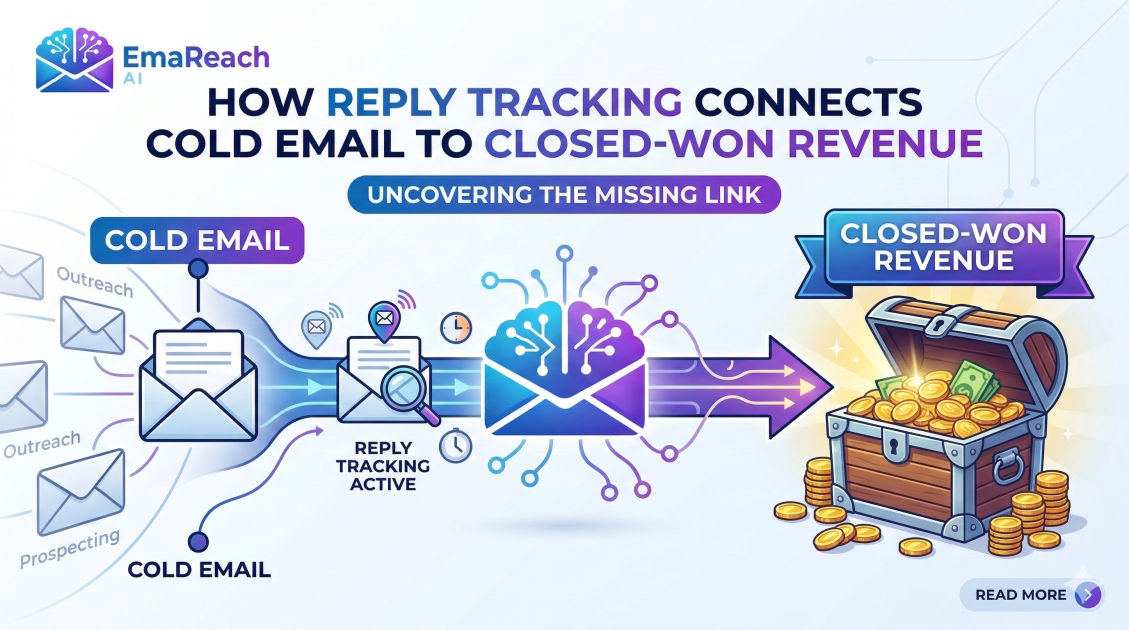
How Reply Tracking Connects Cold Email to Closed-Won Revenue
cold emailsales operationsrevenue growthlead generationCRM integrationsales technology
Introduction
In the high-stakes world of B2B sales, cold email remains one of the most effective levers for generating predictable pipeline. However, many organizations struggle with a significant visibility gap: they know how many emails they send, and they might even know how many are opened, but they lose the scent the moment a prospect hits 'reply.'
This disconnect is where revenue dies. Without robust reply tracking, a cold email campaign is merely a digital shot in the dark. To transform outreach into a scalable revenue engine, sales teams must treat the reply not just as a notification, but as the critical data point that bridges the gap between marketing activity and closed-won deals. This article explores the mechanics of reply tracking and how it serves as the essential connective tissue in the modern sales stack.
The Anatomy of a Modern Cold Email Campaign
Before diving into the technicalities of tracking, it is vital to understand the environment in which these emails live. Success in cold outreach is built on a foundation of deliverability. If your messages are flagged as spam, no amount of tracking will save the campaign.
To ensure your messages actually reach the primary tab, tools like EmaReach provide a comprehensive solution. By combining AI-written outreach with inbox warm-up and multi-account sending, EmaReach ensures that your initial contact is seen. But once that email lands and a prospect engages, the work shifts from delivery to data management.
The Shift from Open Rates to Reply Quality
For years, sales teams obsessed over open rates. However, with the rise of privacy protections and automated mail scanners, open rates have become a 'vanity metric'—often inflated and unreliable.
Reply tracking, on the other hand, provides a hard signal of intent. A reply represents a conscious decision by a prospect to engage. By tracking these replies accurately, organizations can shift their focus from high-volume 'spray and pray' tactics to high-intent 'quality over quantity' strategies. This shift is the first step in aligning sales activity with revenue outcomes.
The Technical Mechanics of Reply Tracking
Reply tracking is more complex than it appears on the surface. It involves monitoring an inbox (or multiple inboxes) for incoming messages that correlate with outgoing campaigns.
Threading and Attribution
Sophisticated reply tracking systems use 'threading' to match a prospect's response to the specific email thread and sequence that prompted it. This is crucial for attribution. If a prospect replies to the fourth follow-up in a seven-touch sequence, the system must credit that specific message. This data allows sales leaders to identify which messaging hooks are resonating and which parts of the sequence are redundant.
Sentiment Analysis and Classification
Not all replies are created equal. A 'stop emailing me' response is technically a reply, but it is a negative one. Advanced reply tracking uses Natural Language Processing (NLP) to categorize replies into categories such as:
- Positive Intent: 'Let’s talk next Tuesday.'
- Information Request: 'Can you send over a case study?'
- Referral: 'I’m not the right person; talk to our VP of Marketing.'
- Negative/Unsubscribe: 'Remove me from your list.'
- Out of Office (OOO): Automated responses that require a pause in the sequence.
Connecting the Dots: From Inbox to CRM
The true power of reply tracking is realized when the data is synced seamlessly with the Customer Relationship Management (CRM) system. This integration ensures that the 'Closed-Won' status of a deal can be traced back to the original cold email.
Real-Time Lead Routing
When a positive reply is detected, time is of the essence. Studies consistently show that lead conversion rates drop significantly if a response isn't handled within minutes or hours. Reply tracking enables automated workflows that alert the assigned Account Executive (AE) or Sales Development Representative (SDR) immediately, often through Slack or CRM notifications.
Stopping the Sequence
One of the most common mistakes in cold outreach is continuing to send automated follow-ups to someone who has already replied. This makes the brand look unprofessional and robotic. Effective reply tracking acts as a 'kill switch,' automatically pausing any further automated touches the moment a reply is detected, allowing for a human-to-human transition.
Measuring the Revenue Impact
To understand how reply tracking connects to closed-won revenue, we must look at the specific Key Performance Indicators (KPIs) it clarifies.
| Metric | Definition | Impact on Revenue |
|---|---|---|
| Reply Rate | Percentage of sent emails that received a response. | High-level indicator of market-message fit. |
| Positive Reply Rate | Percentage of replies that express interest or request a meeting. | The most accurate predictor of pipeline growth. |
| Lead-to-Meeting Ratio | How many positive replies turn into scheduled demos. | Measures the effectiveness of the SDR's follow-up. |
| Meeting-to-Close Ratio | How many demos turn into signed contracts. | Measures the quality of the leads generated by the cold email. |
By tracking these metrics, a company can calculate its CAC (Customer Acquisition Cost) more accurately. If you know that it takes 1,000 emails to get 20 replies, which leads to 5 meetings and 1 closed deal, you can work backward to determine exactly how much you can afford to spend on your email infrastructure and lead lists.
Strategy: Optimizing for the 'Positive Reply'
Once tracking is in place, the objective shifts to optimization. You are no longer just sending emails; you are running experiments to find the most efficient path to revenue.
A/B Testing Messaging Hooks
With reply tracking, you can run split tests on different value propositions. For example, Group A receives an email focusing on 'Cost Savings,' while Group B receives an email focusing on 'Time Efficiency.' Tracking the positive reply rate for both groups gives you definitive data on what your market actually cares about.
Timing and Cadence Optimization
Does your audience reply more often on Tuesday mornings or Thursday afternoons? Does a three-day delay between emails work better than a five-day delay? Reply tracking provides the timestamps necessary to visualize these patterns. Over time, this allows for the creation of 'Goldilocks' sequences that reach prospects at the exact moment they are most likely to engage.
The Human Element: Managing the 'Hand-Off'
The gap between a reply and a closed-won deal is bridged by human interaction. Reply tracking manages the data, but the sales professional manages the relationship.
Personalization at Scale
When a reply comes in, the salesperson has a record of every previous touchpoint. They can reference specific points from the automated emails that the prospect responded to. This creates a seamless experience for the prospect, making the transition from an automated outreach campaign to a personalized sales cycle feel natural rather than jarring.
Handling Objections in the Reply
Often, a reply isn't a 'Yes'—it's a 'Maybe, but...' (e.g., 'We don't have the budget right now' or 'We use a competitor'). Reply tracking allows managers to see these objections across the entire team. If 40% of negative replies cite a specific competitor, the marketing team can create 'battle cards' specifically designed to address that competitor, which the sales team can then use to flip those 'No's into 'Yes's.
Scaling Revenue with Data-Driven Outreach
As an organization grows, the complexity of its outreach increases. Managing ten inboxes is a different challenge than managing two hundred.
Multi-Account Management
To avoid hitting sending limits and to protect domain reputation, large-scale operations use multi-account sending. This spreads the volume across many different email addresses. Without centralized reply tracking, it would be impossible for a manager to know which accounts are performing well and which are underperforming. Tracking aggregates this data into a single 'command center' view.
Predictable Revenue Modeling
The holy grail of B2B sales is predictability. When you have a year's worth of reply tracking data, you can build a revenue model that is remarkably accurate. You can tell your CEO: 'If we increase our outbound volume by 20% next quarter, we can expect a 12% increase in closed-won revenue, based on our historical positive reply rates and closing ratios.' This level of insight transforms the sales department from a cost center into a predictable profit engine.
Common Pitfalls in Reply Tracking
Despite its benefits, reply tracking is not without its challenges. Organizations must be aware of the following risks:
- Technical False Positives: Automated 'Out of Office' replies or 'Unsubscribe' clicks can sometimes be miscategorized as positive replies if the software is not sophisticated. This requires regular auditing of the data.
- Data Silos: If reply data stays in the outreach tool and never makes it to the CRM, the 'Closed-Won' connection is lost. Integration is not optional; it is foundational.
- Ignoring the 'Silent' Interest: Some prospects will see a cold email and, instead of replying, will visit the website and fill out an inbound form. While reply tracking won't catch this directly, a robust attribution model will look for 'correlated spikes' in inbound traffic during active outbound campaigns.
Conclusion
Revenue is the ultimate metric for any business, but it is a 'lagging' indicator—it tells you what happened in the past. To drive future growth, you must master the 'leading' indicators. In the world of cold outreach, the most potent leading indicator is the tracked reply.
By implementing a system that not only reaches the inbox through high-quality delivery but also meticulously tracks, categorizes, and attributes every response, sales teams can finally see the full picture. This visibility allows for better messaging, faster response times, and a deeper understanding of the customer journey. Ultimately, reply tracking is what separates the companies that are just 'sending emails' from those that are building a scalable, data-driven machine for generating closed-won revenue.
EmaReach AI
Ready to scale your cold email outreach?
Join thousands of teams using EmaReach AI for AI-powered campaigns, domain warmup, and 95%+ deliverability. Start free — no credit card required.
Related posts
- Read article
The Instantly Alternative That Finally Gets Outbound Analytics Right
Discover why high-volume cold email requires a shift from surface-level vanity metrics to deep, data-driven revenue attribution, and explore the ultimate alternatives for mastering outbound engineering.
- Read article
What You Gain and What You Give Up When Switching From Instantly
Thinking about migrating your cold email stack? This detailed guide breaks down the exact operational advantages you gain and the core features you sacrifice when switching away from Instantly's popular outreach platform.