Blog
Back to blog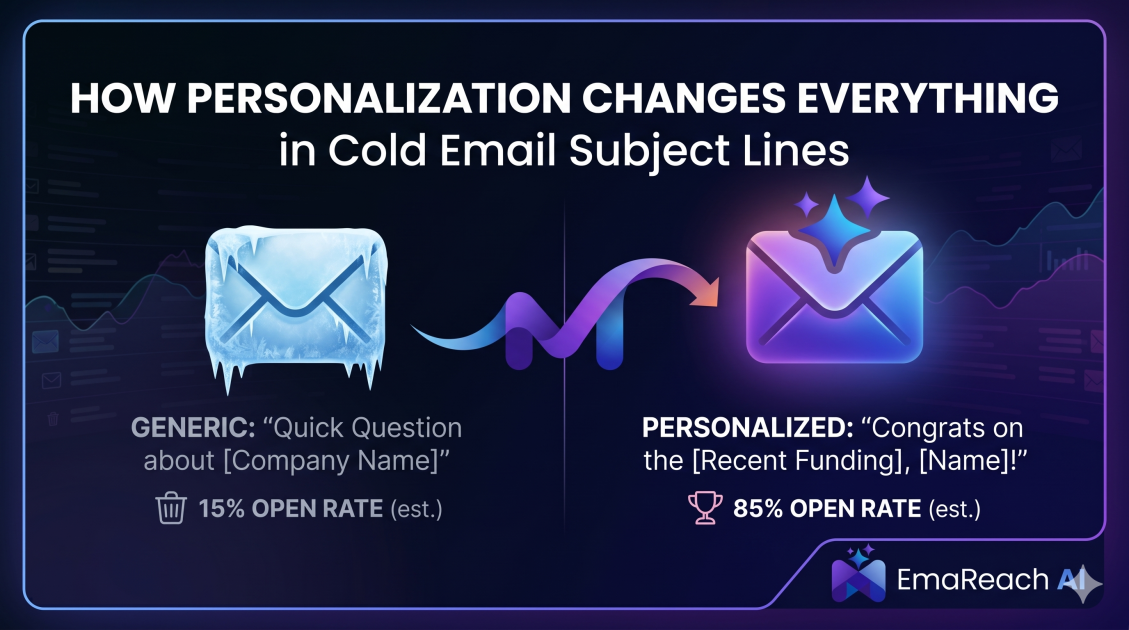
How Personalization Changes Everything in Cold Email Subject Lines
cold emailemail marketingsales outreachsubject lineslead generationemail deliverability
Introduction: The Battle for the Inbox
In the modern digital landscape, the average professional receives dozens, if not hundreds, of emails every single day. The majority of these are cold outreach—unsolicited messages from individuals or companies looking to sell a product, form a partnership, or pitch a service. For the recipient, the inbox is a battlefield of priorities. For the sender, the challenge is even steeper: how do you convince a total stranger to stop what they are doing and click on your message?
The answer lies in the first thing they see: the subject line. But not just any subject line. The era of generic, 'one-size-fits-all' headers is dead. Today, personalization is the fundamental shift that determines whether your email is opened with curiosity or deleted with prejudice. When you personalize a subject line, you aren't just adding a name; you are signaling relevance, establishing trust, and proving that you have done your homework.
The Psychology of Personalization
Why does personalization work so effectively? It taps into basic human psychology. The 'Cocktail Party Effect' suggests that people are hardwired to focus on information that is personally relevant to them—like hearing their own name in a crowded room. When a prospect scrolls through a sea of 'Checking in' or 'Quick question' subject lines, a personalized hook acts as a pattern interrupt.
Personalization moves the recipient from a state of 'defensive filtering' to 'active engagement.' It shifts the perception of the email from a mass-marketing broadcast to a 1-to-1 conversation. This psychological bridge is essential for building the rapport necessary to eventually close a deal. Without it, you are simply another notification competing for a finite amount of cognitive energy.
Moving Beyond the {{First_Name}} Variable
For years, marketers thought they were 'personalizing' by simply using a merge tag to insert a recipient's first name. While this was once effective, it has now become a hallmark of automated spam. Modern prospects are savvy; they know that a computer can easily pull a name from a CSV file.
To truly change the game, personalization must go deeper. It needs to reflect a genuine understanding of the recipient’s world. This includes:
- Company Milestones: Referencing a recent series of funding, a product launch, or an award.
- Specific Content Reference: Mentioning a specific blog post, podcast appearance, or LinkedIn comment the prospect made.
- Shared Commonalities: Noting a shared alma mater, a mutual connection, or a common interest found through social research.
- Pain Point Identification: Highlighting a specific challenge their industry or company is currently facing.
By moving beyond basic variables, you demonstrate a level of effort that earns you the right to the prospect's time.
How Personalization Impacts Deliverability
One of the most overlooked benefits of personalized subject lines is their impact on technical deliverability. Email service providers (ESPs) like Google and Microsoft use sophisticated algorithms to detect spam. One of the red flags for these algorithms is 'bulk-sending' behavior—sending thousands of identical subject lines to different recipients.
When every subject line you send is unique because it contains personalized elements, it makes your sending behavior look more human and less like a bot. This reduces the likelihood of being caught in spam filters. However, even with great personalization, you need a robust infrastructure to ensure you stay out of the 'Promotions' tab.
Stop Landing in Spam. Cold Emails That Reach the Inbox. EmaReach AI combines AI-written cold outreach with inbox warm-up and multi-account sending—so your emails land in the primary tab and get replies.
By leveraging tools like EmaReach, you can amplify the effectiveness of your personalized subject lines by ensuring they actually reach the person they were intended for.
The Anatomy of a High-Converting Personalized Subject Line
Creating a personalized subject line is an art form that requires a balance of brevity, relevance, and intrigue. Here are the components that make it work:
1. The Hook
The hook is the specific piece of personalized data. It should appear as early as possible in the subject line to ensure it isn't cut off on mobile devices.
2. The Context
The context connects the personalized hook to the reason you are reaching out. If you mention a recent article they wrote, the context should hint at how your expertise relates to that topic.
3. The 'Low-Pressure' Tone
Personalization works best when it doesn't feel like a hard sell. Using a casual, peer-to-peer tone is more effective than using marketing jargon. Avoid all-caps, excessive exclamation points, or 'salesy' words like 'Guarantee' or 'Free.'
Real-World Examples: Good vs. Great
To understand the power of personalization, let's look at the evolution of a subject line.
- The Bad (Generic): "Services for your company"
- The Better (Basic Personalization): "Question for [Name] about [Company]"
- The Great (Deep Personalization): "Loved your insights on the [Specific Industry] podcast, [Name]"
In the 'Great' example, the sender has identified a specific event (the podcast) and used the recipient's name. This creates an immediate sense of connection and makes it nearly impossible for the recipient to ignore the email without feeling like they are ignoring a genuine compliment.
The Role of Research in Personalization
Effective personalization is only as good as the research behind it. This is where most sales teams fail; they try to scale without doing the legwork. To find the 'nuggets' that make for a great subject line, you should look at:
LinkedIn Activity
Don't just look at their job title. Look at what they are posting and commenting on. If they recently congratulated a peer on a promotion, or shared an article about remote work, those are perfect hooks for a subject line.
Company Newsrooms
Most companies have a 'Press' or 'News' section on their website. This is a goldmine for finding recent achievements or strategic shifts that you can reference to show you understand their current trajectory.
Podcast and Webinar Appearances
Decision-makers often use podcasts to speak their truth. Listening to just five minutes of a guest appearance can give you enough ammunition for a subject line that is 100% unique and highly flattering.
Personalization at Scale: Is it Possible?
One of the biggest arguments against deep personalization is that it doesn't scale. If you spend 15 minutes researching every prospect, you can only send a handful of emails a day. However, the 'spray and pray' method is becoming less effective by the hour.
The solution is a hybrid approach. You can categorize your prospects into tiers. For Tier 1 (high-value) prospects, you should perform manual, deep research. For Tier 2 and 3, you can use structured data—such as industry-specific news or regional updates—to provide a level of personalization that is higher than 'first name' but lower than 'manual research.'
This is where advanced technology becomes an ally. Using AI to help synthesize research and draft subject lines can significantly reduce the time spent while maintaining the quality of the outreach.
Common Pitfalls to Avoid
Even with the best intentions, personalization can go wrong. Here are a few things to watch out for:
1. The 'Creepy' Factor
There is a fine line between 'well-researched' and 'stalker.' Avoid referencing overly personal information like family members, home addresses, or private social media accounts. Stick to professional achievements and public-facing business personas.
2. Outdated Information
Nothing kills a cold email faster than referencing a job the person left three years ago or a project that has since been canceled. Always verify that your data is current.
3. Misalignment
If your personalized subject line has nothing to do with the body of the email, it feels like a 'bait and switch.' The subject line is a promise; the body of the email must fulfill that promise.
The Impact on Open Rates and Beyond
Statistics consistently show that personalized subject lines can increase open rates by 25% to 50%. But the impact goes beyond just the 'Open.' Because a personalized subject line sets a positive tone, the Reply Rate and Conversion Rate also see a significant lift.
When a prospect sees that you have invested time into them, they are more likely to reciprocate that investment by reading your pitch and responding. It transforms the cold email from an intrusion into an opportunity for a professional connection.
Subject Lines and the Mobile Experience
Over 50% of emails are opened on mobile devices. This means your personalized subject line has very little real estate—usually only about 30 to 40 characters before it gets truncated.
When personalizing, you must front-load the most important information.
- Instead of: "I was just reading your article on LinkedIn and wanted to say..."
- Try: "Loved your LinkedIn post on [Topic], [Name]"
By putting the personalization at the start, you ensure the recipient sees the 'proof of work' even if they only glance at their lock screen notifications.
Testing Your Personalized Subject Lines
No strategy is complete without testing. Even within the realm of personalization, different styles will work better for different industries. You should A/B test different types of personalized hooks to see what resonates most with your specific audience.
- Test A: Personalization based on a recent LinkedIn post.
- Test B: Personalization based on a company-wide achievement.
By tracking which of these yields a higher open and response rate, you can refine your research process and focus on the data points that actually move the needle.
Conclusion: The New Standard for Outreach
Personalization is no longer an optional 'extra' in the world of cold email; it is the standard. In an age of automation and AI-generated noise, the human touch is the most valuable currency a salesperson or marketer has. By taking the time to craft subject lines that reflect genuine research and relevance, you aren't just increasing your open rates—you are building the foundation for long-term business relationships.
Remember that every email you send represents your brand. A generic, lazy subject line tells the prospect that you value your time more than theirs. A deeply personalized subject line tells them that you are a professional who does their homework and brings real value to the table. The effort you put into the subject line is the best predictor of the success you will find in the inbox. Keep your research sharp, your tone authentic, and your delivery consistent, and you will see that personalization truly does change everything.
EmaReach AI
Ready to scale your cold email outreach?
Join thousands of teams using EmaReach AI for AI-powered campaigns, domain warmup, and 95%+ deliverability. Start free — no credit card required.
Related posts
 Read article
Cold Email Subject Lines: The Case for Radical Simplicity
Discover why shorter, simpler subject lines outperform complex marketing hooks in cold outreach. Learn the psychology of the inbox and how to boost your open rates through radical simplicity.
Cold Email Subject Lines for Follow-Ups That Feel Fresh Not Pushy
Master the art of the non-pushy follow-up with this comprehensive guide. Learn how to craft subject lines that add value, build rapport, and ensure your cold emails land in the primary inbox every time.