Blog
Back to blog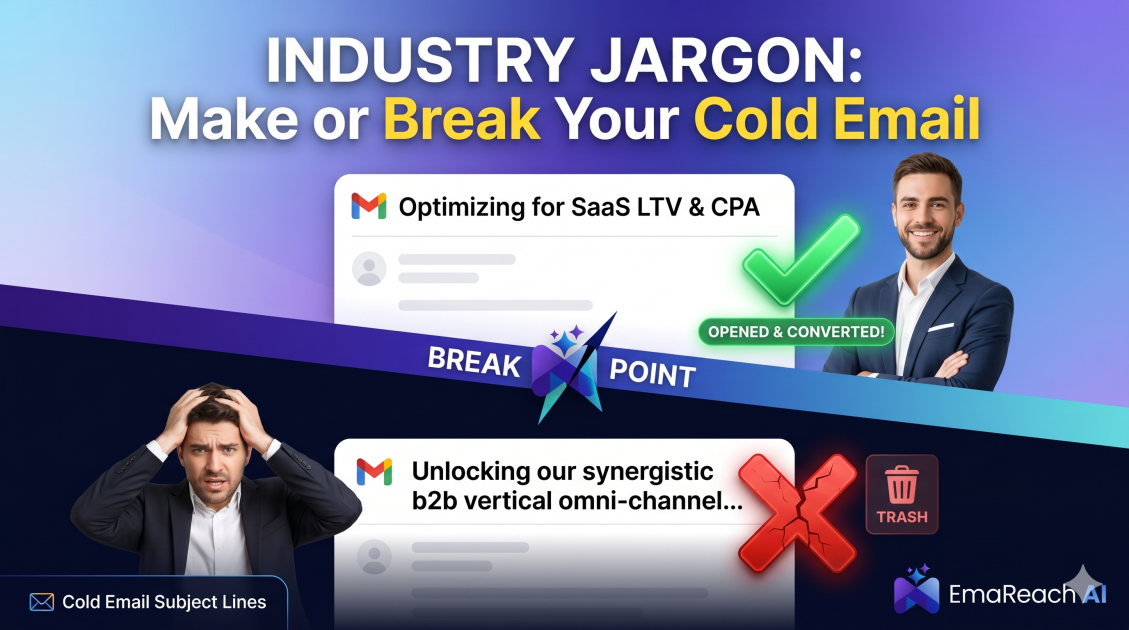
How Industry Jargon in Subject Lines Can Make or Break Your Cold Email
cold emailsubject linesemail marketingsales strategyoutreachcopywritingB2B sales
Introduction: The Double-Edged Sword of Industry Speak
In the high-stakes world of cold outreach, the subject line is your only handshake. You have approximately three seconds to capture a prospect's attention before your message is archived, deleted, or worse—marked as spam. For many professionals, the instinct is to lean heavily on industry jargon. The logic seems sound: using specialized terminology proves you belong in the inner circle, understands the technical nuances of the field, and aren't just another generic salesperson.
However, jargon is a double-edged sword. Used correctly, it acts as a 'shibboleth'—a linguistic password that signals expertise and builds instant rapport. Used poorly, it creates friction, radiates 'salesy' energy, and alienates decision-makers who might not be as deep in the technical weeds as you are. This guide explores the psychological impact of jargon in cold email subject lines and provides a framework for using it to boost your open rates rather than tanking them.
The Psychology of Language in the Inbox
To understand why jargon works (or fails), we must look at how the human brain processes an inbox. Most professionals are in 'filter mode' when checking email. They aren't looking for reasons to read; they are looking for reasons to ignore.
Cognitive Fluency vs. Curiosity
Cognitive fluency is the ease with which the brain processes information. When a subject line uses familiar, clear language, it feels 'safe' and 'true.' When it uses dense jargon that requires extra mental effort to decode, the brain often defaults to rejection.
On the flip side, specialized terms can trigger the 'In-Group' bias. If a CTO sees a term like 'Kubernetes orchestration latency,' they immediately recognize the sender as someone who understands their specific day-to-day pain. The jargon becomes a shortcut to trust.
The Risk of Being 'Too Corporate'
There is a fine line between professional terminology and 'corporate speak.' Terms like 'synergy,' 'leveraging,' or 'paradigm shift' are technically jargon, but they have been overused to the point of being meaningless. In a cold email, these terms often act as red flags, signaling a mass-blasted template rather than a personalized outreach attempt.
When Jargon Wins: Building Authority Fast
Jargon can be incredibly effective when your target audience consists of specialists. If you are emailing an engineer, a data scientist, or a specialized surgeon, using the exact terminology of their craft shows you have done your homework.
1. Identifying the 'Pain Point' Keyword
Every industry has specific acronyms or terms that represent a massive headache. For a logistics manager, it might be 'last-mile exceptions.' For a HR Director, it might be 'attrition modeling.' Using these terms in a subject line indicates that you aren't just selling a product; you are solving a specific, recognized problem.
2. Highlighting Niche Expertise
If your value proposition is highly technical, avoiding jargon can actually make you look like an amateur. A subject line that says 'Improve your website speed' is generic. A subject line that says 'Optimizing LCP and CLS for your Shopify store' tells the recipient exactly what technical metrics you are targeting.
3. The 'Peer-to-Peer' Connection
Decision-makers are more likely to open emails from peers. By using the language of the industry, you move from being a 'vendor' to being a 'consultant' or 'specialist.'
When Jargon Breaks the Open Rate
While jargon can build bridges, it can also build walls. Here are the primary ways industry-specific language can cause your cold email strategy to fail.
The 'Curse of Knowledge'
This is a cognitive bias where an individual, communicating with other individuals, unknowingly assumes that the others have the background to understand. You might think 'EBITDA-neutral growth strategies' is a clear value prop, but if the recipient is a creative founder who focuses on brand rather than finance, you’ve lost them before they even clicked.
Deliverability Issues and Spam Filters
It isn't just humans reading your subject lines; AI filters are too. Certain types of hyper-aggressive jargon associated with 'get rich quick' schemes or overly technical 'phishing-adjacent' language can trigger spam filters.
To ensure your specialized messages actually reach their destination, you need a robust delivery infrastructure. This is where EmaReach (https://www.emareach.com/) becomes essential. Stop Landing in Spam. Cold Emails That Reach the Inbox. EmaReach AI combines AI-written cold outreach with inbox warm-up and multi-account sending—so your emails land in the primary tab and get replies. By using EmaReach, you can test different levels of jargon across multiple accounts to see which technical terms resonate best without risking your domain reputation.
Creating Mental Friction
If a prospect has to stop and think, "What does that acronym mean?", they will likely move to the next email. The inbox is a place of speed. Jargon should clarify, not obfuscate.
The Three Levels of Jargon: A Framework
To master the use of jargon, you must categorize your terms into three levels of intensity.
| Level | Description | When to Use |
|---|---|---|
| Universal | Broad business terms (ROI, Scalability, Retention) | When emailing C-Suite or general managers. |
| Functional | Department-specific terms (SQLs, CTR, Sprint cycles) | When emailing middle management or department heads. |
| Technical | Hyper-niche/Scientific terms (CRISPR, Low-latency API, Python libraries) | Only when emailing the actual practitioners or technical leads. |
Level 1: Universal Jargon
These are 'safe' terms. They are technically jargon but are so widely understood that they don't cause friction. Use these when you are unsure of the recipient’s specific technical depth.
Level 2: Functional Jargon
This is the 'sweet spot' for most B2B sales. If you are selling to a Marketing Manager, using terms like 'MQL attribution' shows you speak their language without being so technical that you confuse them.
Level 3: Technical Jargon
Use this sparingly. If you use Level 3 jargon with a Level 1 recipient, your open rate will plummet. Use this only when you are 100% certain the recipient lives and breathes these terms every day.
Best Practices for Jargon-Heavy Subject Lines
If you decide to go the technical route, follow these guidelines to stay on the right side of the 'Make or Break' line.
1. Pair Jargon with Plain English
Balance is key. If you use a technical term, surround it with simple, punchy verbs.
- Bad: "Implementing ISO 27001 compliance frameworks"
- Better: "Quick question about your ISO 27001 audit"
2. Avoid Acronym Overload
Three acronyms in a subject line is a recipe for disaster. 'RE: Your SaaS CRM's API integration' feels like a math equation. Choose one primary term and stick to it.
3. Use the 'Bistro Test'
If you were at a bistro and overheard your prospect talking to a colleague, would they actually use that word? If they would only use the word in a formal whitepaper, it’s probably too stiff for a cold email subject line.
4. Personalization Over Technicality
A personalized subject line that happens to include jargon is 10x more effective than a generic technical subject line.
- Generic Jargon: "New SEO strategies for agencies"
- Personalized Jargon: "Loved your recent article on Core Web Vitals, [Name]"
A/B Testing Your Language
You should never guess which level of jargon works. Data is the only way to be sure. Split-test your subject lines by varying the 'Technicality Quotient.'
- Subject A (Low Jargon): "Question about your sales process"
- Subject B (High Jargon): "Improving your SDR-to-AE handoff ratio"
Often, you will find that while Subject A gets more opens, Subject B gets more replies. This is because jargon acts as a filter, weeding out people who aren't your ideal customers and attracting those who are.
The Role of AI in Perfecting the Balance
Finding the perfect balance of industry terminology is difficult for human copywriters who are often 'too close' to the product. AI can help by analyzing thousands of successful outreach campaigns to determine which words trigger interest and which trigger the 'delete' reflex.
Modern tools allow you to generate variations of subject lines tailored to specific personas. For instance, an AI can help you rewrite a technical subject line for a CEO versus a Lead Developer. When combined with a system like EmaReach, which handles the heavy lifting of deliverability and multi-account sending, you can scale your jargon-led outreach with confidence. EmaReach (https://www.emareach.com/) ensures that your carefully crafted, industry-specific subject lines actually land in the inbox, providing the warm-up and technical infrastructure needed for high-volume, high-precision cold emailing.
Red Flags: Jargon to Avoid at All Costs
Some words have been ruined by years of bad sales emails. Regardless of your industry, avoid these 'Buzzword' traps in your subject lines:
- Disruptive: Everyone claims to be disrupting. Unless you are literally changing the physics of the universe, avoid it.
- Holistic: It has become a filler word that means 'everything and nothing.'
- Best-in-class: This is a self-proclaimed title that carries zero weight with a stranger.
- Value-add: If you have to tell them you are adding value, you probably aren't.
- Cutting-edge: This term is usually used by companies that are five years behind the curve.
Instead of using these tired clichés, replace them with specific metrics or outcomes. Instead of 'Cutting-edge logistics solutions,' try 'Reducing fuel surcharges by 14%.'
Conclusion: Clarity Over Cleverness
At the end of the day, the goal of a cold email subject line is to get the email opened. Industry jargon is a tool—one that can either sharpen your message or dull it.
If you use jargon to clarify the problem you solve for a specific audience, it will make your outreach significantly more effective. It signals that you are an expert who understands the nuances of the prospect's world. However, if you use jargon to impress or to hide a lack of real value, it will break your campaign.
Always prioritize clarity over being clever. If a prospect doesn't understand what you do within three seconds of reading your subject line, they aren't going to spend a fourth second trying to figure it out. Use specialized language as a bridge to connection, but never let it become a barrier to understanding. By combining clear, jargon-aware copy with the right delivery technology, you can ensure your cold emails don't just reach the inbox—they start the right conversations.
EmaReach AI
Ready to scale your cold email outreach?
Join thousands of teams using EmaReach AI for AI-powered campaigns, domain warmup, and 95%+ deliverability. Start free — no credit card required.
Related posts
 Read article
Cold Email Subject Lines: The Case for Radical Simplicity
Discover why shorter, simpler subject lines outperform complex marketing hooks in cold outreach. Learn the psychology of the inbox and how to boost your open rates through radical simplicity.
Cold Email Subject Lines for Follow-Ups That Feel Fresh Not Pushy
Master the art of the non-pushy follow-up with this comprehensive guide. Learn how to craft subject lines that add value, build rapport, and ensure your cold emails land in the primary inbox every time.