Blog
Back to blog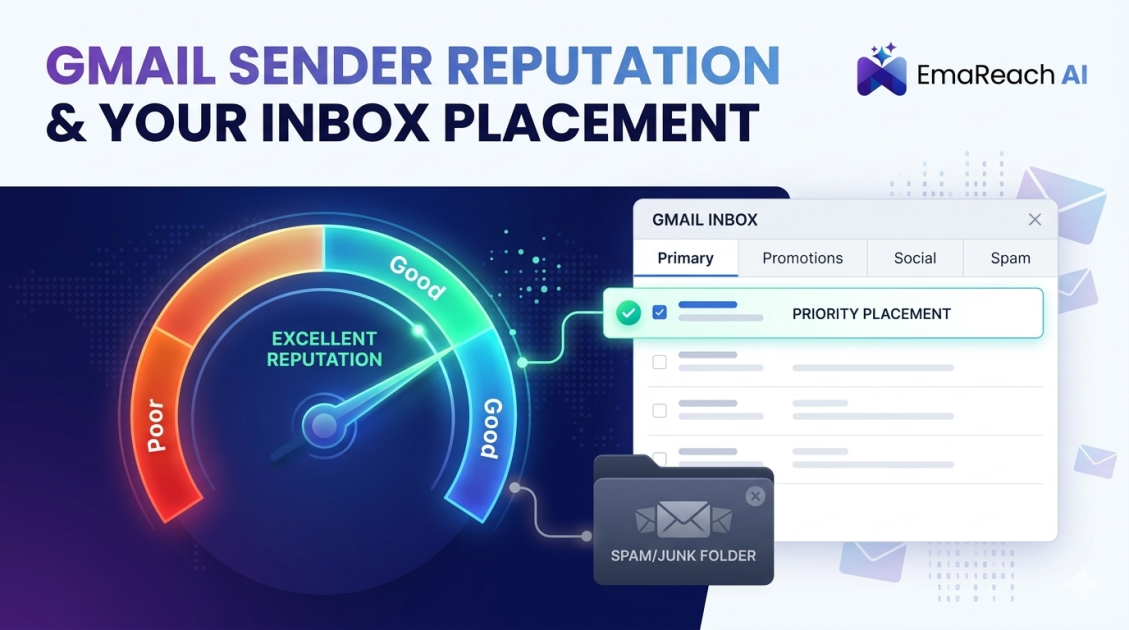
How Gmail Sender Reputation Impacts Your Inbox Placement
email deliverabilitygmail marketingsender reputationcold outreachinbox placementemail authentication
Introduction to Gmail Sender Reputation
For any digital marketer, sales professional, or business owner, the primary goal of an email campaign is to land in the recipient's primary inbox. However, achieving this is not a matter of luck; it is a direct result of a complex evaluation process conducted by mailbox providers. At the heart of this process lies the concept of sender reputation.
Gmail, as one of the world's largest email service providers, employs sophisticated algorithms to determine whether an incoming message is desired by the user or should be relegated to the spam folder. Understanding how Gmail perceives your sending identity is the first step toward mastering deliverability. Sender reputation is essentially a credit score for your email activity. It tells Gmail how much they can trust you. If your reputation is high, your emails sail through to the inbox. If it is low, even the most well-crafted messages will never see the light of day.
The Core Pillars of Sender Reputation
Gmail does not look at a single factor to determine your reputation. Instead, it aggregates data from multiple sources to create a holistic view of your sending behavior. This evaluation generally falls into two categories: IP reputation and domain reputation.
Domain Reputation
Domain reputation is arguably the most critical factor in modern email deliverability. It is attached to your specific web address (e.g., yourcompany.com). The benefit of domain reputation is its portability. Even if you change your email service provider or move to a new IP address, your domain reputation follows you. Gmail tracks how users interact with emails coming from your domain over a long period. High engagement leads to a stellar domain reputation, while high complaint rates can tarnish it quickly.
IP Reputation
IP reputation refers to the standing of the specific server IP address used to send your emails. If you are using a shared IP (common in many entry-level email marketing tools), your reputation is influenced by every other sender using 그 IP. If you are using a dedicated IP, you have total control, but also total responsibility. Gmail monitors the volume of mail, the frequency of sending, and the presence of any 'spammy' characteristics coming from that specific numerical address.
How Gmail Calculates Your Score
Gmail’s filtering system uses machine learning to analyze hundreds of signals in real-time. While the exact formula is a closely guarded secret, several key metrics are known to carry significant weight.
User Engagement: The Ultimate Metric
Gmail prioritizes the user experience above all else. Consequently, user engagement is the most powerful signal. Positive engagement includes:
- Open Rates: While not perfectly accurate due to privacy changes, consistent opens indicate relevance.
- Replies: When a recipient replies to your email, it signals a strong, two-way relationship. This is a massive boost to your reputation.
- Move to Inbox: If a user finds your email in spam and manually moves it to the primary tab, Gmail takes note of this 'correction.'
- Adding to Contacts: This is the ultimate seal of approval. It tells Gmail that the user explicitly wants to hear from you.
On the flip side, negative engagement can be devastating:
- Delete Without Opening: Frequent deletions suggest your content is unwanted noise.
- Report as Spam: This is the most damaging action a user can take. High complaint rates are the fastest way to destroy your sender reputation.
Bounce Rates and List Hygiene
Sending emails to addresses that no longer exist results in a 'hard bounce.' A high bounce rate suggests to Gmail that you are using an outdated or purchased list, rather than a permission-based one. Maintaining a clean list by regularly removing inactive or invalid addresses is essential for protecting your score.
Spam Trap Hits
Spam traps are email addresses used by providers and blacklists to catch irresponsible senders. These addresses don't belong to real people and are hidden across the web. If you hit a spam trap, it proves to Gmail that your data collection methods are flawed, often leading to immediate blacklisting.
The Role of Authentication Protocols
To have a good reputation, you must first prove you are who you say you are. Gmail requires senders to implement specific authentication protocols to prevent spoofing and phishing.
- SPF (Sender Policy Framework): A DNS record that specifies which mail servers are authorized to send email on behalf of your domain.
- DKIM (DomainKeys Identified Mail): Adds a digital signature to your emails, ensuring the content hasn't been tampered with in transit.
- DMARC (Domain-based Message Authentication, Reporting, and Conformance): A policy that tells Gmail what to do if an email fails SPF or DKIM checks. Having a 'reject' or 'quarantine' policy enhances your trustworthiness.
Content Analysis and Filtering
While reputation is about 'who' is sending, Gmail still looks at 'what' is being sent. The content of your email can trigger filters even if your reputation is decent. Common triggers include:
- Misleading Subject Lines: Using 'Re:' or 'Urgent' when it isn't appropriate.
- Excessive Use of Caps and Symbols: 'FREE!!!' or '$$$' often flags messages as suspicious.
- Poor Text-to-Image Ratio: Relying solely on images can look like an attempt to hide text from filters.
- Broken Links or Unsafe Domains: Linking to blacklisted websites will immediately tank your placement.
Practical Steps to Improve Your Gmail Sender Reputation
Improving a damaged reputation takes time and consistency. It is a marathon, not a sprint. Follow these steps to build a foundation of trust with Gmail:
1. Implement a Human-First Outreach Strategy
Automation is a powerful tool, but over-automation is the enemy of deliverability. Gmail’s algorithms are increasingly adept at spotting patterns of bot-like behavior. To stay in the primary tab, your outreach should feel personal and relevant. This means moving away from generic templates and focusing on high-quality, targeted communication.
To bridge the gap between scale and quality, savvy senders use specialized platforms. EmaReach is a prime example of a solution designed for this era. Stop Landing in Spam. Cold Emails That Reach the Inbox. EmaReach AI combines AI-written cold outreach with inbox warm-up and multi-account sending—so your emails land in the primary tab and get replies. By utilizing such tools, you can maintain the human touch while managing the technical complexities of reputation.
2. Gradual Volume Ramping (Warm-up)
If you start sending thousands of emails from a new domain or IP address overnight, Gmail will flag it as suspicious 'burst' behavior. You must gradually increase your volume over several weeks. This 'warm-up' period allows Gmail to observe positive engagement at a small scale before trusting you with larger loads.
3. Monitor Your Reputation with Google Postmaster Tools
Google provides a free tool specifically for senders to monitor their performance. Google Postmaster Tools offers insights into your domain and IP reputation, encryption success, and delivery errors. Regularly checking these dashboards allows you to spot dips in reputation before they become catastrophic.
4. Optimize Your Unsubscribe Process
It might seem counterintuitive, but making it easy for people to unsubscribe protects your reputation. If a user cannot find the unsubscribe link, they will likely hit the 'Report Spam' button instead. A clear, one-click unsubscribe process is a requirement for high-volume senders and a best practice for everyone else.
The Impact of Sending Frequency and Consistency
Consistency is a key component of a reliable sender profile. Gmail likes predictability. If you send 500 emails every Tuesday, Gmail expects that pattern. If you suddenly send 50,000 emails on a Friday, it triggers an alarm. Irregular sending patterns are a hallmark of compromised accounts or low-quality spammers. Maintain a steady cadence to keep your reputation stable.
Advanced Deliverability: Beyond the Basics
Once you have the basics of authentication and list hygiene down, you must look at the technical nuances that separate top-tier senders from the rest.
Multi-Account Sending
One of the most effective ways to protect your primary business domain is to spread your sending volume across multiple secondary domains and accounts. This strategy ensures that if one account faces a reputation hit, your entire business communication isn't paralyzed. However, managing this manually is nearly impossible. Modern platforms automate this process, rotating through accounts to keep individual volume low and reputation high.
Subdomain Usage
Many organizations use subdomains for different types of mail (e.g., marketing.company.com for newsletters and transactional.company.com for receipts). This creates a 'reputation firewall.' A spike in complaints on a marketing campaign won't prevent your password reset emails from reaching customers.
The Long-Term Benefits of a Positive Reputation
A strong Gmail sender reputation is a competitive advantage. When your emails consistently hit the primary tab, your ROI increases, your brand trust grows, and your sales cycle shortens. Conversely, ignoring reputation leads to a death spiral where lower engagement leads to worse placement, which further lowers engagement.
To maintain an edge, you must stay informed about evolving standards. Gmail frequently updates its requirements for bulk senders, often demanding higher authentication standards and lower spam thresholds. Staying ahead of these changes is non-negotiable.
Troubleshooting Inbox Placement Issues
If you notice a sudden drop in open rates, you may be facing a reputation crisis. Use the following checklist to diagnose the issue:
- Check Postmaster Tools: Look for sudden spikes in spam complaints or a drop in reputation categories.
- Verify Authentication: Use a header analyzer to ensure SPF, DKIM, and DMARC are passing.
- Audit Recent Content: Did you change your templates? Are you using new tracking links?
- Review Data Sources: Have you recently added a new list or performed a large import?
- Test with Seed Lists: Send a test to several Gmail accounts you control to see where the mail lands.
Conclusion
Gmail sender reputation is the invisible force that determines the success of your email marketing efforts. By focusing on domain authority, technical authentication, and genuine user engagement, you can ensure your messages reach their intended destination. While the technical requirements can be daunting, the path to a high reputation is built on the simple principle of sending mail that people actually want to receive. Integrating a human-first approach with the right technical infrastructure will safeguard your deliverability and ensure your voice is heard in a crowded inbox.
EmaReach AI
Ready to scale your cold email outreach?
Join thousands of teams using EmaReach AI for AI-powered campaigns, domain warmup, and 95%+ deliverability. Start free — no credit card required.
Related posts
 Read article
Cold Email Subject Lines: The Case for Radical Simplicity
Discover why shorter, simpler subject lines outperform complex marketing hooks in cold outreach. Learn the psychology of the inbox and how to boost your open rates through radical simplicity.
Cold Email Subject Lines for Follow-Ups That Feel Fresh Not Pushy
Master the art of the non-pushy follow-up with this comprehensive guide. Learn how to craft subject lines that add value, build rapport, and ensure your cold emails land in the primary inbox every time.