Blog
Back to blog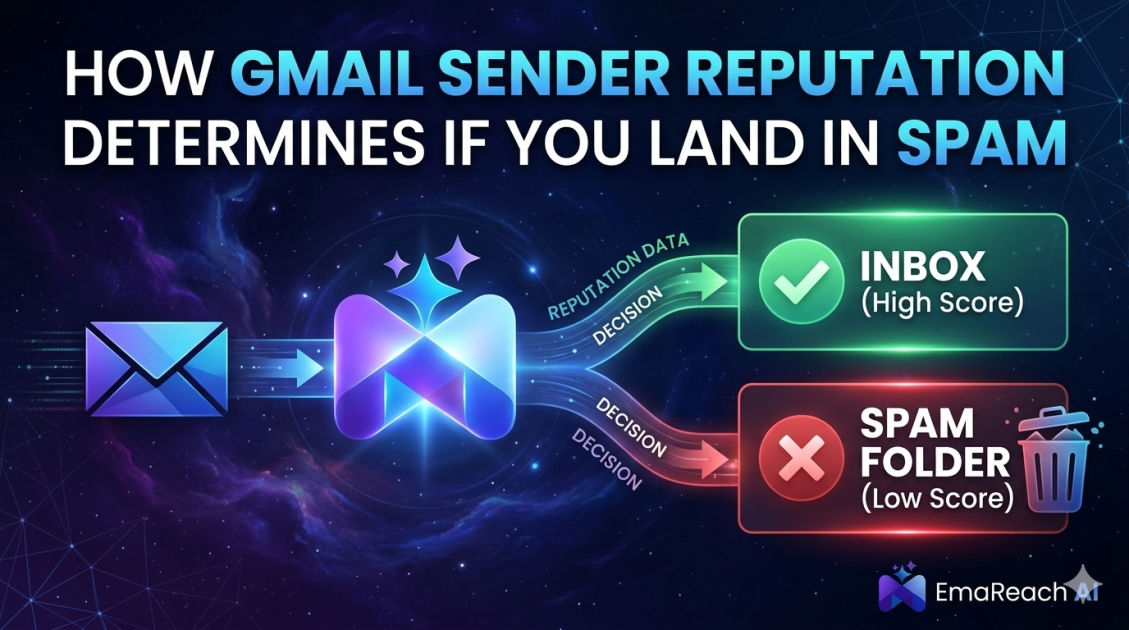
How Gmail Sender Reputation Determines If You Land in Spam
email deliverabilitygmailsender reputationcold emailspam filtersoutreach strategy
Introduction to Gmail Sender Reputation
For any business or individual relying on digital communication, the inbox is the ultimate destination. However, reaching that destination is not a matter of luck; it is a matter of reputation. Gmail, as one of the world's most sophisticated email service providers, utilizes a complex, multi-layered system to determine whether an incoming message is a valuable communication or unwanted clutter. At the heart of this system lies Sender Reputation.
Think of sender reputation as a credit score for your email behavior. It is a metric that Gmail uses to gauge how much it trusts you as a sender. If your reputation is high, your emails glide effortlessly into the primary inbox. If it is low, your messages are diverted to the dreaded spam folder or, in severe cases, blocked entirely. Understanding the nuances of how Gmail calculates this score is essential for anyone engaged in outreach, marketing, or transactional messaging.
The Two Pillars: IP Reputation vs. Domain Reputation
To understand Gmail's evaluation process, we must distinguish between the two primary forms of reputation: IP reputation and domain reputation.
IP Reputation
IP reputation is tied to the specific server address used to send your emails. Gmail tracks the history of the IP address to see if it has been associated with high volumes of spam or malicious activity. For users on shared hosting, IP reputation can be tricky, as the actions of other users on that same IP can negatively impact your deliverability. Conversely, a dedicated IP allows you full control over your reputation, though it requires a 'warm-up' period to establish trust.
Domain Reputation
Domain reputation is increasingly becoming the more critical factor. This is tied to your actual web domain (e.g., yourcompany.com). Unlike an IP address, which can change if you switch providers, your domain follows you everywhere. Gmail uses sophisticated machine learning to track how users across its entire network interact with emails coming from your domain. Even if you change your sending server, your domain's baggage—good or bad—stays with you.
How Gmail Calculates Your Reputation Score
Gmail does not publish a single 'score' for public viewing, but its filters analyze hundreds of signals in real-time. These signals generally fall into three categories: technical authentication, engagement metrics, and negative signals.
1. Technical Authentication (The Foundation)
Before Gmail even looks at your content, it checks your 'ID card.' If your technical setup is flawed, Gmail's security filters will immediately flag you as a risk.
- SPF (Sender Policy Framework): A record that lists which IP addresses are authorized to send email on behalf of your domain.
- DKIM (DomainKeys Identified Mail): A digital signature that proves the email was not tampered with during transit.
- DMARC (Domain-based Message Authentication, Reporting, and Conformance): A policy that tells Gmail what to do if SPF or DKIM fails (e.g., quarantine the email or reject it).
2. Positive Engagement Metrics
Gmail monitors how recipients interact with your emails. High engagement tells Gmail that people want to hear from you.
- Open Rates: While not the only metric, consistent opens signify relevance.
- Replies: This is the gold standard of engagement. When a user replies to an email, it signals to Gmail that a real conversation is happening.
- Marking as 'Not Spam': If a user rescues your email from the spam folder, it provides a massive boost to your reputation.
- Moving to Folders: If users drag your email to their primary tab or a specific folder, it reinforces your status as a 'wanted' sender.
3. Negative Signals and Spam Triggers
On the flip side, certain behaviors act as red flags that quickly tank your reputation.
- Spam Complaints: The 'Report Spam' button is the most powerful tool a user has. Even a small percentage of spam complaints can lead to a domain-wide blacklist.
- High Bounce Rates: Sending emails to non-existent addresses suggests poor list hygiene or that you are using a purchased list.
- Spam Traps: These are 'decoy' email addresses used by providers to catch bad actors. Hitting a spam trap is a fast track to a blocked reputation.
- Sudden Volume Spikes: Going from sending 10 emails a day to 10,000 overnight is classic spammer behavior.
The Role of AI in Modern Deliverability
Gmail’s filters are powered by advanced AI and machine learning that learn from the behavior of billions of users. This means that old-school 'hacks' like using invisible text or weird spellings no longer work. To beat an AI, you often need the assistance of specialized tools designed to mimic human behavior and maintain high engagement standards.
For those involved in professional outreach, EmaReach provides a vital solution. Stop Landing in Spam. Cold Emails That Reach the Inbox. EmaReach AI combines AI-written cold outreach with inbox warm-up and multi-account sending—so your emails land in the primary tab and get replies. By automating the 'warm-up' process, EmaReach ensures that your domain builds a positive history of engagement before you start high-volume campaigns.
Behavioral Factors That Influence Gmail's Filters
Gmail looks at more than just 'binary' data; it looks at the patterns of your communication.
Consistent Sending Frequency
Spammers are erratic. They blast a million emails and then disappear. Legitimate businesses have a predictable cadence. Maintaining a steady volume of outgoing mail helps Gmail’s algorithms categorize you as a stable, reliable entity.
Content Quality and Formatting
While 'spam words' (like 'FREE' or 'WINNER') aren't the only thing Gmail looks at, they still matter when combined with other factors. Over-reliance on heavy images, excessive tracking links, or broken HTML code can make an email look suspicious. Gmail prefers clean, text-based, or lightly styled emails that resemble how one human would write to another.
List Hygiene
If you haven't emailed a segment of your list in six months, don't suddenly blast them. A significant portion of those addresses may have been deactivated or converted into spam traps. Regularly 'scrubbing' your list to remove inactive subscribers is a non-negotiable part of maintaining a healthy reputation.
The Importance of the 'Warm-up' Period
If you are starting with a new domain or a new IP, you have no reputation. In the eyes of Gmail, 'no reputation' is almost as bad as a 'bad reputation.' You are an unknown variable.
To build trust, you must start small. Send a handful of emails to colleagues or friends who you know will open and reply to them. Gradually increase the volume over several weeks. This process, known as 'warming up,' proves to Gmail that you are a legitimate sender. Using a platform like EmaReach automates this delicate process, using AI to generate realistic interactions that solidify your standing with Gmail’s filters.
How to Monitor Your Gmail Reputation
You cannot fix what you cannot measure. Fortunately, Google provides a free tool called Google Postmaster Tools. This dashboard gives you direct insight into how Gmail views your domain.
- IP Reputation Dashboard: Shows whether your sending IPs are considered Low, Medium, or High reputation.
- Domain Reputation Dashboard: Tracks the health of your domain specifically.
- Spam Rate: Shows the percentage of users who marked your emails as spam compared to the total volume delivered to the inbox.
- Authentication Success: Confirms that your SPF, DKIM, and DMARC are working correctly.
If you notice your reputation dipping into the 'Medium' or 'Low' categories, it is a sign that you need to pause your campaigns immediately and investigate your sending practices.
Actionable Steps to Improve Your Deliverability
If you find yourself landing in the spam folder, follow this checklist to rebuild your reputation:
- Verify Authentication: Ensure your SPF, DKIM, and DMARC records are valid and correctly formatted.
- Audit Your List: Remove any email addresses that have bounced or haven't opened an email in the last 90 days.
- Check Your Content: Reduce the number of links and images. Ensure your 'Unsubscribe' link is easy to find; it's better for someone to unsubscribe than to report you as spam.
- Slow Down: Reduce your sending volume and rebuild trust slowly.
- Use a Warm-up Tool: Leverage EmaReach to generate positive engagement signals automatically, which helps offset any previous negative marks on your record.
Common Myths About Gmail Spam Filters
There is a lot of misinformation regarding email deliverability. Let’s clarify a few things:
- Myth: Only 'Spammy' Words Matter.
- Truth: Context is king. You can use the word 'Sale' as long as your engagement is high and your authentication is solid.
- Myth: Once you are in spam, you can never get out.
- Truth: Gmail’s filters are dynamic. By improving your behavior and engagement over time, you can absolutely rehabilitate a bad reputation.
- Myth: Unsubscribe links hurt deliverability.
- Truth: The opposite is true. Gmail favors senders who provide a clear, one-click unsubscribe path for their users.
Future-Proofing Your Email Strategy
As AI continues to evolve, Gmail’s filters will only get smarter. They will become better at detecting 'mass-produced' content that lacks value. The key to future-proofing your deliverability is to focus on personalization and relevance.
Sending the right message to the right person at the right time is the ultimate way to stay in the inbox. When you use tools that help you behave like a human rather than a machine, you align yourself with what Gmail wants for its users: a high-quality, relevant experience.
Conclusion
Gmail sender reputation is the invisible force that determines the success of your email efforts. It is a reflection of your technical integrity, your list quality, and how much your audience values your content. By prioritizing authentication, maintaining strict list hygiene, and utilizing tools like EmaReach to foster positive engagement, you can ensure that your messages don't just get sent, but actually get read. Building a stellar reputation takes time, but the reward—a direct line to your audience’s inbox—is well worth the effort.
EmaReach AI
Ready to scale your cold email outreach?
Join thousands of teams using EmaReach AI for AI-powered campaigns, domain warmup, and 95%+ deliverability. Start free — no credit card required.
Related posts
- Read article
The Instantly Alternative That Handles High Bounce Rates Without Panic
Discover how transitioning to an advanced Instantly alternative can safeguard your cold email infrastructure. Learn to handle high bounce rates effortlessly using real-time verification, smart mailbox rotation, and automated safety nets to protect your sender reputation and maintain consistent primary inbox placement.
- Read article
Beyond Instantly: The Cold Email Platforms Worth Taking Seriously
Discover the top advanced cold email platforms that go beyond basic multi-inbox rotation. Learn how to optimize your technical infrastructure, leverage advanced personalization, and scale your B2B sales pipeline safely without landing in the spam folder.