Blog
Back to blog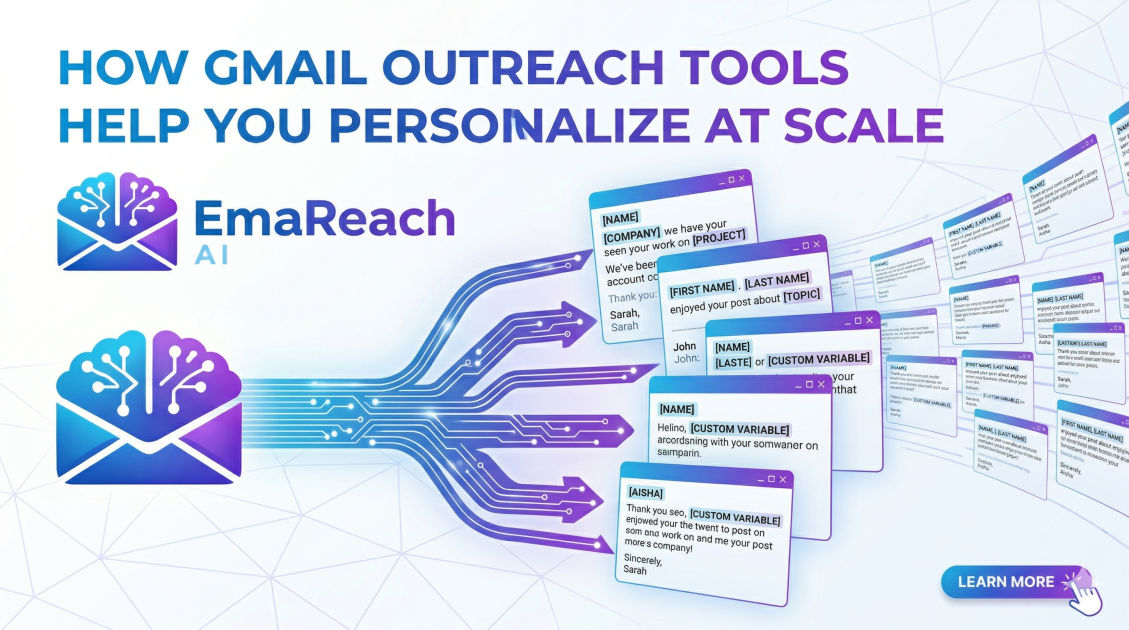
How Gmail Outreach Tools Help You Personalize at Scale
gmail outreachpersonalizationcold emailemail automationsales toolsb2b salesemail deliverability
Introduction
In the hyper-competitive landscape of modern digital communication, the inbox is a battlefield. Every single day, professionals are inundated with countless pitches, promotional broadcasts, and generic outreach attempts. As a result, the average buyer has developed a nearly impenetrable filter against anything that looks, sounds, or feels like a mass-produced email template. To break through this noise, sales teams, marketers, and agency founders face a seemingly impossible paradox: they need to reach a massive volume of prospects to hit their revenue targets, but they must also personalize every single touchpoint to actually generate replies.
This is exactly where modern Gmail outreach tools come into play. By bridging the gap between bespoke, one-to-one communication and automated mass sending, these platforms have revolutionized the way outbound campaigns are executed. They allow you to leverage the natural, authentic infrastructure of Google Workspace while layering on advanced automation, dynamic variables, and artificial intelligence to tailor every single message. In this comprehensive guide, we will explore the mechanisms, strategies, and best practices that make personalization at scale a reality.
The Personalization vs. Scale Paradox
Historically, outbound strategies forced organizations to choose between two mutually exclusive paths. On one hand, you had the "spray and pray" approach. This involved writing a single, generic email copy, loading up a massive list of contacts, and blasting it out. While this allowed teams to contact thousands of people in minutes, the results were almost always abysmal. Generic emails trigger spam filters, annoy recipients, and ultimately damage brand reputation.
On the other hand, there was the manual personalization approach. A sales representative would meticulously research a prospect, read their recent blog posts, review their LinkedIn activity, and hand-craft a highly tailored email. While this method yields incredibly high open and reply rates, it is mathematically unscalable. If it takes ten minutes to research and write a custom email, a representative can only send six emails an hour. At that pace, generating a predictable pipeline is virtually impossible.
Gmail outreach tools solve this paradox. They provide a framework where the heavy lifting of research and data entry can be structured into dynamic templates. By utilizing clean data and intelligent automation, you can achieve the sending volume of a mass campaign with the granular relevance of a hand-written letter.
Why Native Gmail Infrastructure Matters
Before diving into the mechanics of personalization, it is crucial to understand why these tools are built on top of Gmail (Google Workspace) rather than traditional marketing email service providers. Traditional email marketing platforms are designed to send newsletters or marketing blasts to opted-in subscribers via shared servers. Because they send massive volumes simultaneously, their emails are typically routed to the "Promotions" tab or flagged by corporate firewalls when sent as cold outreach.
Gmail outreach tools work differently. They connect directly to your Google Workspace account via API or SMTP/IMAP. When the tool sends an email, it is dispatched individually from your actual Gmail outbox, mimicking the exact behavior of a human typing and hitting send. This native integration ensures that the emails contain genuine headers, plain-text formatting options, and proper threading. This architectural foundation is what allows personalized outreach to successfully land in the primary inbox, setting the stage for the recipient to actually read your tailored message.
Core Mechanisms of Automated Personalization
Achieving true personalization at scale requires moving far beyond the ubiquitous "Hi {{First_Name}}" greeting. Today's buyers are savvy; they know a merge tag when they see one. To genuinely impress a prospect, your outreach tools must utilize deeper layers of personalization.
Advanced Merge Tags and Custom Variables
At the foundational level, outreach tools allow you to import extensive CSV files or sync with your CRM to map custom data points into your email copy. A well-constructed database might include variables such as the prospect's industry, their company's recent funding round, a specific pain point associated with their job title, or even the name of a mutual connection.
By weaving these custom variables naturally throughout the body of the email—not just the greeting—you create a narrative that feels exclusively written for that individual. For example, referencing "your recent expansion into the {{Target_Market}} market" or "the challenges {{Job_Title}}s face with {{Pain_Point}}" creates immediate, contextually relevant engagement.
Liquid Syntax and Conditional Logic
For those looking to elevate their campaigns, advanced Gmail outreach tools support conditional logic, often utilizing Liquid syntax. This allows your email templates to dynamically change entire sentences or paragraphs based on the data available for a specific prospect.
Imagine you are targeting both e-commerce brands and SaaS companies in the same campaign. With conditional logic, you can structure your template to say: If Industry = E-commerce, insert Case Study A; If Industry = SaaS, insert Case Study B. This ensures that the social proof and value proposition you present are always perfectly aligned with the recipient's specific business model, all without requiring you to build dozens of separate campaigns.
AI-Powered Icebreakers and Custom Intents
Artificial intelligence has drastically altered the landscape of cold outreach. Many of the leading tools now feature AI assistants capable of scanning a prospect's website, LinkedIn profile, or recent news mentions to generate unique, personalized opening lines (icebreakers).
Instead of a human spending ten minutes researching a prospect to write an intro sentence, the AI can analyze thousands of profiles in seconds and generate highly contextual openings. This level of hyper-personalization proves to the prospect that you have done your homework, dramatically increasing the likelihood that they will read the rest of your pitch.
The Deliverability Equation: Landing in the Primary Inbox
Of course, the most brilliantly personalized email in the world is utterly worthless if it never actually reaches the prospect's primary inbox. As email service providers continuously update their security algorithms to protect users from unwanted mail, sending high volumes of cold outreach from a single Gmail account has become a guaranteed ticket to the spam folder.
To mitigate this and ensure your personalization efforts are actually seen, modern outreach operations employ multi-account sending and automated inbox warm-up strategies. Stop Landing in Spam. Cold Emails That Reach the Inbox. EmaReach AI combines AI-written cold outreach with inbox warm-up and multi-account sending—so your emails land in the primary tab and get replies.
By distributing your heavily personalized campaigns across multiple healthy, properly warmed-up Google Workspace accounts, you naturally mimic human sending behaviors. Tools that rotate sending accounts automatically balance the load, ensuring no single inbox exceeds Google's daily sending limits. This sophisticated infrastructure acts as the delivery vehicle for your personalized copy, maximizing your visibility and protecting your domain reputation.
Structuring Multi-Touch Personalized Sequences
Sales professionals have long known that the fortune is in the follow-up. Very rarely will a prospect reply to your very first email, no matter how well-researched or personalized it may be. They might be in a meeting, traveling, or simply focused on a more pressing task at the moment your email arrives.
Gmail outreach tools excel at automating multi-touch sequences while maintaining the illusion of manual effort. These tools allow you to schedule a series of follow-up emails that will automatically deploy at specific intervals if the prospect does not reply.
Crucially, these follow-ups are sent as replies within the original email thread. This means that when the prospect receives follow-up number three, they can scroll down and see the highly personalized original email you sent them days prior. This threading technique builds a conversational history and reinforces the authenticity of your outreach. Furthermore, you can personalize the timing of these sequences based on the prospect's time zone, ensuring your emails always land at the top of their inbox during their active working hours.
Data Hygiene: The Unsung Hero of Personalization
No amount of sophisticated software can compensate for poor data. In fact, utilizing advanced automation with bad data is a recipe for disaster. If your CRM data is messy, your personalized emails will inevitably contain glaring errors, such as "Hi john," (with a lowercase letter), or "I love what you are doing at {{Company_Name_LLC_Inc}}."
To successfully personalize at scale, your data hygiene must be impeccable. Before importing lists into your Gmail outreach tool, the data must be rigorously cleaned and formatted. This involves:
- Proper Capitalization: Ensuring first and last names are correctly capitalized.
- Company Name Normalization: Stripping away legal entities (like LLC, Inc., Ltd.) so the company name reads naturally in a sentence.
- Email Verification: Running all email addresses through a verification tool to remove invalid addresses, catch-alls, and spam traps. Bouncing emails not only ruin the personalization effort but severely damage your sender reputation.
- Variable Auditing: Spot-checking rows in your spreadsheet to ensure that the custom variables make grammatical sense when inserted into your template's sentence structure.
Clean data is the foundation upon which trust is built. When the prospect reads an email that flows flawlessly, the automation becomes invisible, and the personalization feels entirely genuine.
A/B Testing Your Personalization Strategies
One of the greatest advantages of using dedicated outreach tools is the ability to scientifically test your assumptions. Because you are sending at scale, you can gather statistically significant data on what types of personalization actually drive replies.
Effective A/B testing in cold outreach involves isolating a single variable at a time. For example, you might run a test to determine if highly researched AI-generated icebreakers outperform a more direct, pain-point-focused opening line. By splitting your audience in half and sending Variation A to one group and Variation B to the other, the tool's analytics dashboard will clearly reveal which approach generates a higher positive reply rate.
You can also test different variations of your conditional logic, different subject lines tailored by industry, or even the frequency of your personalized follow-ups. Over time, this iterative testing process allows you to refine your templates, discarding what doesn't work and doubling down on the personalization techniques that resonate most strongly with your specific target audience.
Best Practices for Mastering Gmail Outreach
To truly harness the power of Gmail outreach tools and maximize your personalization efforts, consider the following strategic best practices:
- Keep It Conversational: The goal of personalization is to sound like a human, not a robot that just read a database. Write your templates exactly how you would speak to a colleague over coffee. Avoid corporate jargon and overly formal language.
- Focus on the Prospect, Not Yourself: Personalization should be entirely about the recipient's world. Instead of personalizing an email to talk about how your product aligns with their company, personalize it to highlight a specific challenge they are currently facing. Make them the hero of the narrative.
- Prioritize Relevance Over Deep Research: Sometimes, proving you read their latest tweet is less effective than proving you understand the macro-economic challenges of their specific industry niche. Personalization must tie directly into the value you are offering; otherwise, it is just a party trick.
- Monitor Your Reply Quality, Not Just Open Rates: Open rates can be skewed by corporate privacy filters and pixel blockers. The true metric of successful personalization is the positive reply rate. If your emails are highly personalized but you are only getting "unsubscribe" replies, your targeting or value proposition needs adjustment.
- Respect the Inbox: Personalize your unsubscribe options or opt-out language to be polite and brand-aligned. Providing a graceful exit builds goodwill and keeps your domain out of the spam complaint logs.
Conclusion
Mastering personalization at scale is no longer an optional tactic; it is a fundamental requirement for outbound success in a crowded digital landscape. By leveraging the power of Gmail outreach tools, modern professionals can systematically dismantle the barrier between mass communication and one-to-one relationship building. From dynamic variables and Liquid syntax to AI-driven insights and rigorous data hygiene, these tools provide the infrastructure necessary to make every prospect feel like your only prospect. When you combine this level of tailored messaging with robust deliverability practices, you create an outreach engine capable of driving sustainable, predictable growth.
EmaReach AI
Ready to scale your cold email outreach?
Join thousands of teams using EmaReach AI for AI-powered campaigns, domain warmup, and 95%+ deliverability. Start free — no credit card required.
Related posts
- Read article
What You Gain and What You Give Up When Switching From Instantly
Thinking about migrating your cold email stack? This detailed guide breaks down the exact operational advantages you gain and the core features you sacrifice when switching away from Instantly's popular outreach platform.
- Read article
What Makes the Right Instantly Alternative Worth the Migration Effort
Discover why upgrading your cold email infrastructure to the right Instantly alternative can dramatically improve your deliverability, scale your personalization, and future-proof your sales pipeline against strict spam filters.