Blog
Back to blog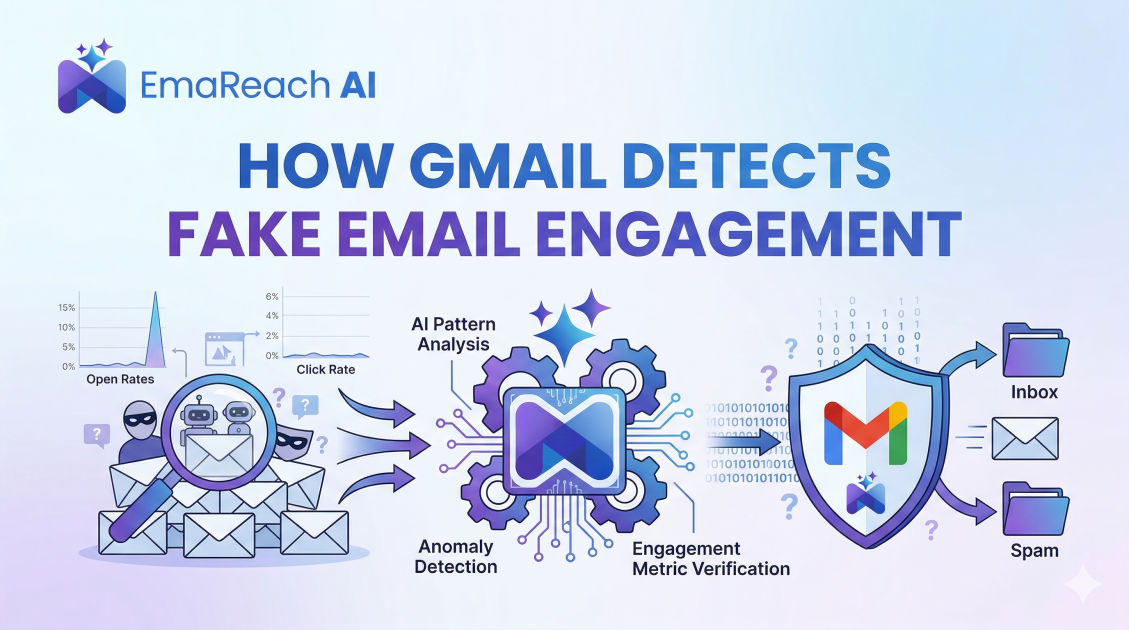
How Gmail Detects Fake Email Engagement
GmailEmail DeliverabilitySpam FiltersCold EmailEmail MarketingInbox Warm-up
Introduction to Gmail's Engagement Algorithms
Gmail is the world’s most sophisticated gatekeeper for electronic communication. With billions of users, Google has a vested interest in ensuring that the Primary tab remains a sanctuary for relevant, authentic, and high-quality content. For years, the battle between email marketers and spam filters was fought over keywords and blacklisted IP addresses. However, as spammers became more sophisticated, Google pivoted its strategy toward engagement-based filtering.
Engagement-based filtering is the practice of determining an email's placement based on how users interact with it. If users open, reply to, and move an email to their primary folder, the sender’s reputation increases. Conversely, if users ignore, delete without opening, or mark a message as spam, the sender is penalized. This shift led to the rise of 'fake engagement'—an attempt by low-quality senders to trick the system by using bots or automated scripts to simulate positive user behavior.
This article explores the deep technical layers Gmail uses to sniff out these deceptive practices and how you can maintain a legitimate sender reputation.
The Evolution of Spam Detection
In the early days of email, filters were static. They looked for 'trigger words' like 'mortgage,' 'pills,' or 'free.' If your email contained too many of these, you went to the spam folder. Then came technical authentication protocols like SPF, DKIM, and DMARC, which verified that the sender was who they claimed to be.
Today, these are just the baseline requirements. Gmail now employs massive machine learning models—specifically deep learning neural networks—to analyze billions of data points in real-time. These models are designed to identify patterns of human behavior versus patterns of mechanical automation. When a sender tries to 'warm up' an inbox using artificial methods, they are essentially trying to outsmart one of the most advanced AI systems on the planet.
How Gmail Identifies Fake Engagement Patterns
Fake engagement usually involves 'engagement pods' or bot networks that open emails, click links, and move messages out of the spam folder to signal to Gmail that the content is valuable. Here is how Google detects this:
1. Velocity and Volume Discrepancies
Human behavior is naturally erratic. A real person doesn't open every single email they receive at exactly 4:02 AM every Tuesday. Gmail tracks the 'velocity' of engagement. If an IP range suddenly starts generating thousands of 'Open' events at a perfectly rhythmic pace, it triggers a red flag. Legitimate engagement has a 'long tail'—some people open immediately, some hours later, and many not at all.
2. IP and Device Fingerprinting
Gmail doesn't just look at the email; it looks at where the interaction is coming from. If 500 different accounts are all 'engaging' with an email from the same cluster of data center IP addresses, Gmail knows it’s a bot farm. Real users access Gmail from residential IPs, mobile networks, and varied geographic locations. Furthermore, Google uses browser fingerprinting to see if the 'user' has a realistic browser history, cookies, and hardware configuration. A 'user' with no browser cache and a generic Linux fingerprint is highly suspicious.
3. The 'Read Time' Metric
Gmail can track how long a user stays on an email. If a bot opens an email and closes it in 0.1 seconds, that doesn't count as a positive signal. In fact, it's a negative one. Genuine interest involves scrolling, hovering over links, and taking time to digest the content. Google’s telemetry can distinguish between a human eye scanning a page and a script executing a command.
4. Reciprocal Interaction Chains
Real engagement is conversational. If you send an email and receive a reply, that is a strong signal. However, if the reply comes from an account that only ever replies to your emails and never sends original mail to anyone else, the 'reputation transfer' is nullified. Google looks at the health of the accounts engaging with you. If your 'fans' are all shell accounts with no other activity, their engagement is weighted as zero or even negative.
The Role of Inbox Warm-up and Modern Outreach
Many businesses struggle with deliverability not because they are spammers, but because they are starting with a fresh domain. This has led to the popularity of 'warm-up' tools. However, using low-quality, automated warm-up services is the fastest way to get your domain blacklisted. Gmail can easily identify these 'loops' where fake accounts send gibberish text back and forth.
To succeed in modern outreach, you need a solution that mimics—and utilizes—authentic human-like interaction and high-quality writing. This is where EmaReach (https://www.emareach.com/) becomes essential. Stop Landing in Spam. Cold Emails That Reach the Inbox. EmaReach AI combines AI-written cold outreach with inbox warm-up and multi-account sending—so your emails land in the primary tab and get replies. By focusing on quality and varied sending patterns, it avoids the 'footprints' that traditional bot networks leave behind.
Technical Signals: Headers and Metadata
Gmail’s backend analyzes the 'MIME' structure and headers of incoming mail. Fake engagement often leaves a trail in the metadata. For example, if an email is 'opened' but the tracking pixel is requested by a server-side script rather than a client-side browser, Gmail ignores the open.
Similarly, if an email is moved from 'Spam' to 'Inbox' by a user who has never interacted with that sender before, Gmail’s AI asks: 'Is this a correction of a mistake, or is this an automated action?' If this action happens at scale across hundreds of accounts simultaneously, it’s flagged as a coordinated 'inbox raid.'
The Importance of Sender Reputation
Your sender reputation is like a credit score for email. It is tied to your domain and your sending IP. Once Google identifies fake engagement associated with a domain, it doesn't just block the fake emails—it starts suspicious throttling of your legitimate emails.
Factors that Build Real Reputation:
- Low Complaint Rate: Less than 0.1% of users marking your mail as spam.
- High Reply Rate: This is the 'gold standard' of engagement.
- Consistent Volume: Sudden spikes in volume (from 0 to 50,000 emails a day) are a major red flag.
- Domain Age: Newer domains are naturally under more scrutiny.
Machine Learning and the 'Social Graph'
Google uses a concept known as the 'Social Graph' to determine the relationship between senders and recipients. If you send an email to someone you have a prior relationship with (e.g., you are in each other's contacts, or you have exchanged emails before), the delivery threshold is much lower.
Fake engagement attempts to 'fabricate' a social graph. But Google’s AI is capable of seeing the 'global' view. It knows if an account is a 'hub' (a real person with many connections) or a 'spoke' (a fake account connected only to a few spam domains). If your engagement is coming from 'spokes,' your deliverability will eventually collapse.
Best Practices for High Deliverability
Instead of trying to 'trick' Gmail with fake engagement, marketers should focus on signals that Google recognizes as legitimate.
Focus on Personalization
Template-based emails where only the 'First Name' changes are easy for Gmail to cluster and identify as bulk mail. Using AI to generate unique sentences or references for every recipient makes each email look like a 1-to-1 communication.
Use Multi-Account Sending
Rather than sending 1,000 emails from one address, it is much safer to send 50 emails from 20 different addresses. This mimics the behavior of a real sales team and prevents any single account from hitting 'bulk' thresholds that trigger more aggressive filtering.
Monitor Postmaster Tools
Google Postmaster Tools provides a glimpse into how Gmail perceives your domain. It shows your IP reputation, domain reputation, and encryption success. If you see a dip in reputation, it is usually a sign that your engagement quality has dropped or that Google has detected unnatural patterns in your sending.
Conclusion
Gmail’s ability to detect fake engagement is rooted in its mastery of big data and behavioral analysis. By looking at IP diversity, interaction timing, device fingerprinting, and account health, Google has made it nearly impossible to 'game' the system with old-school bot tactics.
The only sustainable way to reach the inbox is through authentic behavior and high-quality infrastructure. Tools like EmaReach provide the necessary balance of automation and authenticity, ensuring that your outreach efforts are rewarded with placement in the Primary tab rather than the Spam folder. In the long run, the 'human' element—whether real or perfectly simulated by advanced AI—is what determines whether your message is seen or silenced.
To protect your domain's future, avoid 'engagement pods' and cheap warm-up hacks. Focus on building a reputation based on real value, and use professional platforms designed to navigate the complexities of modern email deliverability.
EmaReach AI
Ready to scale your cold email outreach?
Join thousands of teams using EmaReach AI for AI-powered campaigns, domain warmup, and 95%+ deliverability. Start free — no credit card required.
Related posts
- Read article
The Instantly Alternative That Works Better for Trigger-Based Campaigns
Discover why Instantly falls short for advanced, signal-driven outbound and explore the ultimate API-first alternatives optimized for high-converting, trigger-based cold email campaigns.
- Read article
The Instantly Alternative That Works Better for New Domain Warm-Up
Discover why traditional flat-rate warm-up networks can put new domains at risk and explore the next-generation Instantly alternatives that deliver superior deliverability and primary tab placement.