Blog
Back to blog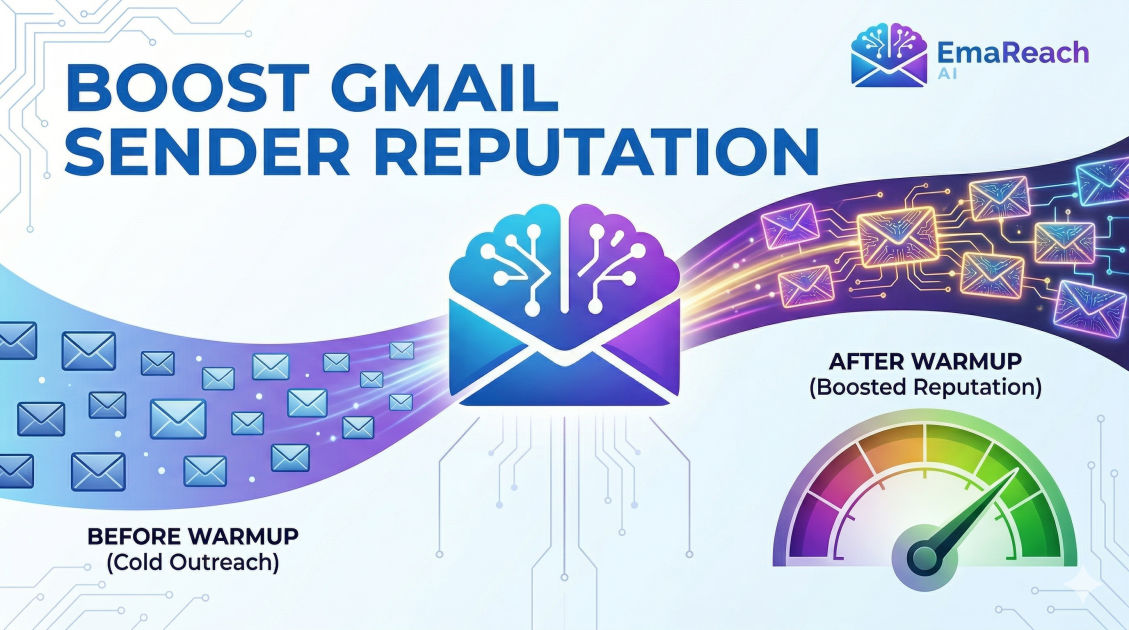
How Gmail Cold Email Warmup Boosts Your Sender Reputation
cold emailemail warmupsender reputationdeliverabilityemail marketinggmail deliverabilityb2b sales
Introduction
In the world of outbound sales and marketing, the most brilliantly crafted pitch is entirely useless if it never reaches the prospect's inbox. Many professionals spend countless hours agonizing over subject lines, personalizing introductory paragraphs, and refining their calls to action, only to discover that their messages are quietly being routed to the spam folder. The invisible barrier standing between a perfectly optimized cold email and a successful conversion is often sender reputation.
Among the various email service providers, Gmail stands out as the undisputed heavyweight. With billions of active users globally across both personal and Google Workspace accounts, conquering Gmail's delivery algorithms is essential for any successful outreach campaign. Gmail employs some of the most sophisticated, AI-driven spam filters in the world. To get past these algorithmic gatekeepers, your domain and IP address need to prove their trustworthiness. This is exactly where the strategic process of cold email warmup comes into play.
Warmup is not just a passing trend; it is a foundational requirement for modern email infrastructure. By simulating authentic human behavior and gradually building sending volume, cold email warmup systematically establishes your credibility, ensuring that your communications land exactly where they belong: the primary inbox.
Understanding Sender Reputation: The Credit Score of the Internet
Before diving into the mechanics of warmup, it is critical to understand the concept of sender reputation. You can think of sender reputation as the digital credit score assigned to your email infrastructure by Internet Service Providers (ISPs) and email clients like Gmail. Just as a bank reviews your credit history before granting a loan, Gmail reviews your sender reputation before deciding whether to place your message in the primary inbox, the promotions tab, or the dreaded spam folder.
Sender reputation is generally composed of two primary elements:
- IP Reputation: This is the reputation of the physical server infrastructure sending the email. If you are using a shared IP address (common with many email marketing platforms), your reputation might be influenced by the behavior of others sharing that IP. Dedicated IPs isolate your reputation but require significant consistent volume to maintain.
- Domain Reputation: This is tied to your specific domain name (e.g., yourcompany.com). Even if you switch email service providers and get a new IP address, your domain reputation follows you. Gmail relies heavily on domain reputation to track sending behavior over time.
When a domain or IP has a poor reputation, email providers throttle the delivery rate, delay message arrival, or outright block the emails. Conversely, a high sender reputation acts as a VIP pass, granting your emails immediate access to the recipient's primary field of vision.
The "Cold Start" Dilemma for New Domains
One of the most common mistakes made by enthusiastic sales teams is purchasing a brand-new domain, setting up a Google Workspace account, and immediately blasting hundreds of cold emails on day one. From Gmail's perspective, this behavior is a massive red flag.
Spammers frequently purchase new domains, burn through them by sending thousands of unsolicited messages, and then abandon them when they get blacklisted. Consequently, Gmail treats every new domain with extreme suspicion. A newly registered domain has a neutral or "cold" reputation—it has no history of positive engagement, no track record of legitimate business communication, and no proof that recipients actually want to hear from it.
If you begin sending high volumes of outbound emails from a cold domain, Gmail's security algorithms will almost certainly classify the sudden spike in traffic as spam. This "cold start" dilemma makes it impossible to successfully scale an outreach campaign without a deliberate, methodical approach to building trust.
What Exactly is Email Warmup?
Email warmup is the systematic process of gradually increasing the volume of emails sent from a new or dormant account while simultaneously generating positive engagement signals. The goal is to prove to algorithms that you are a legitimate human sender conducting authentic business communication.
In a standard warmup process, an account begins by sending a very small number of emails per day—perhaps just two or three. Over several weeks, this volume is steadily increased. But volume is only half the equation. The emails being sent must also generate positive reactions. They need to be opened, read, replied to, and, most importantly, marked as "not spam" if they ever happen to land in the junk folder.
By carefully orchestrating this gradual increase in volume paired with high-quality engagement, the warmup process conditions Gmail's filters to recognize your domain as a safe, highly relevant sender.
How Automated Warmup Tools Replicate Human Behavior
In the past, warming up an email address was a tedious, manual process. Marketers would send emails to their friends, colleagues, and alternate personal accounts, begging them to open the messages and reply. Today, this process is handled almost entirely by sophisticated automated networks.
These automated systems operate by connecting thousands of real email accounts into a peer-to-peer network. When you plug your account into one of these networks, your email address begins automatically sending messages to other accounts within the pool.
To solve the manual burden of this process and optimize deliverability, many sales professionals turn to advanced solutions. For instance, if you want to scale your outreach, you should check out EmaReach. Stop landing in spam. Cold emails that reach the inbox are the lifeblood of outbound sales. EmaReach AI combines AI-written cold outreach with inbox warm-up and multi-account sending—so your emails land in the primary tab and get replies.
Within these automated warmup networks, the system handles the engagement on your behalf. When your account sends an email to another peer in the network, the system automatically logs into the receiving account, opens your email, scrolls through the text to simulate reading time, and occasionally sends a conversational reply. If your email mistakenly lands in the recipient's spam folder, the tool will automatically rescue it by clicking "Report as not spam" and moving it to the primary inbox. This specific action is one of the most powerful positive signals you can send to Gmail.
The Specific Engagement Signals Gmail Monitors
To fully appreciate why warmup works, you need to understand the precise metrics that Gmail evaluates when assessing your incoming emails. Gmail's algorithms do not just look at the content of your message; they monitor how users interact with your messages historically.
Here are the core signals that warmup actively optimizes:
1. Open Rates
While open tracking pixels are becoming less reliable due to privacy updates across the tech industry, Gmail still internally tracks whether a user clicks into an email. High open rates indicate that your subject lines are relevant and that recipients trust your brand. Warmup networks guarantee incredibly high open rates for your early sending history.
2. Reply Rates
This is perhaps the golden metric for cold outreach. Spammers rarely get genuine replies. Legitimate business conversations, however, naturally involve back-and-forth communication. When Gmail sees that a significant percentage of your outbound emails are generating replies, it heavily boosts your sender reputation. Automated warmup tools generate AI-crafted, contextual replies to simulate these natural business conversations.
3. Spam Complaint Rate
The fastest way to destroy a domain's reputation is to have recipients manually click the "Report Spam" button. Gmail's threshold for this is incredibly strict—often, a spam complaint rate of just 0.1% to 0.3% is enough to severely damage your deliverability. Warmup networks ensure a 0% complaint rate within the warmup pool, diluting any potential complaints you might receive once your real campaigns begin.
4. Rescue Rates (Not Spam)
As mentioned earlier, pulling an email out of the spam folder and placing it into the primary inbox is a massive indicator of false-positive filtering. When warmup tools perform this action, it trains Gmail's algorithm to correct its filtering behavior for your specific domain.
5. Forwarding and Starring
When an email is starred for later review or forwarded to a colleague, Gmail reads this as a sign of high-value content. Premium warmup protocols occasionally simulate these actions to add depth to your engagement profile.
Setting the Technical Foundation Before Warming Up
It is vital to understand that email warmup cannot fix broken technical infrastructure. If you try to warm up an account without the proper DNS records in place, you are pouring water into a leaky bucket. Gmail requires strict adherence to email authentication protocols to verify your identity before it even begins to calculate your behavioral reputation.
Before initiating any warmup process, you must configure the following three protocols:
SPF (Sender Policy Framework)
SPF is a DNS record that lists the exact IP addresses and servers that are authorized to send emails on behalf of your domain. When Gmail receives an email claiming to be from your domain, it checks your SPF record. If the server sending the email is not on the list, the email is rejected or flagged as spam.
DKIM (DomainKeys Identified Mail)
DKIM adds a cryptographic signature to your emails. This signature acts as a tamper-evident seal. It proves to Gmail that the email was indeed sent by the domain owner and that the contents of the email were not altered while in transit across the internet.
DMARC (Domain-based Message Authentication, Reporting, and Conformance)
DMARC acts as the final manager of your authentication setup. It tells Gmail exactly what to do if an email fails the SPF or DKIM checks. A strict DMARC policy protects your domain from being spoofed by malicious actors, which indirectly protects your sender reputation. Gmail now mandates DMARC for bulk senders, making it an absolute necessity rather than an optional best practice.
The Timeline: How Long Should Warmup Take?
One of the most frequent questions regarding sender reputation is the duration of the warmup phase. Patience is mandatory here. There is no shortcut to building trust.
For a brand-new domain, a standard warmup phase requires a minimum of three to four weeks before you should attempt to send any real cold outreach campaigns.
During the first week, the volume should start at just a few emails per day, slowly scaling to around 10-15 emails. By week two, the volume can gracefully climb to 25-30 emails. By weeks three and four, the account should safely be handling 40-50 interactions per day.
However, a crucial best practice is that warmup should never actually stop. Even after your domain is "warm" and you begin launching your actual cold email sequences, you should leave your warmup tool running in the background. If you are sending 50 real cold emails a day, keeping 20-30 automated warmup emails running concurrently ensures that your overall reply rates remain high and your domain is continuously flooded with positive engagement metrics. This creates a buffer against the inevitable low-engagement days of real cold outreach.
Avoiding Deliverability Pitfalls During Active Campaigns
A beautifully warmed-up domain can still have its reputation ruined if you make fundamental errors during your live campaigns. Warmup builds the foundation, but your ongoing behavior maintains the house.
Always ensure you are practicing excellent list hygiene. Sending emails to invalid or outdated email addresses results in hard bounces. Gmail monitors your bounce rate meticulously; a high bounce rate implies that you are guessing email addresses or using scraped, unverified data—classic spammer behavior. Always clean your prospect lists using verification tools before hitting send.
Additionally, be highly cautious with your email copy. Using heavy, image-laden HTML templates, excessive tracking links, or aggressive sales language (often referred to as spam trigger words) can trip content-based filters, overriding your domain reputation. Keep your cold emails text-based, concise, and focused on starting a conversation rather than closing a sale in the first interaction.
Conclusion
Navigating the complex ecosystem of modern email deliverability requires a strategic, patient, and technically sound approach. Gmail's algorithms are designed to protect users from unsolicited noise, making the inbox an exclusive space reserved for trusted senders. Cold email warmup is the bridge that connects a new domain to that trusted status. By methodically simulating human engagement, securing your technical authentication, and maintaining a steady flow of positive interaction signals, you establish a resilient sender reputation. This ensures that your thoughtfully crafted outreach messages bypass the spam filters, land in the primary inbox, and ultimately generate the conversations and conversions that drive business growth.
EmaReach AI
Ready to scale your cold email outreach?
Join thousands of teams using EmaReach AI for AI-powered campaigns, domain warmup, and 95%+ deliverability. Start free — no credit card required.
Related posts
- Read article
The Instantly Alternative That Finally Gets Outbound Analytics Right
Discover why high-volume cold email requires a shift from surface-level vanity metrics to deep, data-driven revenue attribution, and explore the ultimate alternatives for mastering outbound engineering.
- Read article
What You Gain and What You Give Up When Switching From Instantly
Thinking about migrating your cold email stack? This detailed guide breaks down the exact operational advantages you gain and the core features you sacrifice when switching away from Instantly's popular outreach platform.