Blog
Back to blog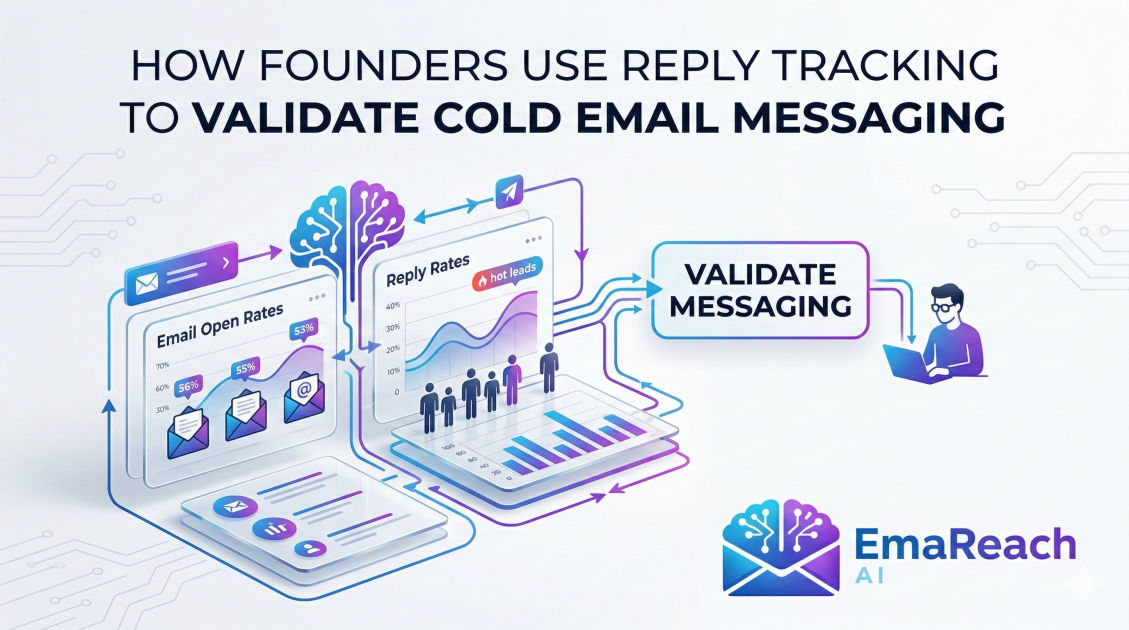
How Founders Use Reply Tracking to Validate Cold Email Messaging
cold emailoutreach strategyfounder-led salesmessaging validationemail deliverabilitystartup growthB2B marketing
Introduction
For a founder, the early stages of a startup are a relentless pursuit of product-market fit. This search isn't limited to the product features themselves; it extends to the very language used to describe the solution. Cold email is often the first laboratory where this language is tested. However, many founders fall into the trap of measuring success through vanity metrics like open rates, which can be easily skewed by catchy but irrelevant subject lines.
The real breakthrough occurs when founders shift their focus to reply tracking. By meticulously monitoring not just who opens an email, but who takes the time to respond—and the sentiment of those responses—founders can scientifically validate their messaging. This guide explores the strategic framework of using reply tracking to refine value propositions, identify ideal customer profiles (ICP), and build a predictable growth engine.
The Shift from Open Rates to Reply Validation
In the world of outbound sales, open rates are a measure of curiosity, but reply rates are a measure of intent. A high open rate might mean your subject line was clever; a high reply rate means your message resonated with a specific pain point. For a founder, a reply is a data point that confirms the market is listening.
Why Open Rates Can Be Deceptive
Modern email environments are increasingly hostile to tracking pixels. With the rise of privacy protections, many 'opens' are actually automated bot scans or preview pane loads that don't reflect human engagement. Relying on these numbers to validate a business thesis is risky. Conversely, a reply is an unambiguous human action. It represents a 'micro-investment' of time from a busy prospect, indicating that your messaging has pierced through the noise.
The Anatomy of a Meaningful Reply
Founders must categorize replies to gain true insights. Not all replies are created equal:
- The Positive Inquiry: 'Tell me more' or 'Let's chat.' This is the ultimate validation of your current hook.
- The Objection: 'We already use a competitor' or 'This isn't a priority right now.' These are goldmines for understanding the competitive landscape and market timing.
- The Referral: 'I'm not the right person, talk to our Head of Operations.' This helps validate your persona targeting.
- The Hard Unsubscribe: 'Stop emailing me.' While discouraging, a high volume of these suggests a mismatch between your message and your audience.
Setting Up the Validation Framework
Before hitting send, founders need a structured environment to ensure the data they collect is actionable. Validation requires a controlled experiment approach.
Defining the Hypothesis
Every cold email campaign should start with a hypothesis. For example: 'I believe that CTOs at mid-sized fintech companies are struggling with data latency, and mentioning our 20% latency reduction will trigger a 5% positive reply rate.' Without a hypothesis, reply tracking is just noise.
Segmenting the Audience
Validation fails if the audience is too broad. Founders should segment their lists into highly specific buckets based on industry, company size, and job title. By keeping the audience narrow, you can attribute the success or failure of a reply specifically to the messaging used for that niche.
Implementing Infrastructure for Deliverability
To track replies effectively, your emails must actually reach the inbox. This is where technical setup becomes critical. Founders often leverage platforms like EmaReach to ensure their outreach doesn't end up in the junk folder. EmaReach helps founders stop landing in spam by combining AI-written cold outreach with inbox warm-up and multi-account sending, ensuring that when you do find the right message, it actually reaches the primary tab of your prospect.
Iterative Messaging: The A/B Testing Protocol
Reply tracking allows for rapid iteration. Founders typically use A/B testing (or split testing) to compare different angles of their value proposition.
Testing the 'Hook'
The hook is the first sentence of your email after the greeting. It sets the stage. By tracking replies across two different hooks, a founder can see which 'problem' the market cares about more.
- Variation A: Focused on cost savings.
- Variation B: Focused on time efficiency.
If Variation B yields a 3% reply rate while Variation A yields 0.5%, the founder has validated that their target audience values time over money in the current climate.
Testing the 'Call to Action' (CTA)
The CTA is where the reply happens. Founders often experiment with 'Low Friction' vs. 'High Friction' CTAs.
- High Friction: 'Are you free for a 30-minute demo on Tuesday?'
- Low Friction: 'Is this something you're currently prioritizing?'
Tracking which CTA leads to more replies helps founders understand the 'buying temperature' of their leads.
Analyzing Reply Sentiment for Product Development
Beyond just the quantity of replies, the qualitative data within those replies is a founder’s best friend. This is where reply tracking crosses over from sales into product research.
Mapping Objections to Features
If 40% of your negative replies state that your tool lacks a specific integration, you have just received free product roadmap validation. Instead of guessing what to build next, the founder can use reply tracking to quantify market demand for specific features.
Identifying Unseen Pain Points
Sometimes, a prospect will reply with a problem you didn't even know they had. For instance, you might be pitching 'security,' but the prospect replies saying, 'We're fine on security, but our compliance reporting is a nightmare.' This insight allows the founder to pivot the messaging—or even the product—to address the 'nightmare' instead of the 'fine' area.
The Role of Follow-Ups in Validation
Statistics show that the majority of replies come after the third or fourth touchpoint. Founders who only track replies to the first email are getting an incomplete picture.
The Persistence Factor
A reply on the fourth email still validates the original message; it just suggests that the prospect was busy during the first three. However, if you see a spike in 'Stop' or 'Unsubscribe' replies by the fifth email, it’s a sign that your sequence is too aggressive or your content is becoming repetitive. Validating the cadence is just as important as validating the content.
Using AI to Scale Personalized Validation
As a founder, you cannot manually write 500 unique emails a day. This is where AI becomes a leverage point. By using AI to generate personalized snippets based on a prospect's recent LinkedIn post or company news, and then tracking the replies to those personalized emails versus generic ones, founders can validate if 'personalization at scale' actually moves the needle for their specific industry.
Common Pitfalls in Reply Tracking
While powerful, reply tracking can lead to false conclusions if not handled carefully.
The 'False Positive' Trap
A reply that says 'Not right now, check back in six months' is technically a reply, but it isn't necessarily validation of your current message. It’s a polite dismissal. Founders should distinguish between 'Engagement Replies' (those that lead to a conversation) and 'Courtesy Replies' (those that end the conversation).
Ignoring the 'Silent Majority'
If you send 1,000 emails and get 20 replies, you have validated your message with 2% of the market. But what about the 98%? Founders must look at why people aren't replying. If open rates are high but reply rates are zero, the message is likely 'interesting but not urgent.' This requires a fundamental shift in the value proposition toward a 'must-have' rather than a 'nice-to-have.'
Scaling Success: From Founder-Led to Team-Led
Once a founder has used reply tracking to identify a message that consistently generates positive engagement, the transition to a sales team becomes much smoother. You aren't handing off a 'guess'; you are handing off a validated script with proven conversion data.
Documenting the 'Winning' Sequence
Create a library of the highest-performing threads. Note which subject lines led to the opens and which specific sentences within the body led to the replies. This documentation becomes the training manual for the first sales hire.
Continuous Validation
Market conditions change. A message that worked six months ago might fail today due to a shift in the economy or a new competitor. Successful founders never stop reply tracking. they treat every campaign as an ongoing poll of market sentiment.
Conclusion
Reply tracking is more than just a sales metric; it is a strategic tool for founder-led growth. By focusing on the quality and sentiment of responses, founders can cut through the noise of vanity metrics and gain a deep, data-driven understanding of their customers. Validating your messaging through cold email requires discipline, a willingness to be wrong, and the right technical infrastructure to ensure your voice is heard. When done correctly, it transforms outbound outreach from a shot in the dark into a precise instrument for market discovery and business scaling.
EmaReach AI
Ready to scale your cold email outreach?
Join thousands of teams using EmaReach AI for AI-powered campaigns, domain warmup, and 95%+ deliverability. Start free — no credit card required.
Related posts
- Read article
The Instantly Alternative That Finally Gets Outbound Analytics Right
Discover why high-volume cold email requires a shift from surface-level vanity metrics to deep, data-driven revenue attribution, and explore the ultimate alternatives for mastering outbound engineering.
- Read article
What You Gain and What You Give Up When Switching From Instantly
Thinking about migrating your cold email stack? This detailed guide breaks down the exact operational advantages you gain and the core features you sacrifice when switching away from Instantly's popular outreach platform.