Blog
Back to blog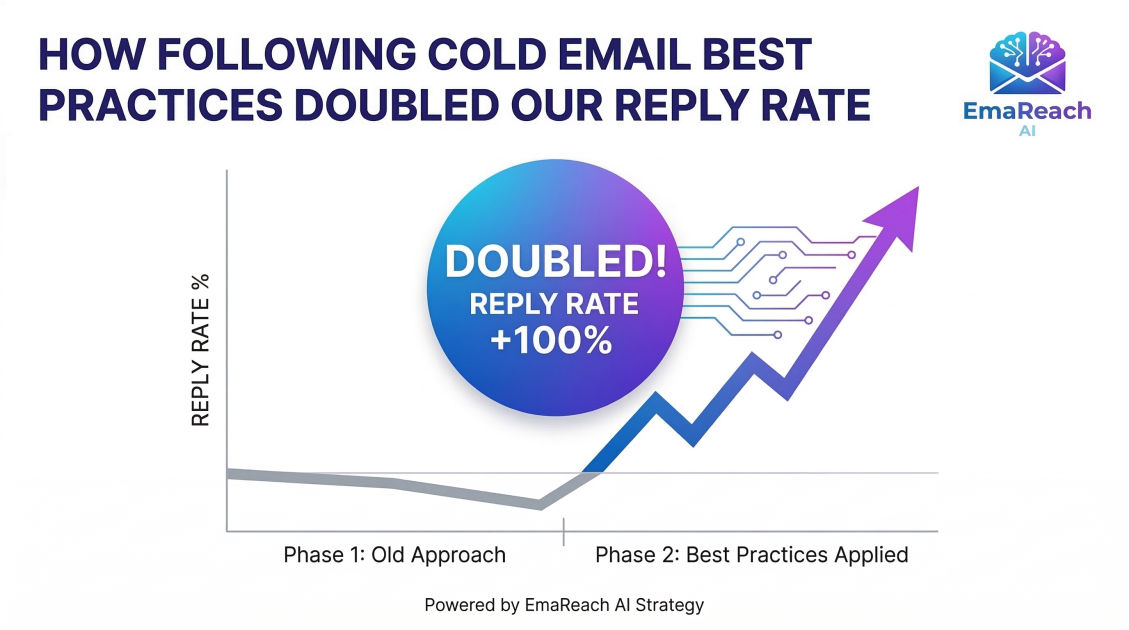
How Following Cold Email Best Practices Doubled Our Reply Rate
cold emailsales outreachemail deliverabilitylead generationb2b marketingemail marketing tips
Introduction: The Turning Point in Our Outreach Strategy
There is a thin line between a cold email that sparks a multi-million dollar partnership and one that ends up in the digital equivalent of a landfill. For a long time, we were firmly stuck in the latter category. Our outbound sales team was sending hundreds of emails every week, yet our reply rates were hovering at a dismal 1% to 2%. Most of our messages weren't even being opened, and those that were rarely elicited a response beyond 'Please unsubscribe.'
We realized that we weren't suffering from a bad product or a lack of effort; we were suffering from a lack of discipline. We were treating cold email like a volume game—a 'spray and pray' approach that ignored the psychological and technical nuances of modern inbox management.
Determined to turn things around, we did a complete audit of our process. We stripped back every element, from our technical infrastructure to our subject lines and call-to-actions. By strictly adhering to industry best practices, we didn't just see a marginal improvement; we doubled our reply rate in less than ninety days. This is the blueprint of how we did it.
Section 1: Fixing the Technical Foundation (The Deliverability First-Aid)
Before you write a single word of copy, you have to ensure that your emails actually reach the primary inbox. Most companies fail here because they treat their email accounts like disposable assets.
Authentication and DNS Records
We discovered that our emails were often flagged as spam because our domain authentication was incomplete. To fix this, we ensured that three key protocols were properly configured:
- SPF (Sender Policy Framework): A record that specifies which mail servers are authorized to send email on behalf of your domain.
- DKIM (DomainKeys Identified Mail): A digital signature that ensures the email hasn't been tampered with in transit.
- DMARC (Domain-based Message Authentication, Reporting, and Conformance): A policy that tells receiving servers what to do if an email fails SPF or DKIM checks.
The Importance of Inbox Warm-up
Sending 50 emails a day from a brand-new domain is a one-way ticket to the spam folder. We implemented a strict warm-up period, gradually increasing our volume over several weeks. This signaled to providers like Google and Outlook that we were legitimate senders. For those looking to streamline this process, EmaReach offers a powerful solution that combines AI-written cold outreach with automated inbox warm-up, ensuring your emails land in the primary tab where they belong.
Using Subdomains or Alternative Domains
To protect our primary business domain's reputation, we moved all cold outreach to dedicated 'sending domains.' This meant that even if one domain's reputation took a hit, our internal company communication remained unaffected.
Section 2: Building a High-Quality Prospect List
The most persuasive email in the world will fail if it is sent to the wrong person. Our initial failure was rooted in using outdated, generic lists purchased from low-quality brokers. These lists were riddled with 'catch-all' addresses and people who had changed jobs years ago.
Granular Segmentation
Instead of targeting 'Marketing Managers,' we started targeting 'Growth Marketing Leads at SaaS companies with 50-200 employees who recently raised Series B funding.' This level of granularity allowed us to tailor our message to specific pain points that were highly relevant to that exact moment in the company's lifecycle.
Verification is Non-Negotiable
We implemented a mandatory verification step for every email address. Any email that came back as 'undeliverable' or 'risky' was purged immediately. Keeping our bounce rate below 3% was a critical factor in maintaining our sender reputation and doubling our engagement levels.
Section 3: The Art of the Subject Line
The subject line has one job: to get the email opened. Our old subject lines were 'salesy' and transparent. Things like 'Quick Question' or 'Increase your ROI today!' were being filtered out by prospects' internal 'spam radars.'
The 'Low-Key' Approach
We shifted to lowercase, informal, and highly specific subject lines. We found that subject lines that looked like they could have come from a colleague or a friend performed best. Examples included:
- re: [Company Name] growth
- question about [Specific Project]
- ideas for [Department]
By removing the marketing fluff, our open rates climbed from 25% to over 60%. This higher open rate was the first vital step toward doubling our total reply volume.
Section 4: Crafting the Content - From Pitching to Problem Solving
Most cold emails fail because they are selfish. They focus on what the sender wants (a meeting, a demo, a sale) rather than what the recipient needs. Our transformation involved a radical shift in perspective.
The Personalization Hierarchy
True personalization isn't just inserting a {first_name} tag. We adopted a three-tier personalization strategy:
- The Individual: Mentioning a specific LinkedIn post they wrote, a podcast they appeared on, or a recent promotion.
- The Company: Mentioning a recent product launch, a news article, or a specific challenge their industry is facing.
- The Value Prop: Connecting our solution directly to one of the two points above.
The 'Short and Sweet' Rule
We capped our emails at 150 words. In a world of mobile-first reading, no one has time for a five-paragraph essay from a stranger. We focused on a clear structure:
- The Hook: A personalized opening sentence that proves we did our research.
- The Problem: Acknowledging a specific pain point they likely face.
- The Solution: A one-sentence explanation of how we solve that problem.
- Social Proof: A brief mention of a similar company we helped.
- The CTA: A low-friction request.
Low-Friction Call to Actions (CTAs)
We stopped asking for '15 minutes on Tuesday.' That is a high-friction request that requires the prospect to check their calendar. Instead, we shifted to interest-based CTAs:
- 'Would you be opposed to seeing a short video on how we did this?'
- 'Is this something that is currently a priority for your team?'
- 'Worth a brief chat?'
These questions are much easier to answer with a 'Yes' or 'No,' significantly lowering the barrier to entry for a response.
Section 5: The Power of the Follow-Up
Statistics consistently show that the majority of sales happen after the fourth or fifth touchpoint, yet most people give up after one or two. We realized we were leaving money on the table by being 'too polite' to follow up.
The Multi-Channel Sequence
We built a 6-step sequence that spanned 21 days. It wasn't just more emails; it was a mix of value-adds.
- Day 1: Initial Email
- Day 3: Follow-up (Bumping the previous email with a quick thought)
- Day 7: Value-Add (Sharing a relevant case study or article)
- Day 12: The 'Permission' Follow-up (Asking if we should stop reaching out)
- Day 21: The Break-up Email
Our 'Break-up' email—where we politely informed the prospect that we would be closing their file—accounted for nearly 15% of our total replies. People don't like to miss out on potentially valuable opportunities, and this final nudge often triggered a response from someone who had simply been too busy to reply earlier.
Section 6: Testing and Iteration
You cannot improve what you do not measure. We stopped guessing what worked and started relying on A/B testing. We tested everything:
- Subject line A vs. Subject line B
- Sending at 8:00 AM vs. 2:00 PM
- Direct CTA vs. Interest-based CTA
By isolating variables, we could see exactly which changes contributed to the doubling of our reply rate. We found, for example, that sending emails on Tuesday and Wednesday mornings resulted in a 20% higher reply rate than sending on Fridays. We also discovered that mentioning a specific competitor of the prospect increased engagement by 35%.
Section 7: Common Pitfalls We Eliminated
As we refined our process, we identified several 'deadly sins' of cold emailing that we had previously been guilty of. Removing these was just as important as adding the best practices.
1. The 'I' Centric Language
We scanned our old emails and found the word 'I' or 'We' appeared 15 times, while 'You' or 'Your' appeared only twice. We flipped that ratio. The email should always be about the prospect's world, not yours.
2. Including Links and Attachments too Early
In initial emails, links and attachments are spam triggers. They also distract the reader. We moved all links (except for the required unsubscribe link) to the second or third email in the sequence.
3. Using Tracked Links
While it’s tempting to track every click, many spam filters view tracked links (which use redirects) with suspicion. We moved toward plain-text emails with no tracking on the links themselves to ensure maximum deliverability.
Conclusion
Doubling our reply rate wasn't the result of a single 'magic' hack or a secret template. It was the cumulative effect of dozens of small, disciplined improvements. By focusing on technical health, hyper-specific targeting, genuine personalization, and persistent follow-up, we transformed cold email from an annoying chore into our most predictable revenue driver.
The landscape of digital communication is constantly evolving, but the core principles of human psychology remain the same. People want to be seen, they want their problems solved, and they want to be treated like individuals rather than entries in a database. When you align your cold email strategy with these truths, the results speak for themselves.
EmaReach AI
Ready to scale your cold email outreach?
Join thousands of teams using EmaReach AI for AI-powered campaigns, domain warmup, and 95%+ deliverability. Start free — no credit card required.
Related posts
- Read article
The Instantly Alternative That Works Better for Trigger-Based Campaigns
Discover why Instantly falls short for advanced, signal-driven outbound and explore the ultimate API-first alternatives optimized for high-converting, trigger-based cold email campaigns.
- Read article
The Instantly Alternative That Handles High Bounce Rates Without Panic
Discover how transitioning to an advanced Instantly alternative can safeguard your cold email infrastructure. Learn to handle high bounce rates effortlessly using real-time verification, smart mailbox rotation, and automated safety nets to protect your sender reputation and maintain consistent primary inbox placement.