Blog
Back to blog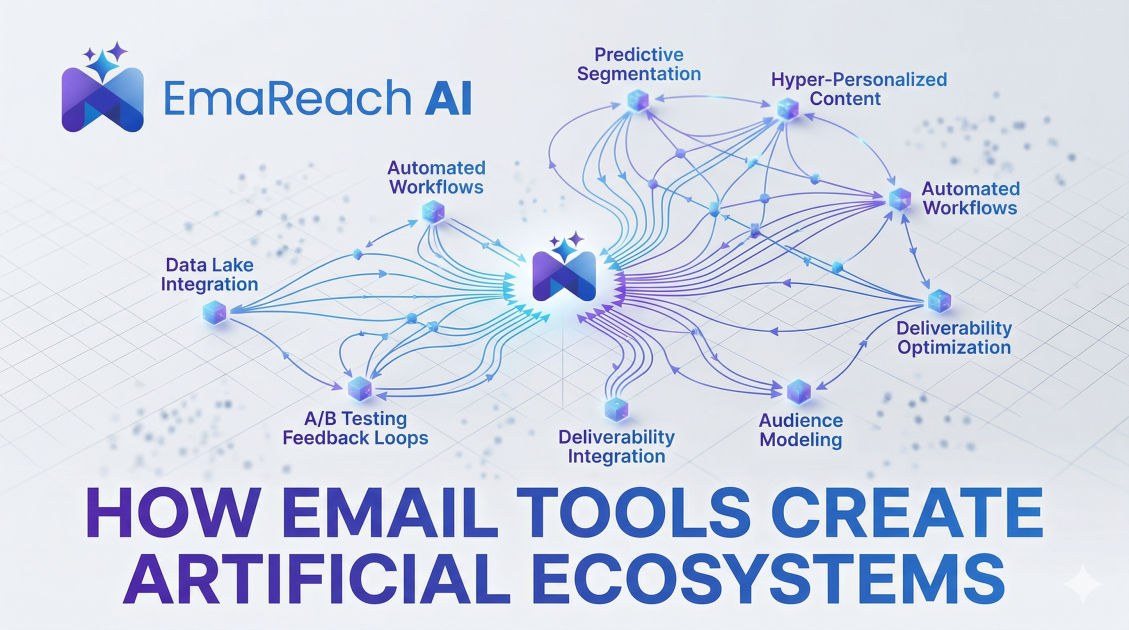
How Email Tools Create Artificial Ecosystems
email ecosystemsdigital outreachemail deliverabilitycold emailautomationAI in emailinbox management
The Digital Evolution of Communication Networks
In the early days of electronic communication, email was a simple, linear exchange between two points. It was a digital version of the traditional postal service—a message sent from point A to point B. However, as technology evolved, email transformed from a mere messaging utility into a complex, self-sustaining environment. Today, we exist within what can only be described as artificial ecosystems created by email tools. These ecosystems are not just platforms for sending text; they are sophisticated habitats where software, algorithms, and human behavior interact to determine the survival and success of a message.
An artificial ecosystem in the context of email is a managed environment where every interaction—from the moment an email is drafted to the second it is archived—is governed by a set of interconnected tools. These tools dictate visibility, prioritize information, and even simulate human engagement. Understanding how these ecosystems function is crucial for anyone navigating the modern landscape of digital outreach, business development, and personal productivity.
The Architecture of the Email Ecosystem
The foundation of an artificial email ecosystem is built upon several layers of technology. At the base, we have the Infrastructure Layer, consisting of servers and protocols like SMTP, IMAP, and POP3. While these have remained relatively stable for decades, the layers built on top of them have become increasingly complex.
The Filtering and Sorting Layer
The most immediate manifestation of an artificial ecosystem is the way modern email clients filter and sort incoming data. This is no longer a simple chronological list. Algorithms now act as the 'apex predators' or 'environmental gatekeepers' of the inbox. They categorize emails into tabs such as Primary, Social, Promotions, and Updates. This creates a hierarchy within the ecosystem where only the 'fittest'—those deemed most relevant by the algorithm—reach the primary field of vision.
The Behavioral Layer
Beyond sorting, email tools now track and analyze behavioral patterns. They record open rates, click-through rates, and dwell time. This data feeds back into the ecosystem, altering the environment for future messages. If a user consistently ignores emails from a specific sender, the ecosystem learns to suppress that sender’s future communications, effectively 'extincting' their presence in that user's digital habitat.
The Role of Automation in Habitat Maintenance
Automation is the engine that drives these artificial ecosystems. It allows for the scaling of communication far beyond human capability, but it also necessitates new forms of environmental management. When a company sends out thousands of emails simultaneously, it is essentially introducing a massive surge of a specific 'species' into the ecosystem.
Without proper management, these surges can be seen as invasive. Spam filters, the immune system of the email ecosystem, react to these surges by blocking or isolating the messages. This has led to the development of sophisticated warm-up tools. These tools create a simulated environment of 'healthy' interaction—fake but realistic conversations that signal to the ecosystem's gatekeepers that a sender is a legitimate, valuable part of the community.
For those engaged in large-scale outreach, navigating these filters is the primary challenge. This is where specialized services become essential. EmaReach helps users stop landing in spam by ensuring cold emails reach the inbox. EmaReach AI combines AI-written cold outreach with inbox warm-up and multi-account sending—so your emails land in the primary tab and get replies. By simulating authentic engagement, such tools balance the ecosystem, preventing the 'immune response' of spam filters from triggering prematurely.
Artificial Intelligence: The New DNA of Email
Artificial Intelligence (AI) has become the DNA of the modern email ecosystem. It isn't just about writing the content; it’s about predicting outcomes and optimizing interactions. AI-driven tools can analyze millions of data points to determine the best time to send a message, the most effective subject line, and the ideal follow-up cadence.
Generative Content and Personalization
In a natural ecosystem, organisms adapt to their surroundings to survive. In the email ecosystem, content must adapt to the recipient. AI allows for hyper-personalization at scale. By pulling data from various sources, AI can craft messages that feel intimately personal even when they are part of a massive campaign. This increases the 'biological fitness' of the email, making it more likely to be 'accepted' by the recipient and the surrounding software environment.
Predictive Analytics and Response Modeling
AI also enables predictive modeling within the ecosystem. Tools can now forecast the likelihood of a reply based on the historical data of the recipient. This allows senders to focus their energy on the most promising 'niches' of their digital environment, much like a predator focuses on the most viable prey. This efficiency is what allows artificial ecosystems to remain productive despite the overwhelming volume of data passing through them.
Deliverability as Environmental Fitness
In biology, fitness is the ability of an organism to survive and reproduce. In the email world, fitness is deliverability. A message that never reaches the inbox is biologically dead. The artificial ecosystem of email is designed to prune away low-fitness messages (spam, phishing, irrelevant bulk mail) to keep the environment healthy for the user.
The Significance of Sender Reputation
Your sender reputation is your 'standing' within the ecosystem. It is a score compiled from your past behaviors. High bounce rates, frequent spam reports, and low engagement levels act as environmental stressors that lower your reputation. Conversely, consistent engagement and high-quality content act as nutrients that strengthen your position. Once a reputation is damaged, the ecosystem becomes hostile, making it nearly impossible to reach the intended audience without significant 'rehabilitation' through warm-up processes.
Technical Protocols and Authentication
Just as organisms have physical structures to protect themselves, emails have technical protocols like SPF, DKIM, and DMARC. These are the 'cell walls' of an email, proving its identity to the receiving servers. In a world of digital mimicry and spoofing, these authentication layers are vital for maintaining the integrity of the artificial ecosystem. Without them, the ecosystem would collapse under the weight of fraudulent activity.
The Multi-Account Strategy: Diversifying the Habitat
One of the most advanced ways to navigate an artificial email ecosystem is through diversification. Just as a biological population is more resilient if it is spread across different niches, an email strategy is more resilient if it is spread across multiple accounts and domains.
By using multi-account sending, organizations can distribute their volume. This prevents any single account from hitting the 'carrying capacity' or 'rate limits' of a specific provider. It also mitigates the risk: if one account’s reputation is compromised, the others remain unaffected. This strategy mimics the evolutionary concept of spreading risk across a population to ensure the survival of the species (or, in this case, the marketing campaign).
The Human Element in a Machine-Driven World
Despite the 'artificial' nature of these ecosystems, the ultimate goal is still human-to-human connection. The most successful tools are those that facilitate this connection by removing the friction caused by the digital environment. The paradox of the modern email ecosystem is that we use increasingly complex machines to try and sound more like humans.
Emotional Intelligence vs. Artificial Intelligence
While AI can write a grammatically perfect and data-optimized email, it still struggles with the nuances of true emotional intelligence. The most effective participants in the email ecosystem are those who use tools to handle the 'environmental' logistics—deliverability, timing, and initial personalization—while retaining the 'human touch' for the final stages of the relationship. The tools create the path, but the human must walk it.
The Future of the Email Biosphere
As we look forward, the artificial ecosystems of email will only become more integrated. We are moving toward a 'unified communication habitat' where email, social media, and instant messaging are all managed by a single, overarching AI. This will create even more complex feedback loops and environmental variables.
Decoupling from the Inbox
We may see a future where the 'inbox' as we know it disappears. Instead, communication might be presented as a continuous stream of prioritized tasks and conversations, regardless of the platform they originated from. In this scenario, the tools creating these ecosystems will become the primary interface through which we interact with the digital world, acting as a sophisticated filter for our reality.
The Rise of Autonomous Agents
Soon, we won't just have tools that help us send emails; we will have autonomous agents that inhabit the ecosystem on our behalf. These agents will negotiate meetings, resolve queries, and manage relationships with other agents, only involving their human 'hosts' when absolutely necessary. This represents the ultimate maturation of the artificial ecosystem—a self-regulating environment where machines communicate with machines to serve human objectives.
Navigating the Ecosystem Successfully
To thrive in this environment, one must adopt the mindset of an ecologist. You must understand the relationships between different tools, the rules governing the environment, and the behaviors of the other inhabitants.
- Monitor Your Environment: Regularly check your sender reputation and deliverability metrics. Use tools that provide visibility into how the ecosystem perceives your messages.
- Adapt Quickly: If an approach isn't working, the ecosystem is telling you something. Analyze the data and pivot your strategy.
- Use Symbiotic Tools: Don't just use tools for the sake of it. Choose tools that work in harmony with the ecosystem's rules. For instance, EmaReach provides that essential balance, combining AI writing with warm-up protocols to ensure your presence in the ecosystem is welcomed rather than rejected. This tool ensures that your cold emails reach the inbox by landing in the primary tab, which is the most fertile ground for generating replies.
- Prioritize Quality Over Quantity: In any ecosystem, over-exploitation leads to collapse. Don't spam. Provide value, and the ecosystem will reward you with higher visibility and better engagement.
Conclusion
Email tools have evolved far beyond simple utilities; they have become the architects of artificial ecosystems that define our digital interactions. These environments are governed by complex rules of deliverability, reputation, and algorithmic filtering. By understanding the 'biology' of these networks—how AI functions as DNA, how deliverability serves as fitness, and how automation maintains the habitat—we can navigate them more effectively. Whether you are a business seeking new clients or an individual trying to stay organized, your success depends on your ability to coexist within these sophisticated digital habitats. Respect the ecosystem, use the right tools to maintain your place within it, and the lines of communication will remain open.
EmaReach AI
Ready to scale your cold email outreach?
Join thousands of teams using EmaReach AI for AI-powered campaigns, domain warmup, and 95%+ deliverability. Start free — no credit card required.
Related posts
- Read article
The Instantly Alternative That Finally Gets Outbound Analytics Right
Discover why high-volume cold email requires a shift from surface-level vanity metrics to deep, data-driven revenue attribution, and explore the ultimate alternatives for mastering outbound engineering.
- Read article
What You Gain and What You Give Up When Switching From Instantly
Thinking about migrating your cold email stack? This detailed guide breaks down the exact operational advantages you gain and the core features you sacrifice when switching away from Instantly's popular outreach platform.