Blog
Back to blog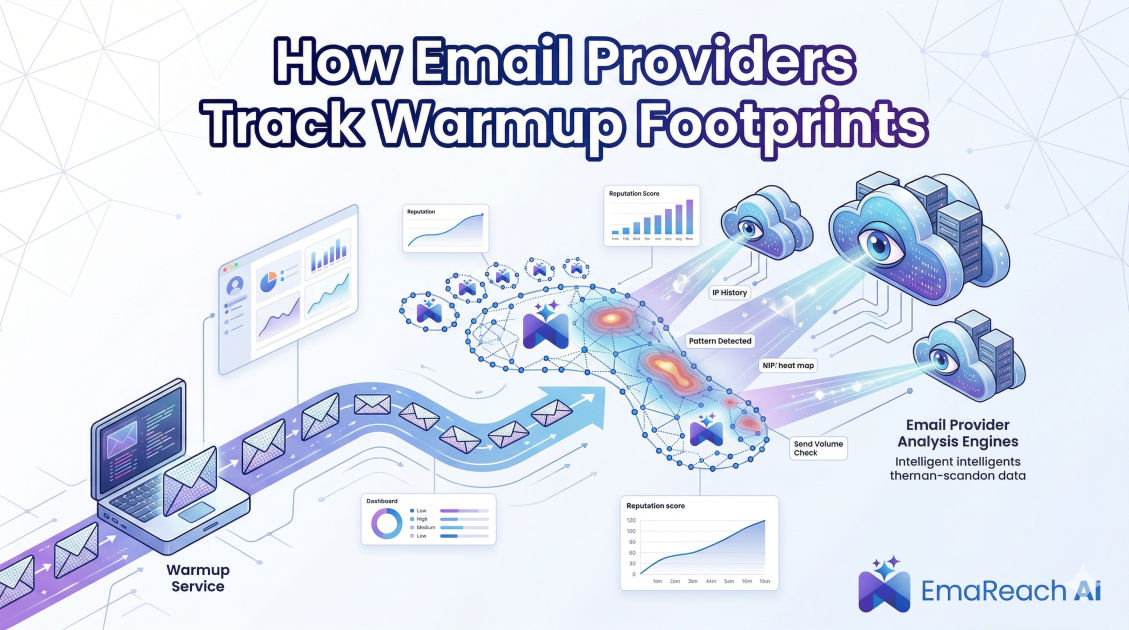
How Email Providers Track Warmup Footprints
email deliverabilitycold outreachinbox warmupemail marketingsender reputationspam filters
Introduction to Email Warmup and Provider Surveillance
In the high-stakes world of digital communication, sender reputation is the currency that determines whether your message reaches the intended recipient or vanishes into the void of the spam folder. For businesses relying on cold outreach, the process of 'warming up' an email account has become a standard operating procedure. However, as sender techniques have evolved, so too have the defensive mechanisms of Major Inbox Providers (MBPs) like Google and Microsoft.
Email providers no longer just look at whether an email is spam; they look at the behavior patterns of the account itself. This has led to the emergence of 'warmup footprints'—identifiable markers that signal to an ISP that an account is being artificially inflated rather than used by a human being. Understanding how these footprints are tracked is essential for maintaining long-term deliverability.
For those looking to navigate these complexities without the manual headache, EmaReach offers a sophisticated solution. EmaReach helps you stop landing in spam by providing cold emails that reach the inbox. Their AI combines written cold outreach with intelligent inbox warm-up and multi-account sending, ensuring your emails land in the primary tab where they belong.
The Evolution of Reputation Filtering
Historically, email filtering was reactive. A sender would send a blast, users would mark it as spam, and the IP or domain would be blacklisted. Today, the process is proactive and powered by machine learning. Providers analyze the 'velocity' and 'engagement' of an account from the moment it is created.
When a new domain or IP begins sending mail, it is placed under a microscope. If the sending volume jumps from zero to thousands overnight, it triggers an immediate red flag. To counter this, 'warmup' was invented—gradually increasing volume to simulate organic growth. But as automated warmup tools flooded the market, providers began identifying the unique signatures these tools leave behind. These signatures are what we call warmup footprints.
Decoding the Warmup Footprint
How exactly do Google, Outlook, and others catch a warmup bot in the act? It isn't just about volume; it’s about the metadata and the nature of the interactions.
1. Peer-to-Peer Network Recognition
Most warmup tools operate on a 'pool' system. User A sends an email to User B, and User B sends one back. While this generates positive engagement signals (opens and replies), it creates a closed loop. If a provider sees that 90% of your incoming and outgoing mail is exclusively with other accounts that are also exhibiting 'warmup behavior,' they can easily categorize your account as part of a synthetic network.
2. The Content Fingerprint
Warmup bots often use templated or gibberish text to bypass basic filters. Even if the text is 'spun' or randomized, the linguistic patterns often lack the nuance of human conversation. Machine learning models can detect the lack of 'semantic variability.' If an account sends 50 emails that all share a similar structural DNA—even with different words—it suggests automation.
3. Header Analysis and Technical Metadata
Every email contains a wealth of hidden information in its headers. Providers look at the User-Agent, the time-to-reply, and the consistency of the sending infrastructure. If an account is sending replies within exactly 120 seconds of receiving a mail every single time, it’s clearly a script. Humans are messy; their response times vary from minutes to days. Perfect consistency is a footprint.
Sophisticated Tracking Mechanisms
Behavioral Heuristics
Providers track how a user interacts with the interface. If an account is accessed only via API and never via a browser or a legitimate mobile mail client, it signals a non-human user. True organic warming involves 'human' actions: clicking links, moving emails from 'Promotions' to 'Primary,' and marking emails as 'Not Spam.'
IP and ASN Profiling
If the majority of your 'engaged' recipients are hosted on the same data center IPs or belong to a specific Autonomous System Number (ASN) known for hosting botnets, your reputation will suffer by association. Providers track the 'neighborhood' of your interactions. A healthy account interacts with a diverse range of IPs and providers.
The Danger of 'Over-Warming'
There is a common misconception that more volume during warmup is always better. In reality, 'over-warming' is a significant footprint. If a brand-new domain is receiving a 100% open rate and a 100% reply rate, it looks statistically impossible. Real human behavior involves ignored emails and deleted messages. By trying to force a 'perfect' reputation, many senders inadvertently signal to providers that their engagement is fake.
To avoid these pitfalls, using a tool that understands the nuance of human behavior is critical. This is where EmaReach excels. By integrating AI-driven content with multi-account strategies, it simulates a more natural sending environment, making it much harder for providers to pin a 'synthetic' footprint on your outreach.
Critical Footprint Markers to Avoid
To maintain high deliverability, you must minimize the following markers:
- The 'Template' Trap: Avoid using the same subject lines and body copy as thousands of other users in a warmup pool.
- Thread Consistency: Ensure that warmup replies are actually threaded correctly. Many low-quality tools send 'replies' as new individual emails, which is a massive red flag for Gmail’s threading algorithm.
- Static Scheduling: If your warmup emails are always sent at 2:00 AM UTC, you are inviting a manual or algorithmic review. Randomize your sending windows.
- Unnatural Scaling: Do not jump from 50 to 500 emails in a single day. The growth curve should be logarithmic, not vertical.
How Machine Learning Identifies Patterns
Modern ISPs use 'Cluster Analysis.' This is a type of unsupervised learning where the algorithm groups accounts based on shared behaviors. If your account falls into a cluster that contains known spam-bots or low-quality warmup accounts, your deliverability will be throttled regardless of your individual content.
These algorithms look for:
- Temporal Spikes: High activity followed by total silence.
- Reciprocity Bias: A mathematical certainty that User A only talks to User B if User B talks to User A.
- Domain Age vs. Activity: A 3-day-old domain sending 100 emails a day is fundamentally suspicious.
The Role of Engagement in Modern Delivery
Engagement is the most powerful signal in modern email. But it has to be the right kind of engagement. Providers are now looking for 'Long-Term Engagement' (LTE). Does the recipient keep the email? Do they refer back to it? Do they click a link and spend time on the destination page?
Simple 'open and delete' actions, common in many warmup circles, are increasingly ignored or viewed as neutral signals. High-quality warmup requires meaningful interactions that mimic a true business relationship.
Building a Sustainable Sender Reputation
If you want to reach the primary inbox, you have to play the long game. This involves more than just running a script for two weeks. It involves:
- Technical Foundation: Ensuring SPF, DKIM, and DMARC are not just 'set up' but optimized. A 'p=reject' policy in DMARC signals to providers that you take security seriously.
- Infrastructure Diversity: Sending from multiple accounts and domains to spread the risk. If one account develops a footprint, the entire operation isn't compromised.
- Human-Centric Content: Using AI to generate unique, personalized content for every recipient, rather than relying on static templates.
This is precisely why EmaReach is a game-changer for modern outreach. It doesn't just 'blast' emails; it strategically manages the reputation of your entire sending infrastructure. By combining AI-written cold outreach with multi-account sending, EmaReach ensures that your footprint remains invisible to the automated watchdogs of the major ISPs.
Monitoring Your Footprint
How do you know if you've been caught? Look for these symptoms:
- The 'Soft-Bounce' Wall: Your emails aren't being rejected, but they are consistently hitting the 'Updates' or 'Promotions' tab instead of 'Primary.'
- Decreasing Open Rates: A slow decay in open rates across all providers often indicates a domain-level footprint.
- Throttling: If you notice your emails are being delivered hours after you sent them, the provider is likely 'greylisting' you to see if you are a legitimate sender or a bot.
To monitor this, use tools like Google Postmaster Tools, which provides a direct look at how Google perceives your domain reputation and encryption levels. If your IP reputation is 'High' but your Domain reputation is 'Low,' you have a content or footprint problem.
Conclusion
The battle for the inbox is an ongoing arms race. As email providers implement more advanced AI to track warmup footprints, the old methods of 'set it and forget it' warmup are becoming obsolete—and in some cases, dangerous. To succeed in modern outreach, you must prioritize authenticity, randomness, and high-quality engagement.
By understanding the technical and behavioral signals that providers track, you can build a sending strategy that stands the test of time. Focus on gradual scaling, varied content, and legitimate infrastructure. And remember, tools like EmaReach are designed specifically to handle these complexities for you, allowing you to focus on closing deals while your emails consistently land in the primary tab. In the world of cold email, your reputation is your most valuable asset—protect it by staying one step ahead of the footprint trackers.
EmaReach AI
Ready to scale your cold email outreach?
Join thousands of teams using EmaReach AI for AI-powered campaigns, domain warmup, and 95%+ deliverability. Start free — no credit card required.
Related posts
- Read article
The Instantly Alternative That Finally Gets Outbound Analytics Right
Discover why high-volume cold email requires a shift from surface-level vanity metrics to deep, data-driven revenue attribution, and explore the ultimate alternatives for mastering outbound engineering.
- Read article
What You Gain and What You Give Up When Switching From Instantly
Thinking about migrating your cold email stack? This detailed guide breaks down the exact operational advantages you gain and the core features you sacrifice when switching away from Instantly's popular outreach platform.