Blog
Back to blog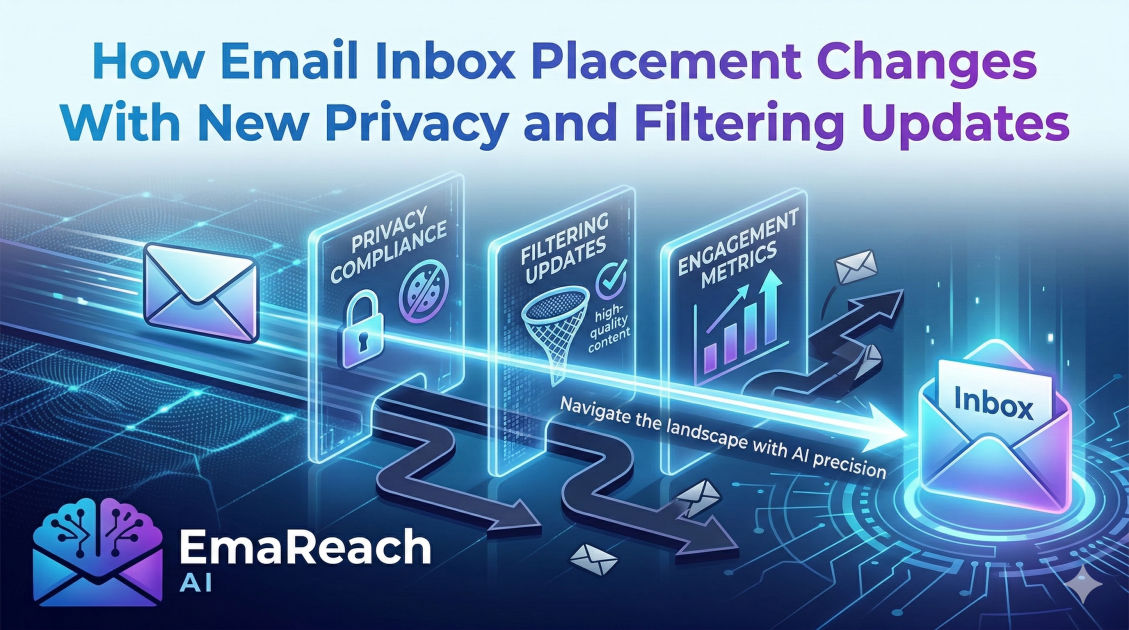
How Email Inbox Placement Changes With New Privacy and Filtering Updates
email deliverabilityinbox placementemail privacysender reputationspam filteringcold emailemail marketing
The New Era of Email Deliverability
The landscape of digital communication is undergoing its most significant transformation since the invention of the spam filter. For years, email marketing was a game of volume and broad technical compliance. However, a wave of new privacy protections and sophisticated filtering updates from major mailbox providers has fundamentally altered how emails are processed, categorized, and delivered. Understanding these changes is no longer optional for businesses—it is a requirement for survival in the inbox.
Today, inbox placement is no longer just about avoiding the 'Spam' folder; it is about earning a spot in the 'Primary' tab. As providers like Google and Yahoo implement stricter requirements for bulk senders and privacy-focused features like Apple Mail Privacy Protection (MPP) become the industry standard, the metrics we once relied on have shifted. This guide explores the mechanics of these changes and provides a roadmap for navigating the future of email deliverability.
The Shift from Technical Compliance to Sender Reputation
In the past, email deliverability was largely viewed as a technical checklist. If you had your SPF, DKIM, and DMARC records set up, you were generally considered a 'good' sender. While these authentication protocols remain critical, they are now merely the baseline. Modern filtering updates have shifted the focus toward Sender Reputation, a dynamic score determined by real-time user engagement and behavioral signals.
The Rise of Engagement-Based Filtering
Mailbox providers now use machine learning models to analyze how individual users interact with your content. If a user consistently opens your emails, clicks links, and moves them to folders, your reputation with that specific provider improves. Conversely, if users ignore your emails, delete them without opening, or—worst of all—mark them as spam, your reach will plummet across the entire network.
The Impact of 'Ghost' Open Rates
With the introduction of privacy features that pre-load tracking pixels, 'Open Rates' have become an unreliable metric. These updates hide the user's IP address and mask their actual activity. As a result, filters are moving away from simple opens and focusing on deeper signals, such as 'Time spent reading,' 'Reply rates,' and 'Forwarding.' To maintain high inbox placement, senders must prioritize content that provokes a genuine response.
Stricter Requirements for Bulk Senders
Major mailbox providers have recently codified new rules for anyone sending high volumes of email. These updates are designed to declutter the inbox and protect users from unsolicited noise. Failure to adhere to these standards doesn't just result in a warning; it leads to immediate blocking or permanent placement in the spam folder.
Mandatory One-Click Unsubscribe
One of the most significant updates is the requirement for a functional, one-click unsubscribe header. Privacy updates now dictate that users should not have to hunt for a link or log into a website to stop receiving emails. If the process is cumbersome, providers will interpret this as a lack of transparency, negatively impacting your sender score.
The 0.3% Spam Complaint Threshold
Filters have become much less tolerant of complaints. While a 0.1% complaint rate was once the 'safe' zone, providers have now established a hard ceiling—often around 0.3%. Crossing this threshold, even briefly, can trigger a 'reputation death spiral' where your emails are automatically diverted to spam for all recipients, regardless of their individual engagement history.
How Privacy Updates Affect Data Collection and Targeting
Privacy-centric updates, such as those that limit cross-app tracking and hide user metadata, have changed the way marketers build and segment their lists. Without accurate location data or reliable open timestamps, traditional 'send time optimization' and 'geo-targeting' are becoming less effective.
The Move Toward Zero-Party Data
To combat the loss of third-party tracking, successful senders are pivoting to Zero-Party Data. This is information that a customer intentionally and proactively shares with a brand. This might include preference centers where users choose the frequency and topics of the emails they receive. By aligning your sending habits with documented user preferences, you bypass many of the algorithmic hurdles set by privacy updates.
The Importance of Infrastructure Health
Beyond content, the 'pipes' through which your email flows are under more scrutiny than ever. This includes the reputation of your IP address and the age of your sending domain. New domains are often 'sandboxed' by filters until they prove a consistent pattern of high-quality sending.
For those engaging in outbound strategies, tools like EmaReach have become essential. EmaReach helps businesses stop landing in spam by providing cold emails that reach the inbox through a combination of AI-written outreach, multi-account sending, and automated inbox warm-up. This ensures that even in a climate of strict filtering, your primary tab placement remains secure.
The Architecture of Modern Filtering: AI and Machine Learning
Modern filters are no longer static lists of 'forbidden words.' Instead, they are complex AI systems that look for patterns. They analyze the 'fingerprint' of an email, comparing it to millions of other messages sent across the global web.
Content Neutrality and Contextual Analysis
Filters can now distinguish between a legitimate promotional offer and a phishing attempt, even if they use similar language. They look for the consistency of the 'From' name, the alignment of the domain in the link with the domain of the sender, and the presence of suspicious attachments. If your infrastructure (the back-end technicals) doesn't match the promise of your content (the front-end message), AI filters will flag the discrepancy.
Behavioral Clusters
Providers are now clustering senders based on behavior. If your sending patterns resemble those of known spammers—such as sudden spikes in volume or high bounce rates—you will be grouped with them. This 'guilt by association' makes it harder for legitimate businesses to recover once their reputation is tarnished. Consistent, steady sending volumes are now a hallmark of a healthy sender.
Strategies for Maintaining High Inbox Placement
Adapting to these updates requires a proactive strategy that spans technical setup, list hygiene, and content creation. Here is how to navigate the new landscape:
1. Rigorous List Hygiene
Sending emails to inactive addresses is a fast track to the spam folder. With modern updates, 'dead' accounts are often converted into Spam Traps by providers. If you hit a spam trap, it signals to the provider that you are using an old, unmaintained, or purchased list. Regularly scrubbing your list to remove unengaged subscribers is the single most effective way to protect your reputation.
2. Diversifying Sending Accounts
Putting all your eggs in one basket is a risky strategy in the current environment. If one domain or IP gets flagged, your entire operation halts. Multi-account sending allows you to spread your volume across multiple authenticated identities, mimicking a more natural, human-like sending pattern that AI filters are less likely to flag as 'bulk' or 'automated.'
3. Authentic Engagement and Personalization
Because engagement is the primary driver of placement, personalization must go beyond just inserting a first name. Content must be relevant to the recipient’s recent actions or specific needs. High-quality AI can assist in crafting messages that feel personal and provide genuine value, increasing the likelihood of a reply—the 'gold standard' of engagement signals.
4. Continuous Reputation Monitoring
Waiting for your delivery rates to drop before checking your reputation is a mistake. Senders should use postmaster tools and reputation monitors to keep a daily eye on their domain health. Early detection of a slight rise in complaint rates or a dip in delivery can allow you to pivot your strategy before the damage becomes permanent.
The Future: Toward a More Transparent Inbox
The ultimate goal of these privacy and filtering updates is a better experience for the end-user. While they present challenges for marketers and outreach professionals, they also provide an opportunity. By focusing on transparency, authentication, and high-value content, senders can build stronger, more profitable relationships with their audience.
In this new era, the 'trickery' of the past—such as misleading subject lines or hidden unsubscribe links—is not just unethical; it is technically impossible to sustain. The inbox is becoming a curated space where only the most relevant and trusted senders are allowed to reside.
Conclusion
Navigating the changes in email inbox placement requires a shift in mindset from 'how much can I send?' to 'how much value can I provide?' Privacy updates and stricter filtering are not barriers; they are the new rules of engagement. By prioritizing sender reputation, embracing multi-account strategies, and utilizing advanced tools like EmaReach to ensure emails land in the primary tab, businesses can thrive in an increasingly competitive digital environment. The secret to the inbox isn't found in a hack or a shortcut—it’s found in building a consistent, authenticated, and engagement-driven presence that mailbox providers and users alike can trust.
EmaReach AI
Ready to scale your cold email outreach?
Join thousands of teams using EmaReach AI for AI-powered campaigns, domain warmup, and 95%+ deliverability. Start free — no credit card required.
Related posts
- Read article
The Instantly Alternative That Finally Gets Outbound Analytics Right
Discover why high-volume cold email requires a shift from surface-level vanity metrics to deep, data-driven revenue attribution, and explore the ultimate alternatives for mastering outbound engineering.
- Read article
What You Gain and What You Give Up When Switching From Instantly
Thinking about migrating your cold email stack? This detailed guide breaks down the exact operational advantages you gain and the core features you sacrifice when switching away from Instantly's popular outreach platform.