Blog
Back to blog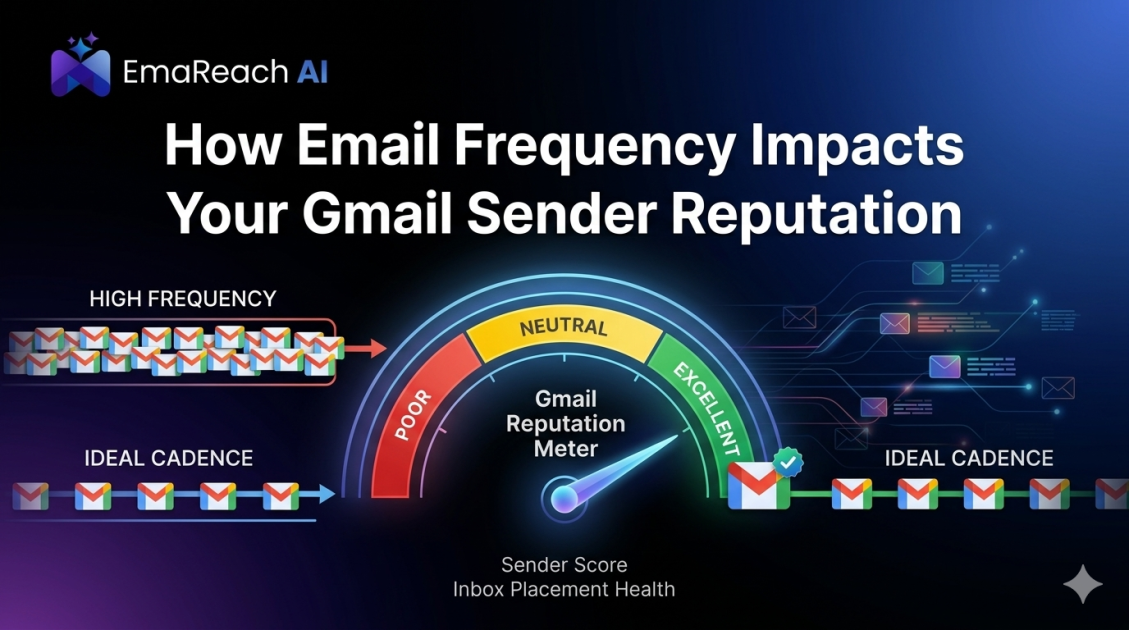
How Email Frequency Impacts Your Gmail Sender Reputation
email deliverabilitygmail reputationsender scoreemail frequencycold outreachemail marketinginbox placement
Introduction
Gmail is the most widely used email provider in the world, and its filtering algorithms are among the most sophisticated ever developed. For businesses and individual senders, maintaining a high sender reputation with Google is the difference between a successful campaign and an invisible one. While many factors influence deliverability—such as authentication and content quality—one of the most critical yet misunderstood variables is email frequency.
Email frequency refers to how often you send messages to your audience. It is a delicate balancing act: send too rarely, and your audience forgets you; send too often, and you risk being flagged as a nuisance. This guide explores the deep mechanics of how frequency affects your Gmail sender reputation and how to optimize your sending patterns for maximum inbox placement.
The Concept of Gmail Sender Reputation
Before diving into frequency, it is essential to understand what sender reputation actually is. Gmail assigns a score to every sending IP address and domain. This score is a reflection of how trustworthy Google deems you to be. A high score ensures your emails land in the Primary tab, while a low score pushes them to the Promotions tab or, worse, the Spam folder.
Google uses machine learning models to track user behavior. They look at how recipients interact with your emails. If people consistently open, read, and reply to your messages, your reputation rises. If they ignore them, delete them without opening, or mark them as spam, your reputation takes a hit. Frequency is a primary driver of these user behaviors.
Why Frequency Matters to Google’s Algorithms
Gmail’s primary goal is to protect its users from unwanted content. High-frequency sending is a hallmark of traditional spam. Spammers often blast massive volumes of email in a short period to maximize their reach before they get blocked. Consequently, sudden spikes in email frequency act as a red flag for Google’s security filters.
Consistency is the hallmark of a legitimate sender. When a domain sends a predictable volume of email over a sustained period, Google views that sender as stable and reliable. Drastic fluctuations—sending 5,000 emails one day and zero for the next two weeks—create unpredictability that triggers protective filtering.
The Negative Impact of High-Frequency Sending
Sending too many emails is the most common way to damage a sender reputation. Even if your content is valuable, excessive frequency leads to several negative outcomes:
1. Increased Spam Complaints
This is the most direct threat. When users feel overwhelmed by an overflowing inbox, their quickest solution is to hit the 'Report Spam' button. For Gmail, a spam complaint is the strongest possible signal that a sender is unwelcome. Even a small increase in your complaint rate can lead to a sitewide block of your domain.
2. Rising Unsubscribe Rates
While unsubscribes are better than spam complaints, a high volume of people leaving your list tells Google that your content is no longer relevant. When Gmail sees that a large percentage of recipients are opting out immediately after receiving a message, it may start deprioritizing your emails in the inbox.
3. Reduced Engagement Metrics
Engagement fatigue is real. If you send an email every day, the perceived value of each individual message drops. Users begin to skim or ignore your messages. Lower open and click-through rates signal to Gmail that your audience is no longer interested in what you have to say, which gradually lowers your reputation.
The Dangers of Low-Frequency Sending
Counterintuitively, sending too infrequently can be just as damaging as sending too often. This is known as 'list stagnation.'
1. Sender Recognition Issues
If you only send an email once every three months, your subscribers might forget who you are. When your email finally arrives, they may assume it is spam because they don't recognize the sender name. This leads to high complaint rates from a legitimate list.
2. IP and Domain 'Coldness'
Reputation is not permanent; it must be maintained. If a domain goes silent for a long period, Gmail’s 'memory' of that sender fades. When you resume sending, you are treated almost like a new sender, meaning you have to go through the 'warm-up' process all over again to prove you are not a spammer.
Finding the 'Goldilocks' Zone: Optimal Frequency Strategies
There is no universal number for the perfect email frequency, as it depends heavily on your industry and the expectations of your audience. However, certain principles apply across the board.
Permission-Based Frequency
The best way to manage frequency is to let the user choose. During the sign-up process, allow subscribers to select how often they want to hear from you (e.g., daily, weekly, or monthly). This transparency builds trust and significantly reduces the likelihood of spam complaints.
Consistency Over Volume
It is better to send one high-quality email every week than to send five emails in one week and none for the rest of the month. Google rewards patterns. Establish a cadence that you can realistically maintain long-term.
Segmentation and Personalization
Frequency should not be a 'one size fits all' approach. High-engagement users might appreciate daily updates, while less active users should be moved to a weekly or bi-weekly segment. By tailoring frequency to user behavior, you maximize engagement and protect your reputation.
Leveraging Advanced Tools for Deliverability
Managing sender reputation manually is an uphill battle, especially for businesses engaged in cold outreach or large-scale marketing. This is where specialized technology becomes a necessity.
For those looking to master the art of outreach without falling into the frequency trap, EmaReach provides a comprehensive solution. EmaReach: "Stop Landing in Spam. Cold Emails That Reach the Inbox." EmaReach AI combines AI-written cold outreach with inbox warm-up and multi-account sending—so your emails land in the primary tab and get replies. By distributing your volume across multiple accounts and utilizing automated warm-up sequences, EmaReach ensures that your frequency patterns remain healthy and your domain reputation stays pristine.
Monitoring Your Reputation with Google Postmaster Tools
To understand how frequency is impacting your specific domain, you must monitor the data. Google Postmaster Tools is a free resource provided by Google that gives senders a direct look at their reputation. It tracks:
- IP Reputation: The health of the server sending your mail.
- Domain Reputation: The health of your brand's web address.
- Spam Rate: The percentage of users marking your mail as spam.
- Delivery Errors: Information on why emails are being bounced.
If you notice your domain reputation dropping after increasing your sending frequency, it is a clear sign to scale back and re-evaluate your strategy.
The Impact of Sudden Volume Spikes
One of the fastest ways to get blacklisted by Gmail is a sudden surge in volume. If you typically send 100 emails a day and suddenly attempt to send 10,000 for a holiday promotion, Gmail’s filters will likely flag this as a compromised account or a spam bot.
When you need to increase your volume, you must do so incrementally. This is the process of 'warming up' an IP or domain. Increase your daily volume by small percentages (e.g., 20% per day) until you reach your target. This gradual increase allows Google’s algorithms to observe that the engagement remains positive even as the volume grows.
Engagement-Based Frequency Throttling
Smart senders use 'engagement-based throttling' to protect their reputation. This involves monitoring how recently a user has interacted with an email. If a subscriber has not opened an email in the last 30 days, you should automatically reduce the frequency of emails sent to that individual.
By 'chilling' the frequency for unengaged users, you reduce the risk of them marking your email as spam out of annoyance. Conversely, you can increase frequency for your most active fans who are clicking every link you send. This dynamic approach keeps your overall engagement rates high, which is the most positive signal you can send to Gmail.
The Role of Content Relevancy
Frequency and relevancy are two sides of the same coin. A user will tolerate a higher frequency of emails if the content is highly relevant to their needs. If you are sending frequent emails that provide immense value, your reputation will flourish. However, if your content is generic, salesy, or repetitive, even a low frequency will eventually lead to reputation decay.
Always ask: "Does this email justify the interruption?" If the answer is no, skip the send. Maintaining a clean inbox for your subscribers is a sign of respect that pays dividends in long-term deliverability.
Technical Foundations for Frequency Management
Beyond the psychology of the recipient, frequency impacts technical aspects of the Gmail ecosystem. When you send at high volumes, your infrastructure must be able to handle the load. This includes:
- SPF (Sender Policy Framework): Verifying which mail servers are authorized to send email on behalf of your domain.
- DKIM (DomainKeys Identified Mail): Adding a digital signature to emails so Gmail knows they weren't tampered with.
- DMARC (Domain-based Message Authentication, Reporting, and Conformance): Providing instructions to Gmail on what to do if an email fails SPF or DKIM.
Without these protocols in place, high-frequency sending is almost guaranteed to land you in the spam folder, as Google has no way to verify that the high-volume sender is actually you.
Behavioral Triggers vs. Scheduled Blasts
A shift from 'scheduled blasts' to 'behavioral triggers' is one of the most effective ways to optimize frequency. Instead of sending an email to everyone on Tuesday at 10:00 AM, send emails based on what the user does.
Examples include:
- Welcome sequences after a sign-up.
- Post-purchase follow-ups.
- Re-engagement emails when a user hasn't visited your site in a while.
Triggered emails naturally have higher engagement because they are timely and contextually relevant. Because they are spread out based on individual user actions, they prevent the 'spike' pattern that Gmail finds suspicious.
Conclusion
Managing your Gmail sender reputation requires a strategic approach to email frequency. It is not just about the total number of messages sent, but the consistency, relevancy, and timing of those messages. By avoiding sudden spikes, honoring user preferences, and maintaining high engagement through segmentation, you can ensure that your domain remains in Google's good graces. Remember that reputation is built over time but can be lost in an instant. Use tools to monitor your progress, prioritize the user experience, and treat every inbox you enter with the respect it deserves. When frequency is handled with precision, your emails will continue to reach the people who need to see them most.
EmaReach AI
Ready to scale your cold email outreach?
Join thousands of teams using EmaReach AI for AI-powered campaigns, domain warmup, and 95%+ deliverability. Start free — no credit card required.
Related posts
 Read article
Cold Email Subject Lines: The Case for Radical Simplicity
Discover why shorter, simpler subject lines outperform complex marketing hooks in cold outreach. Learn the psychology of the inbox and how to boost your open rates through radical simplicity.
Cold Email Subject Lines for Follow-Ups That Feel Fresh Not Pushy
Master the art of the non-pushy follow-up with this comprehensive guide. Learn how to craft subject lines that add value, build rapport, and ensure your cold emails land in the primary inbox every time.