Blog
Back to blog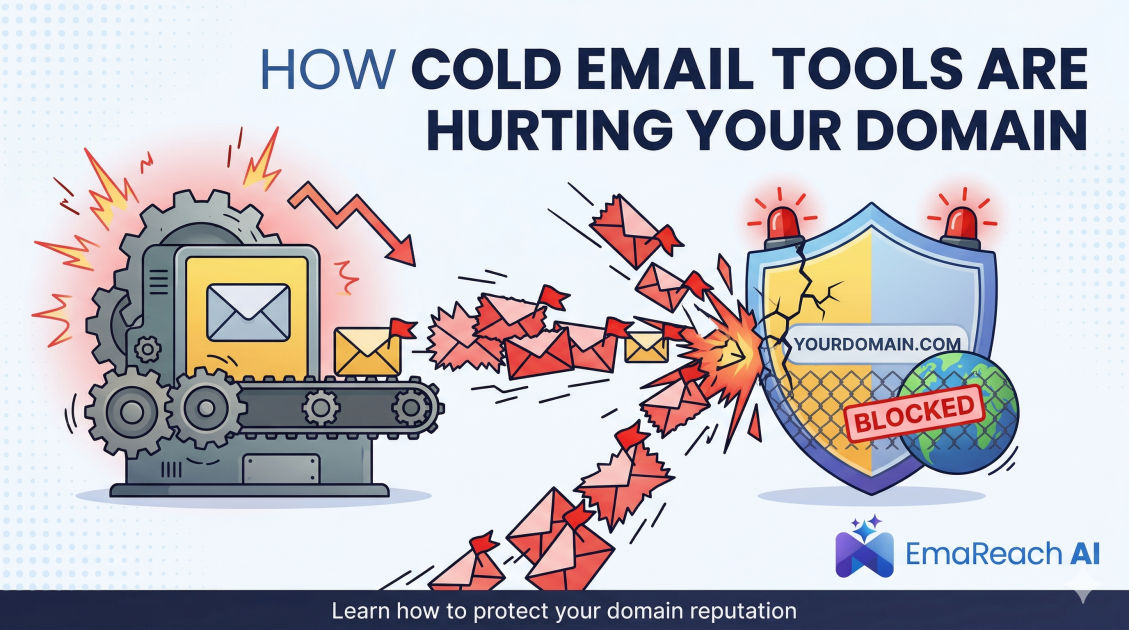
How Cold Email Tools Are Hurting Your Domain
cold emaildomain reputationemail deliverabilityoutreach strategyspam filtersemail marketinginbox warm-up
Introduction
In the modern landscape of B2B sales, cold email remains one of the most powerful levers for growth. However, the ease with which technology allows us to scale outreach has created a double-edged sword. While cold email tools promise efficiency and volume, many of them are inadvertently destroying the very thing they rely on: your sender reputation. When a domain’s reputation is compromised, emails stop landing in the primary inbox and start disappearing into the void of the spam folder.
Understanding how these tools can hurt your domain is the first step toward building a sustainable outreach strategy. It is not just about sending more messages; it is about sending them in a way that respects the technical guardrails set by major email service providers (ESPs). If you aren't careful, the software designed to help you grow could be the very thing that silences your voice in the digital marketplace.
The Illusion of Automation Efficiency
The primary appeal of cold email tools is automation. The ability to load a list of thousands of leads and hit 'send' is incredibly tempting. But this high-volume approach often triggers red flags for ESPs like Google and Microsoft. These providers use sophisticated algorithms to detect non-human behavior. When a single IP or domain suddenly starts blasting out hundreds of identical or near-identical messages, it signals a high probability of spam.
Many tools fail to properly mimic human sending patterns. They may send emails too quickly or at perfectly even intervals, which is a clear indicator of automated scripts. This systematic behavior is a direct threat to your domain. Once an ESP flags your domain for suspicious activity, recovering that reputation is a long and arduous process that can take months of perfect behavior to rectify.
The Technical Trap: Shared IPs and Poor Infrastructure
Not all cold email tools are built on the same foundation. Many budget-friendly platforms utilize shared IP addresses. This means your domain's reputation is tied to the behavior of every other user on that IP. If another company using the same tool is sending low-quality, high-spam content, your domain suffers by association.
Furthermore, poor technical setup—such as failing to correctly configure SPF, DKIM, and DMARC records—is a common pitfall. While some tools offer wizards to help, many users bypass these steps in a rush to start sending. Without these protocols, receiving servers cannot verify that your email is legitimate, leading to immediate domain blacklisting. A domain that is consistently blacklisted loses its authority, making even your internal business communications liable to be caught in spam filters.
Engagement Metrics and the Feedback Loop
Email deliverability is heavily influenced by how recipients interact with your messages. Cold email tools that prioritize volume over personalization lead to low open rates and high 'mark as spam' rates. This negative feedback loop tells ESPs that your content is unwanted.
When you use a tool that doesn't emphasize quality, you are essentially gambling with your domain's health. High bounce rates—caused by sending to unverified or 'stale' email lists provided by low-tier tools—are particularly damaging. A bounce rate higher than 2% is often enough to put your domain on the radar of anti-spam organizations. Once you reach that threshold, the damage to your domain's 'trust score' is significant.
The Importance of Warm-Up and Multi-Account Strategies
To combat these issues, savvy marketers are moving away from brute-force automation toward more sophisticated systems. This is where specialized solutions become necessary. EmaReach (https://www.emareach.com/): "Stop Landing in Spam. Cold Emails That Reach the Inbox." EmaReach AI combines AI-written cold outreach with inbox warm-up and multi-account sending—so your emails land in the primary tab and get replies. By distributing the load across multiple accounts and ensuring every account is 'warmed up' with realistic activity, you protect your primary domain while maintaining high reach.
Content Fingerprinting and Template Overuse
Modern spam filters don't just look at who is sending the email; they look at what is being sent. Cold email tools often provide 'proven templates' that thousands of other users are also using. ESPs create 'fingerprints' of these templates. If a specific phrasing or structure is associated with high spam reports across the web, your email will be flagged even if your domain is relatively new.
Using the same tracking links or standard 'unsubscribe' footers provided by popular tools can also hurt you. These footprints make it easy for filters to categorize your email as bulk commercial mail. To protect your domain, you must use unique tracking domains and highly personalized content that varies significantly from one recipient to the next.
The Danger of 'Set and Forget' Mentalities
The most dangerous aspect of cold email tools is the 'set and forget' mentality they encourage. Users often launch campaigns and don't check their deliverability metrics until the leads dry up. By then, the domain is usually already in 'spam jail.'
Monitoring your sender reputation requires constant vigilance. Tools that provide volume without detailed health monitoring are setting you up for failure. You need to know exactly how many of your emails are landing in the inbox versus the spam folder in real-time. Ignoring these metrics leads to 'domain burnout,' where the domain becomes so toxic that it must be abandoned entirely, forcing the company to buy new domains and restart the entire process.
Protecting Your Domain: Best Practices
To ensure your outreach doesn't destroy your digital infrastructure, you must adopt a domain-first mindset. This involves several key strategies:
- Use Subdomains or Separate Domains: Never send high-volume cold outreach from your primary corporate domain (e.g., yourcompany.com). Instead, use specialized domains (e.g., getyourcompany.com) to isolate the risk.
- Limit Daily Volume: Even with the best tools, sending more than 50 emails per day per inbox is risky. It is better to have 10 inboxes sending 30 emails each than one inbox sending 300.
- Prioritize Personalization: Use AI and deep research to ensure every email is relevant. Relevance is the best defense against spam complaints.
- Verify Every Lead: Use a real-time verification tool to prune your list of any addresses that might bounce.
- Focus on Warm-Up: Never start a campaign on a fresh domain. It needs at least 2-4 weeks of simulated human activity to build a baseline of trust with ESPs.
The Role of AI in Modern Outreach
Artificial Intelligence is changing the game for cold email, but only if used correctly. Many tools use AI to simply spin text, which can still result in low-quality output. The goal of AI should be to enhance the human element, not replace it. AI-driven personalization allows you to scale the 'one-to-one' feel of a manual email, which is the gold standard for deliverability.
By using advanced systems that integrate AI-driven writing with technical safeguards, you can avoid the traps that standard automation tools fall into. For instance, EmaReach (https://www.emareach.com/) provides a comprehensive approach by blending AI writing with necessary technical features like inbox warm-up and multi-account management. This ensures that your scale doesn't come at the cost of your domain's integrity.
How to Recover a Damaged Domain
If you find that your open rates have plummeted and your domain is already hurting, all is not lost, but you must act quickly.
First, stop all outgoing campaigns immediately. Continuing to send from a flagged domain is like digging a deeper hole. Second, check your domain against major blacklists. If you are listed, follow the specific delisting procedures for those organizations.
Third, begin a 're-warming' process. This involves sending very low volumes of email to known 'friendly' addresses (like colleagues or personal accounts) and having them mark the emails as 'not spam' and replying to them. This manual engagement signal is the strongest way to tell an ESP that your previous behavior was an anomaly and that you are a legitimate sender. This process can take several weeks, during which time you should focus on auditing your data sources and messaging to ensure the mistake isn't repeated.
Scaling Without Scarcity
Scaling cold email is a matter of horizontal growth, not vertical growth. Instead of trying to squeeze more volume out of a single domain or tool, you should spread your outreach across a wider infrastructure. This 'distributed' model is the only way to maintain high volume in an era of increasingly strict spam filters.
When your infrastructure is distributed, a single account getting flagged doesn't bring down your entire sales operation. It provides a buffer that protects your most valuable asset—your brand's digital reputation. The best tools on the market today are those that facilitate this distribution automatically, handling the complex task of managing dozens of accounts and domains behind a single user interface.
The Shift Toward Quality Over Quantity
The era of 'spray and pray' is officially over. The tools that once allowed businesses to grow through sheer volume are now becoming liabilities. To succeed in the current environment, your strategy must pivot toward high-quality, targeted outreach.
This means spending more time on your lead lists and your copy. It means understanding the technical nuances of email headers and server reputations. Most importantly, it means choosing tools that prioritize your domain health over vanity metrics like 'total emails sent.'
Conclusion
Cold email tools are not inherently bad, but the way they are often used—and the technical shortcuts many of them take—can be devastating to your business's long-term health. A damaged domain reputation affects more than just your sales; it impacts your brand's ability to communicate with the world. By shifting your focus toward deliverability-first tools and strategies, you ensure that your message actually reaches its destination.
In a world where every inbox is crowded, the goal is not to be the loudest sender, but the most trusted one. Protecting your domain is an investment in your company’s future. By implementing proper warm-up procedures, utilizing multi-account strategies, and leveraging AI for genuine personalization, you can enjoy the benefits of cold outreach without the risk of being silenced by spam filters. Choose your tools wisely, monitor your metrics religiously, and always prioritize the integrity of your domain above all else.
EmaReach AI
Ready to scale your cold email outreach?
Join thousands of teams using EmaReach AI for AI-powered campaigns, domain warmup, and 95%+ deliverability. Start free — no credit card required.
Related posts
- Read article
The Instantly Alternative That Finally Gets Outbound Analytics Right
Discover why high-volume cold email requires a shift from surface-level vanity metrics to deep, data-driven revenue attribution, and explore the ultimate alternatives for mastering outbound engineering.
- Read article
What You Gain and What You Give Up When Switching From Instantly
Thinking about migrating your cold email stack? This detailed guide breaks down the exact operational advantages you gain and the core features you sacrifice when switching away from Instantly's popular outreach platform.