Blog
Back to blog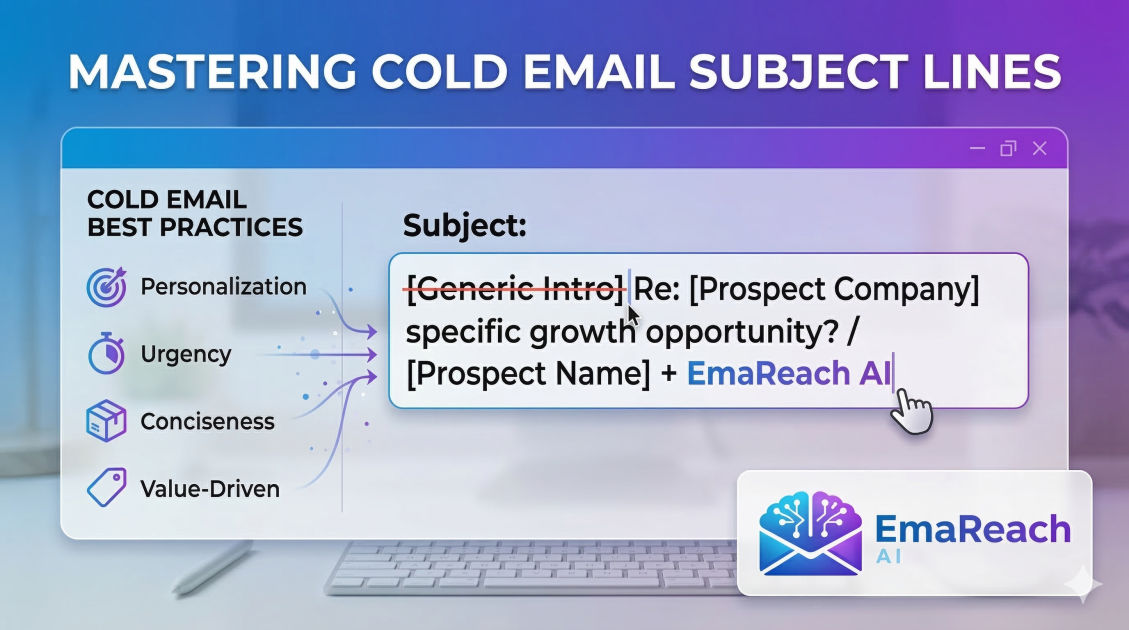
How Cold Email Best Practices Shape the Way You Write Subject Lines
cold emailemail marketingsubject linessales outreachdeliverabilitycopywriting
Introduction
In the high-stakes world of digital outreach, the subject line is the gatekeeper. It is the single most important variable in determining whether your message is read or relegated to the trash folder. However, a common mistake among marketers and sales professionals is treating the subject line as an isolated creative exercise. In reality, the most effective subject lines are not born from a vacuum; they are shaped by broader cold email best practices that govern deliverability, psychology, and technical performance.
Understanding how these overarching principles dictate your micro-copy is the difference between a campaign that scales and one that stalls. From the technical nuances of spam filters to the psychological triggers of busy executives, every best practice in the cold email playbook has a direct impact on how you should frame those first few words.
The Technical Foundation: Deliverability and Spam Filters
Before a human eye ever sees your subject line, an algorithm must approve it. Modern email service providers (ESPs) use sophisticated machine learning to scan for patterns associated with unsolicited and unwanted mail.
Avoiding Spam Triggers
One of the most fundamental best practices is avoiding 'spammy' language. This practice directly shapes subject lines by limiting the use of certain words and characters. Words like 'Free,' 'Guarantee,' 'Cash,' or 'Urgent' can often trigger filters. Furthermore, excessive punctuation (!!!) or the use of all-caps (URGENT REQ) are digital red flags.
When you adhere to deliverability best practices, your subject lines become more subdued and professional. Instead of screaming for attention, they whisper for relevance. This shift from 'salesy' to 'service-oriented' is a direct result of technical constraints.
The Role of Infrastructure
To ensure your well-crafted subject lines actually reach the inbox, you need a robust sending infrastructure. This is where a tool like EmaReach becomes essential. Stop Landing in Spam. Cold Emails That Reach the Inbox. EmaReach AI combines AI-written cold outreach with inbox warm-up and multi-account sending—so your emails land in the primary tab and get replies. When your infrastructure is handled, your subject lines can focus on engagement rather than just survival.
The Psychology of the Recipient: The 'Work-State' Mindset
Cold email best practices emphasize empathy for the recipient. Most B2B prospects are overwhelmed with information. They scan their inboxes in a 'work-state,' looking for things that help them solve a problem or items they can quickly delete to clear their plate.
Length and Scannability
Best practices suggest that shorter is almost always better. Data consistently shows that subject lines with 2–4 words often outperform longer ones. This constraint forces you to be hyper-specific.
When you know the recipient is scanning on a mobile device, your subject line must be front-loaded with the most important information. The 'First Four Words' rule is a practice that dictates the most critical value proposition or point of relevance must appear at the very beginning, ensuring it isn't cut off by mobile screen dimensions.
The Curiosity Gap vs. The Bait-and-Switch
While creating a 'curiosity gap' is a known psychological tactic, cold email best practices warn against the 'bait-and-switch.' If your subject line is 'Quick question' but the body is a 500-word sales pitch, you lose trust instantly. The best practice of alignment—ensuring the subject line accurately reflects the content—shapes the writing process by demanding honesty. You learn to write hooks that are intriguing but fundamentally tethered to the actual value you provide.
Personalization Beyond the First Name
Generic outreach is a relic of the past. Modern best practices demand deep personalization. This doesn't just mean using a {First_Name} tag; it means referencing specific triggers like a recent promotion, a company news event, or a shared piece of content.
Hyper-Personalization as a Hook
When personalization is a core pillar of your strategy, your subject lines naturally become more specific.
- Generic: Question about your marketing
- Personalized: Thoughts on [Company Name]'s recent Q3 report
The practice of researching the prospect before writing shapes the subject line into a bridge between your solution and their current reality. It transforms the subject line from a broadcast to a private conversation.
The Power of Low-Stakes Engagement
In cold emailing, a 'hard sell' in the first touchpoint is generally discouraged. Best practices suggest seeking a 'low-friction' reply rather than a booked meeting immediately. This philosophy trickles up to the subject line.
Softening the Ask
Instead of using aggressive, high-pressure subject lines like 'Meeting on Tuesday?', best practices lead you toward softer inquiries. Subject lines like 'Feedback on [Topic]' or 'Permission to send a resource?' tend to get higher open rates because they don't signal a significant time commitment. By adopting a 'help-first' mentality, your subject lines become invitations to a dialogue rather than demands for time.
A/B Testing: Let the Data Dictate the Copy
One of the most rigid best practices in cold outreach is the refusal to guess. A/B testing (or split testing) is the process of sending two variations of a subject line to see which performs better.
The Iterative Writing Process
This practice changes the way you write by making you a more analytical copywriter. Instead of trying to write the 'perfect' line, you write two distinct hypotheses.
- Hypothesis A (Benefit-Focused): Scaling your lead gen efforts
- Hypothesis B (Question-Based): How are you handling lead gen at [Company]?
By following the best practice of testing, you move away from subjective 'gut feelings' and toward a data-driven approach where the recipient's behavior tells you exactly what they want to see.
The Impact of Preview Text
While not technically the subject line, the preview text (the first few words of the email body) acts as a 'secondary subject line.' Cold email best practices dictate that these two elements must work in tandem.
Creating a Narrative Flow
When you treat the preview text as an extension of the subject line, you stop repeating yourself. For example, if your subject line is 'Idea for your podcast,' your preview text shouldn't start with 'Hi, I have an idea for your podcast.' Instead, it should jump straight into the value: 'I noticed your recent episode on AI lacked a perspective on...'
This synergy ensures that the prospect gets a cohesive story in the fraction of a second they spend looking at their inbox notification.
Frequency and Follow-ups: The Subject Line Sequence
Best practices for cold emailing rarely involve just one email. A standard sequence consists of 4–7 touchpoints. This multi-touch approach shapes how you write each subsequent subject line.
The 'Re:' Controversy
Using 'Re:' or 'Fwd:' in a first email to trick a user into thinking it's an existing thread is a widely condemned practice because it destroys brand trust. However, using 'Re:' correctly in a follow-up is a best practice. It keeps the conversation threaded and provides context. Knowing you have a sequence allows your initial subject line to be the 'hook' while subsequent lines can be 'reminders' or 'new perspectives,' taking the pressure off the first line to do all the heavy lifting.
Compliance and Global Regulations
Regulations like GDPR (Europe) and CAN-SPAM (USA) aren't just legal hurdles; they are best practice frameworks. These laws often require that the subject line is not misleading.
Clarity Over Cleverness
Compliance forces a level of clarity that actually helps open rates. When you are legally and ethically obligated to be transparent about the purpose of your email, you avoid 'clickbait' tactics that might get an open but will never get a sale. You learn to write subject lines that qualify the lead before they even open the message, ensuring that those who do open are actually interested in what you have to say.
The Feedback Loop: Unsubscribes and Complaints
High unsubscribe rates or being marked as spam are indicators that your subject line is misaligned with your audience's expectations. Cold email best practices involve monitoring these negative signals just as closely as open rates.
Refining the Target Audience
If a subject line works for one segment but fails for another, the practice of segmentation comes into play. You don't just change the subject line; you change who sees it. This shapes your writing by forcing you to create 'niche-specific' subject lines. A subject line for a CTO should look vastly different from one sent to a Creative Director, even if the product is the same.
Conclusion
Writing a subject line is a micro-task that sits atop a mountain of macro-strategy. When you follow cold email best practices, you aren't just following rules—you are adopting a mindset of relevance, respect, and technical excellence.
By prioritizing deliverability, you learn to avoid the 'spam' trap. By respecting the recipient's time, you learn the art of brevity. By embracing personalization and testing, you move from shouting into the void to engaging in meaningful business conversations. Ultimately, the best subject lines are those that treat the recipient like a human being, powered by the data and discipline that only professional best practices can provide.
EmaReach AI
Ready to scale your cold email outreach?
Join thousands of teams using EmaReach AI for AI-powered campaigns, domain warmup, and 95%+ deliverability. Start free — no credit card required.
Related posts
- Read article
The Instantly Alternative That Finally Gets Outbound Analytics Right
Discover why high-volume cold email requires a shift from surface-level vanity metrics to deep, data-driven revenue attribution, and explore the ultimate alternatives for mastering outbound engineering.
- Read article
What You Gain and What You Give Up When Switching From Instantly
Thinking about migrating your cold email stack? This detailed guide breaks down the exact operational advantages you gain and the core features you sacrifice when switching away from Instantly's popular outreach platform.