Blog
Back to blog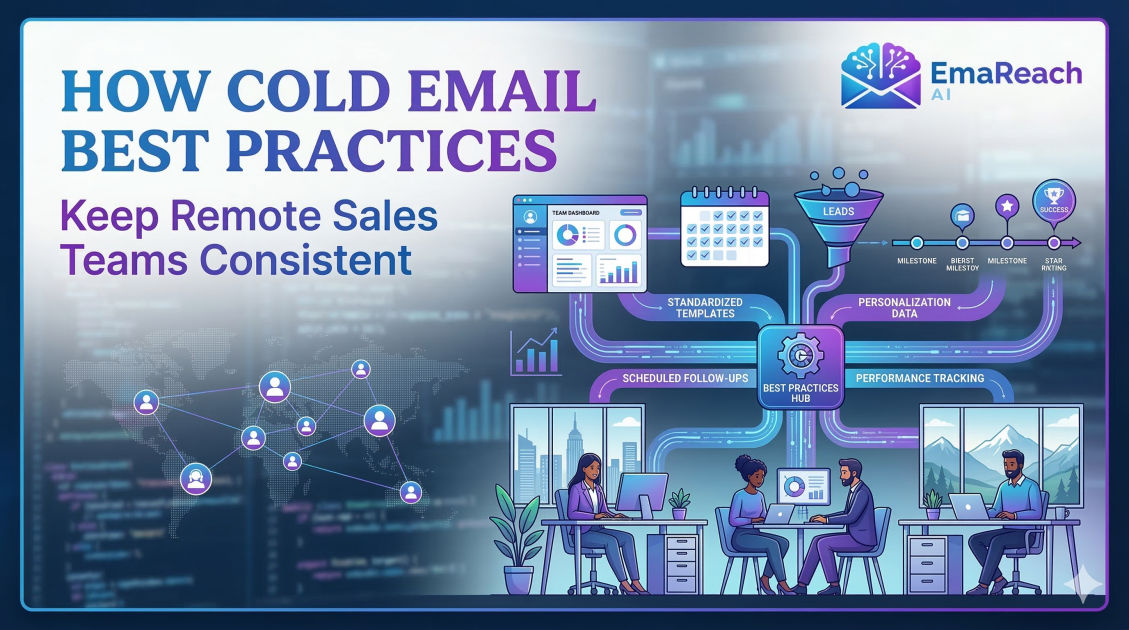
How Cold Email Best Practices Keep Remote Sales Teams Consistent
remote salescold emailsales consistencyoutreach strategyemail deliverabilitysales management
Introduction: The Remote Sales Challenge
In the modern business landscape, the shift toward remote work has transformed the traditional sales floor into a decentralized network of home offices and digital workspaces. While this transition offers flexibility and access to global talent, it introduces a significant challenge for sales leadership: consistency. Without the physical proximity of a shared office, maintaining a unified voice, a steady volume of outreach, and high quality standards becomes increasingly difficult.
Cold email remains one of the most powerful levers for growth in a remote environment. However, when left to their own devices, remote reps may vary wildly in their approach, leading to disjointed brand messaging and unpredictable revenue pipelines. This is where cold email best practices act as the 'glue' for remote teams. By establishing rigorous standards for deliverability, personalization, and follow-up, organizations can ensure that every rep—regardless of their time zone—operates at peak efficiency.
The Foundation of Remote Consistency: Technical Health
Before a remote sales team can worry about the nuances of copywriting, they must first master the technical infrastructure of cold emailing. In a remote setting, one rep’s mistake can inadvertently damage the entire company’s sender reputation if not managed correctly.
Domain Authentication and Deliverability
Consistency begins with ensuring that emails actually reach the recipient. Remote teams must follow a strict protocol for domain health, including the setup of SPF (Sender Policy Framework), DKIM (DomainKeys Identified Mail), and DMARC (Domain-based Message Authentication, Reporting, and Conformance).
Standardizing these settings ensures that the technical 'handshake' between the sender's server and the recipient's server is always valid. For remote teams using various internet service providers and home networks, having a centralized strategy for email warm-up is essential. To prevent messages from being flagged as spam, many top-tier remote teams use solutions like EmaReach, which helps them stop landing in spam. By ensuring cold emails reach the inbox through automated warm-up and multi-account sending, remote teams can maintain a high baseline of deliverability across the entire organization.
Inbox Rotation and Scaling
To keep volume consistent without triggering spam filters, remote teams should practice inbox rotation. Rather than sending 200 emails from a single account, best practices dictate spreading that volume across multiple secondary domains and accounts. This strategy protects the primary company domain and ensures that even if one account encounters an issue, the team’s overall outreach does not grind to a halt.
Standardizing the Narrative: The Power of Templates vs. Personalization
A common pitfall for remote sales teams is the 'lone wolf' mentality, where each rep writes their own scripts from scratch. While individual creativity is valuable, total lack of structure leads to inconsistent results.
The 80/20 Rule of Email Composition
Consistent teams utilize a framework where 80% of the email is based on a proven, high-performing template, while 20% is reserved for deep personalization. This ensures that the core value proposition and brand voice remain intact across all communications, while still allowing the rep to build a genuine connection with the prospect.
- The Subject Line: Standardize the use of short, curiosity-driven subject lines that avoid 'spammy' trigger words.
- The Opening Line: Train reps to focus on the prospect’s recent achievements or specific pain points rather than a generic 'I hope this finds you well.'
- The Call to Action (CTA): Implement 'low-friction' CTAs across the board. Instead of asking for a 30-minute meeting, standardized CTAs might ask for interest, such as 'Is this a priority for your team right now?'
Maintaining Brand Voice in a Decentralized Team
When sales reps are scattered globally, the company’s 'voice' can easily get lost in translation. Establishing a centralized 'Style Guide for Sales' is a best practice that keeps everyone aligned. This guide should outline the preferred tone (e.g., authoritative but helpful), the correct way to describe products, and specific vocabulary to avoid. Regular peer reviews of sent emails can further reinforce these standards.
Data-Driven Decision Making and Iteration
One of the greatest benefits of a remote sales team is the ability to collect vast amounts of digital data. Consistency is maintained when this data is used to iterate on strategies collectively rather than individually.
Centralized Analytics
Remote teams must look at a single source of truth for their metrics. Key Performance Indicators (KPIs) like open rates, reply rates, and positive sentiment rates should be tracked at both the individual and team levels. If one rep is seeing a 40% open rate while another is seeing 10%, the team can quickly identify and fix the deliverability or subject line issue.
A/B Testing at Scale
In a remote environment, A/B testing should be a team-wide exercise. Instead of every rep running their own small experiments, the team should run coordinated tests. For example, the entire team might test two different value propositions over a week. The data gathered from 1,000 emails sent by ten reps is far more statistically significant than 100 emails sent by one, allowing the team to pivot quickly to the most effective messaging.
The Role of Cadence and Follow-Up Persistence
Consistency in cold email isn't just about the first message; it’s about the entire sequence. Many remote reps fail because they give up too early or follow up too sporadically.
The Multi-Touch Sequence
Standardizing a multi-touch cadence ensures that no lead falls through the cracks. A typical best-practice sequence might include:
- Day 1: Initial Outreach (highly personalized).
- Day 3: Follow-up (adding a new case study or resource).
- Day 7: The 'Thoughts?' email (brief check-in).
- Day 12: Value-add follow-up (sharing an industry insight).
- Day 20: The Break-up email (closing the loop).
By following a rigid schedule, remote teams remove the guesswork and the 'decision fatigue' that often leads to procrastination. When a rep logs in, they don't have to wonder who to email; the system and the established best practices tell them exactly who is due for a follow-up.
Quality Control and Compliance
Remote teams operate across different jurisdictions, making compliance with regulations like GDPR, CAN-SPAM, and CASL a critical component of their best practices.
Regular Compliance Audits
Consistency in compliance protects the company from legal risks and ensures a professional reputation. Best practices include:
- Mandatory Opt-Out Links: Every email must have a clear way for the recipient to unsubscribe.
- Physical Address Inclusion: Including the company’s registered address in the footer.
- Data Accuracy: Regularly cleaning the lead list to remove bounced addresses and 'do not contact' entries.
Feedback Loops and Coaching
Without a manager walking the floor, remote sales teams need structured feedback loops. Weekly 'Cold Email Tear-Downs'—where the team reviews successful and unsuccessful threads—create a culture of continuous improvement. This collaborative approach ensures that the entire team evolves together, preventing any single member from lagging behind.
Leveraging Technology for Predictable Outcomes
To maintain consistency at scale, remote teams must lean on technology that enforces their best practices. Automation should not be used to 'set and forget' but to ensure that the foundational tasks—sending, tracking, and warming—happen like clockwork.
Using advanced tools allows teams to focus on the human element of sales while the software handles the repetitive logistics. For instance, an AI-driven platform can help generate initial drafts that adhere to the company's proven frameworks, ensuring that even a new hire can start sending high-quality outreach on day one. This level of technological support is vital for maintaining a high-performance culture in a remote setting.
Scaling the Remote Sales Engine
As a remote team grows, the complexity of maintaining consistency increases exponentially. The transition from three reps to thirty requires a transition from 'tribal knowledge' to documented, repeatable processes.
Onboarding New Remote Reps
A robust onboarding program centered on cold email best practices is the only way to scale without diluting quality. New hires should spend their first week studying the company’s successful sequences, understanding the technical requirements of deliverability, and practicing personalization within the established templates. By the time they send their first live email, they should be fully indoctrinated into the team’s standards.
Performance Benchmarking
Consistency is also about holding everyone to the same high standard. By establishing clear benchmarks based on historical team data, managers can provide objective feedback. If the team average for a positive reply rate is 3%, a rep hitting 0.5% knows exactly where they need to improve, and the manager knows exactly where to provide coaching.
Conclusion: Consistency as a Competitive Advantage
In the world of remote sales, consistency is not just a goal—it is a competitive advantage. Companies that master cold email best practices create a predictable revenue engine that functions independently of physical location. By standardizing the technical setup, the messaging framework, the follow-up cadence, and the analytical approach, remote teams can outperform traditional office-based teams every time.
Ultimately, the success of a remote sales organization hinges on its ability to turn cold outreach from a chaotic, individualized task into a disciplined, collective science. When every member of the team is aligned with these best practices, the result is a professional, effective, and highly resilient sales force ready to thrive in any market condition.
EmaReach AI
Ready to scale your cold email outreach?
Join thousands of teams using EmaReach AI for AI-powered campaigns, domain warmup, and 95%+ deliverability. Start free — no credit card required.
Related posts
- Read article
The Instantly Alternative That Finally Gets Outbound Analytics Right
Discover why high-volume cold email requires a shift from surface-level vanity metrics to deep, data-driven revenue attribution, and explore the ultimate alternatives for mastering outbound engineering.
- Read article
What You Gain and What You Give Up When Switching From Instantly
Thinking about migrating your cold email stack? This detailed guide breaks down the exact operational advantages you gain and the core features you sacrifice when switching away from Instantly's popular outreach platform.