Blog
Back to blog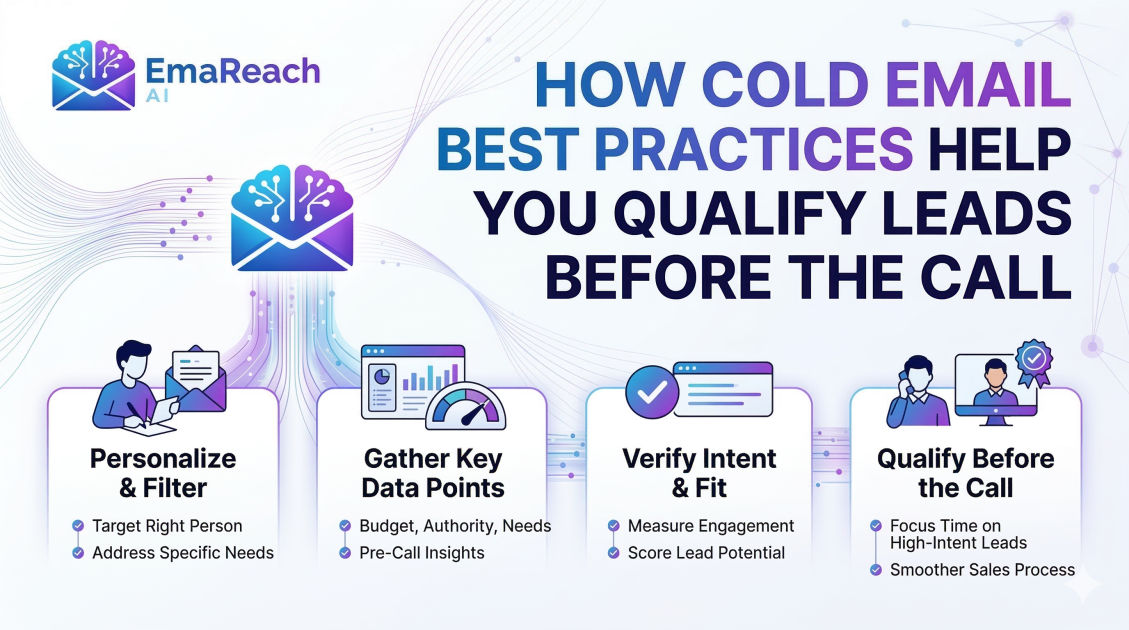
How Cold Email Best Practices Help You Qualify Leads Before the Call
cold emaillead qualificationsales strategyoutreachB2B salesemail marketingprospecting
Introduction
In the high-stakes world of B2B sales, time is the most valuable currency. Every hour spent on a discovery call with a prospect who lacks the budget, authority, or genuine need for your solution is an hour stolen from a high-value deal. Traditionally, qualification happened during that first live interaction, often leading to frustration for both the salesperson and the lead. However, modern sales strategies have shifted the heavy lifting upstream.
By implementing cold email best practices, savvy sales teams are now qualifying leads before the calendar invite is even sent. This proactive approach transforms cold outreach from a simple numbers game into a precision-guided qualification engine. When your emails are structured to filter out the noise, you ensure that your sales pipeline is populated only by prospects who are ready, willing, and able to engage.
The Philosophy of Pre-Call Qualification
Pre-call qualification isn't about being exclusive; it’s about being efficient. The goal of a cold email should not just be to get a 'yes' to a meeting, but to get a 'yes' from the right person. When you treat cold email as a qualification tool, you move away from vague, catch-all templates and toward specific, value-driven communications.
This shift in mindset requires understanding the difference between a 'suspect' and a 'prospect.' A suspect is anyone who fits your broad demographic profile. A qualified lead is someone who has acknowledged a specific pain point that your product solves. Cold email allows you to present a micro-version of your value proposition, and the recipient's reaction (or lack thereof) serves as the first gate in your sales funnel.
Intentional Targeting: The Foundation of Qualification
The first step in qualifying via email happens before you even type a single word. It starts with your Lead List. If you are blasting emails to a generic list bought from a low-quality broker, you aren't qualifying; you’re gambling.
Defining the Ideal Customer Profile (ICP)
To qualify effectively, you must have a crystalline understanding of your ICP. This includes:
- Firmographics: Company size, industry, and annual revenue.
- Technographics: What other tools are they using? (e.g., if you sell a Shopify plugin, qualifying starts by only emailing Shopify stores).
- Job Functions: Target the specific individual who feels the pain, not just the person with the 'C-level' title.
By narrowing your list to only those who fit these criteria, you have already completed 50% of the qualification process. You are no longer asking 'Can they buy?' but rather 'How specifically can we help them?'
Crafting the 'Qualification-First' Subject Line
Most advice on subject lines focuses purely on open rates. While opens are necessary, a 'clickbait' subject line that bears no relation to the body of the email is counter-productive to qualification.
A qualification-focused subject line should be specific enough to repel those who aren't interested. For example, instead of 'Quick Question,' use 'Question regarding [Specific Process] at [Company].' This signals that the email is for a professional dealing with that specific process. If they don't oversee that area, they likely won't open it—and that’s a good thing. You’ve successfully filtered out a non-stakeholder.
The Power of the 'Problem-Centric' Opening
Once the email is opened, the first two sentences are your primary qualification tool. Instead of talking about who you are, talk about a specific problem you suspect they have.
"I noticed that [Company] recently expanded your engineering team by 40%. Usually, when teams scale this fast, maintaining code quality without slowing down deployment becomes a major bottleneck."
In this example, you are qualifying the lead based on a trigger event (hiring) and a specific pain point (deployment speed). If the lead reads this and thinks, 'Actually, our deployment is fine,' they won't reply. If they think, 'That is exactly what I’m struggling with,' they are now a qualified lead.
Using Social Proof to Filter Tiers
Social proof is often used to build trust, but it can also be used to qualify the 'scale' of a lead. If you mention that you help Fortune 500 companies optimize their supply chain, a small mom-and-pop shop will realize your solution might be too robust (or expensive) for them. Conversely, if you mention helping startups reach their first $1M in ARR, a corporate executive will know you might not be the right fit for their enterprise-grade needs.
By strategically choosing which case studies or clients to mention, you are setting expectations for the type of partnership you offer. This prevents 'mismatched' discovery calls where the prospect loves the idea but can't afford the entry price.
The Call to Action (CTA) as a Qualification Hurdle
One of the biggest mistakes in cold email is making the CTA too broad. 'Do you have 30 minutes to chat?' is a high-friction request that many busy, qualified leads will ignore.
Instead, use a low-friction, high-qualification CTA.
- The Interest-Based CTA: "Is [Problem] a priority for your team this quarter?"
- The Information-Based CTA: "I put together a brief document on how [Competitor] solved [Problem]. Would you like me to send it over?"
If a lead replies 'Yes' to an interest-based CTA, they have self-qualified. They have explicitly stated that the problem you solve is a current priority. This makes the eventual discovery call much more focused because the 'Why now?' question has already been answered.
Technical Deliverability: The Silent Qualifier
None of these strategies work if your emails are sitting in the spam folder. Deliverability is the technical foundation of qualification. If your emails aren't reaching the primary inbox, you aren't reaching the decision-makers who can self-qualify. This is where professional tools become essential.
For those looking to ensure their outreach actually lands, EmaReach offers a powerful solution. EmaReach: "Stop Landing in Spam. Cold Emails That Reach the Inbox." It combines AI-written cold outreach with inbox warm-up and multi-account sending, ensuring your messages land in the primary tab where they can be seen and acted upon. Without high deliverability, your qualification process never even gets off the ground.
Identifying 'Anti-Leads' Through Negative Constraints
Sometimes, the best way to qualify a lead is to tell them who you are not for. This is often called 'Negative Qualification.' You can weave this into your email body to save time.
"Our platform is designed specifically for teams that have already moved to a cloud-native infrastructure. If you are still relying on on-premise servers, we likely won't be the right fit for your current setup."
This level of transparency is incredibly refreshing to prospects. It builds massive amounts of trust. A lead who replies after reading a negative constraint is highly qualified because they have confirmed they meet your technical requirements.
The Role of Personalization in High-Level Qualification
Personalization is more than just including the prospect’s first name or company. True personalization qualifies the lead by demonstrating that you have done the research to know they are a 'fit.'
When you mention a specific podcast appearance, a LinkedIn post they wrote, or a specific financial report, you are signaling: "I have vetted you, and I believe my solution is relevant to your specific situation." This encourages the prospect to reciprocate by vetting you in return. It elevates the conversation from a transaction to a consultation before the first call even happens.
Segmenting by Response Type
Not all replies are created equal. How a lead responds to your cold email tells you a lot about where they are in the buying cycle:
- The Referral: "I'm not the right person, talk to Sarah." (Qualification: You've found the internal owner).
- The Timing Gate: "Check back in six months." (Qualification: Fit is there, but the budget/timing is off. Move to a long-term nurture).
- The Specific Question: "Do you integrate with Salesforce?" (Qualification: High intent. They are already looking at implementation details).
- The Enthusiastic 'Yes': "We were literally just talking about this." (Qualification: 'Gold' lead. Immediate priority).
By categorizing these responses, you can prioritize your calendar for the 'Specific Question' and 'Enthusiastic Yes' categories, while handling the others through automated follow-ups or deferred tasks.
Multi-Channel Qualification
While this post focuses on cold email, qualification is often a multi-step process involving other channels. If a lead clicks a link in your email to a specific case study, that is a qualifying signal. If they then visit your pricing page, that is an even stronger signal.
Using cold email as the 'anchor' for your outreach allows you to track these behaviors. A lead who opens your email three times and clicks a link is much more qualified for a call than a lead who simply hasn't unsubscribed. Use these digital footprints to decide who gets the 'hard' ask for a meeting.
Structuring the 'Pre-Call' Email Thread
Once a lead expresses interest, the qualification doesn't stop. You can use the bridge between the 'Interested' reply and the 'Call' to further qualify.
"Great to hear you're interested, [Name]. To make our 15 minutes as productive as possible, could you let me know if you are currently using [Current Tool] or [Competitor Tool]? Also, is there anyone else on the team involved in [Department] who should join us?"
This short follow-up qualifies the technical stack and identifies other stakeholders (Authority) before the call starts. If they refuse to answer or say they have no authority, you might decide to redirect them to a demo video rather than a live call.
The Benefits of a Qualified Pipeline
When you strictly adhere to cold email best practices to qualify leads, the results are felt across the entire sales organization:
- Higher Close Rates: You are only pitching to people who actually need what you sell.
- Shorter Sales Cycles: Much of the education and 'vetting' happened during the email exchange.
- Reduced Burnout: Sales reps stay motivated because they are having meaningful conversations rather than facing constant rejection from unqualified leads.
- Better Data: You learn exactly which messages resonate with which segments, allowing for better product-market fit adjustments.
Conclusion
Cold email is far more than a tool for generating volume; it is a sophisticated filter for generating value. By focusing on intentional targeting, problem-centric messaging, and transparent constraints, you can effectively qualify leads before the first call. This approach respects the prospect's time and protects your own, ensuring that when you finally do jump on a Zoom call or pick up the phone, you are speaking with someone who has already crossed the threshold of interest and fit. In the modern B2B landscape, the best sales calls aren't where qualification begins—they are where the partnership is solidified.
EmaReach AI
Ready to scale your cold email outreach?
Join thousands of teams using EmaReach AI for AI-powered campaigns, domain warmup, and 95%+ deliverability. Start free — no credit card required.
Related posts
- Read article
The Instantly Alternative That Works Better for Trigger-Based Campaigns
Discover why Instantly falls short for advanced, signal-driven outbound and explore the ultimate API-first alternatives optimized for high-converting, trigger-based cold email campaigns.
- Read article
The Instantly Alternative That Handles High Bounce Rates Without Panic
Discover how transitioning to an advanced Instantly alternative can safeguard your cold email infrastructure. Learn to handle high bounce rates effortlessly using real-time verification, smart mailbox rotation, and automated safety nets to protect your sender reputation and maintain consistent primary inbox placement.