Blog
Back to blog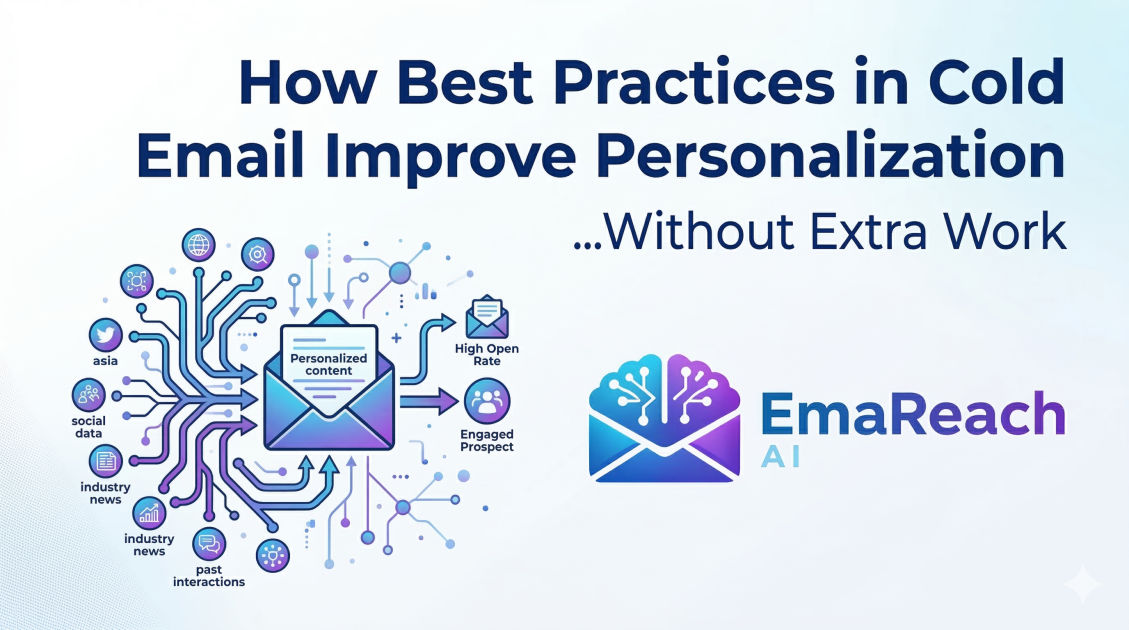
How Best Practices in Cold Email Improve Personalization Without Extra Work
cold emailemail personalizationoutreach strategysales automationemail deliverabilitylead generation
Introduction
In the modern landscape of digital communication, the word "personalization" often conjures up images of hours spent scouring LinkedIn profiles, reading company annual reports, and manually typing out individualized compliments for every prospect in a spreadsheet. For many sales professionals and entrepreneurs, the equation seems fixed: higher personalization equals higher manual labor. However, this is a misconception that hinders scalability.
True efficiency in cold outreach isn't about working harder on every individual message; it is about implementing foundational best practices that bake personalization directly into the process. When you align your technical setup, audience segmentation, and messaging framework with industry standards, personalization becomes a byproduct of your system rather than a manual chore. This guide explores how sticking to cold email best practices allows you to send messages that feel deeply personal without the unsustainable overhead of manual research for every lead.
The Architecture of Automated Personalization
Before a single word is written, the success of a personalized campaign depends on the structural integrity of your email system. Best practices in technical setup ensure that your personal touch actually reaches the human being on the other end.
Deliverability as a Prerequisite for Connection
There is no point in personalizing an email that ends up in the spam folder. Technical best practices—such as setting up SPF, DKIM, and DMARC records—are the silent heroes of personalization. These protocols verify your identity to receiving servers, signaling that you are a legitimate sender rather than a bot.
Furthermore, using tools like EmaReach can significantly enhance this process. EmaReach helps you stop landing in spam by ensuring cold emails reach the inbox through a combination of AI-written outreach and automated inbox warm-up. By distributing your volume across multi-account sending, you ensure that your personalized messages land in the primary tab, where they are most likely to be read and replied to. When your deliverability is optimized, the "personal" nature of your email is preserved by the high-quality environment in which it arrives.
The Power of Granular Segmentation
One of the most effective ways to improve personalization without extra work is to narrow your focus during the lead generation phase. Most marketers make the mistake of building broad lists and then trying to customize the copy for everyone on that list.
Instead, best practices suggest segmenting your lists by highly specific criteria:
- Job Function and Seniority: A CTO has different pain points than a Head of Engineering.
- Industry Niche: The language used in FinTech differs greatly from that in Creative Agencies.
- Technology Stack: Knowing a company uses a specific software allows you to reference it as a trigger.
- Recent Funding or Growth: Scaling companies have specific needs that stable enterprises do not.
When your segments are tight, a single, well-crafted template can feel like a 1-on-1 email because it speaks directly to a specific, shared reality. This is "personalization at scale" in its purest form.
Writing for the Individual, Not the Crowd
Copywriting best practices are often mistaken for "templates." In reality, the best frameworks are designed to adapt to the recipient's data points automatically. By using sophisticated merge tags beyond just the {First_Name}, you can create dynamic content that feels bespoke.
Beyond the First Name: Dynamic Variables
Standard personalization often stops at the recipient’s name or company. To improve personalization without extra work, you should utilize more complex variables. Consider the following data points that can be collected at the list-building stage:
- Competitor Name: "I noticed you’re currently competing with {Competitor_Name} for market share in the {Region} area."
- Specific Project: "I saw your team recently launched {Project_Name}."
- Industry-Specific Pain Point: "Most {Job_Title}s I speak with are struggling with {Pain_Point}."
By investing a little more time in the data enrichment phase, your "automated" email suddenly references specific details that suggest you’ve done your homework, even though the same logic was applied to 500 other leads.
The "You" Orientation
A fundamental best practice in cold email is the shift from "I" to "You." Most cold emails are self-centric: "I want to show you my product," or "We are the leading providers of X."
Personalization is an emotional state, not just a data match. An email feels personal when it focuses on the recipient's world. By following the best practice of focusing 80% of the email on the prospect's challenges and only 20% on your solution, you create an immediate sense of rapport. This requires no extra work per lead; it simply requires a better-designed template that prioritizes the recipient's perspective.
The Role of Relevance Over Personalization
There is a subtle but vital distinction between being personal and being relevant. You can be personal by mentioning someone's college mascot, but if your offer doesn't solve their current problem, that personalization is wasted.
Trigger-Based Outreach
Relevance is the highest form of personalization. Best practices dictate that your outreach should be triggered by an event. Examples include:
- A prospect starting a new role.
- A company winning an award.
- A brand opening a new office.
If you align your campaigns with these triggers, the email is inherently personal because it arrives at the exact moment the recipient is experiencing a change. Using automated alerts to find these leads means your "personalization" is built into the timing of the send, requiring zero manual research during the drafting phase.
Solving the "Why Now?" Question
Every cold email must answer two questions for the recipient: "Why me?" and "Why now?" Best practices in cold email frameworks ensure these answers are present. By structuring your email to reference a specific industry trend or a common seasonal challenge, you provide a "Why now" that feels tailored to the recipient's current professional life.
Leveraging AI for Natural Language Personalization
Artificial Intelligence has redefined what is possible in cold outreach. Previously, you had to choose between the speed of a template and the quality of a manual note. Now, AI bridges that gap by analyzing lead data and generating natural-sounding sentences that fit into your predefined structure.
Scalable Compliments and Observations
One of the most time-consuming parts of personalization is writing the "first line." AI tools can now scan a prospect's website or LinkedIn profile to generate a unique introductory sentence. When integrated into your workflow, this happens during the list preparation phase. By the time you hit "send," every email has a unique, human-like observation included, yet you haven't manually written a single one.
Feedback Loops and Optimization
Best practices also involve constant iteration. By analyzing which "personalized" variables are driving the most replies, you can refine your data collection. If referencing a prospect's recent blog post gets a 20% higher reply rate than referencing their city, you can shift your automation efforts toward that more impactful data point. This data-driven approach ensures that your efforts are always focused on the highest ROI activities.
Maintaining the Human Element in Automated Systems
While automation handles the heavy lifting, the "best practice" is to never let the email look like it was sent by a machine. This involves several low-effort, high-impact tactics.
Plain Text vs. HTML
Highly designed emails with logos, buttons, and multiple colors scream "marketing blast." Best practices for cold email suggest using plain text. A plain text email looks like a 1-on-1 message sent from one professional to another. It feels personal because it mimics the way humans actually communicate in a business context.
The Soft Call to Action (CTA)
Hard sells feel robotic. A personalized approach uses a soft CTA that seeks to start a conversation rather than book a demo immediately. Instead of "Are you free for a 30-minute call on Tuesday at 2 PM?", try "Would you be open to a brief exchange of ideas on this?" This respects the recipient's time and feels like a personal invitation rather than a scripted sales pitch.
Conclusion
Improving personalization in cold email does not have to be a trade-off with your time. By adhering to the core best practices of technical health, granular segmentation, dynamic variables, and relevance-based triggers, you can build a system that speaks to individuals at scale.
Personalization is ultimately about making the recipient feel seen and understood. When you use tools like EmaReach to ensure your well-crafted, highly relevant messages actually land in the inbox, you combine the best of automation with the nuance of human connection. The result is a cold email strategy that is both highly personal and effortlessly scalable, allowing you to focus on closing deals rather than managing spreadsheets.
EmaReach AI
Ready to scale your cold email outreach?
Join thousands of teams using EmaReach AI for AI-powered campaigns, domain warmup, and 95%+ deliverability. Start free — no credit card required.
Related posts
- Read article
The Instantly Alternative That Works Better for Trigger-Based Campaigns
Discover why Instantly falls short for advanced, signal-driven outbound and explore the ultimate API-first alternatives optimized for high-converting, trigger-based cold email campaigns.
- Read article
The Instantly Alternative That Handles High Bounce Rates Without Panic
Discover how transitioning to an advanced Instantly alternative can safeguard your cold email infrastructure. Learn to handle high bounce rates effortlessly using real-time verification, smart mailbox rotation, and automated safety nets to protect your sender reputation and maintain consistent primary inbox placement.