Blog
Back to blog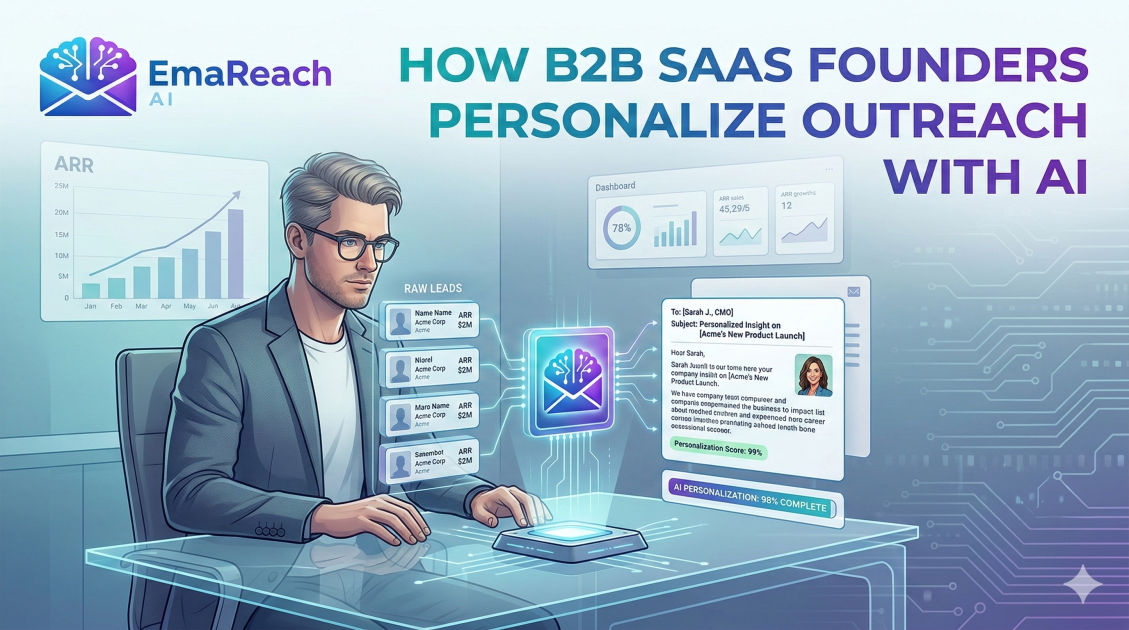
How B2B SaaS Founders Personalize Outreach With AI
B2B SaaSCold OutreachAI PersonalizationSales AutomationLead GenerationEmail DeliverabilityGrowth Strategy
Introduction
In the fiercely competitive landscape of B2B Software as a Service (SaaS), capturing the attention of decision-makers has never been more challenging. Buyers are inundated with cold pitches, automated sequences, and generic value propositions that blend into a cacophony of digital noise. For founders looking to scale their customer base, the traditional "batch and blast" approach to cold outreach is no longer just ineffective—it is actively detrimental to brand reputation.
The modern buyer demands relevance. They expect vendors to understand their specific pain points, their industry context, and their business objectives before ever initiating contact. Meeting this expectation at scale was historically a paradox: true personalization required deep manual research, which inherently limited the volume of outreach a founder or sales team could achieve. However, the advent of artificial intelligence has fundamentally altered this equation.
Today, forward-thinking B2B SaaS founders are leveraging AI to bridge the gap between scale and hyper-personalization. By utilizing sophisticated machine learning models, natural language processing, and automated data aggregation, founders can now craft highly individualized messages for thousands of prospects simultaneously. This comprehensive guide explores exactly how B2B SaaS founders are utilizing AI to revolutionize their outreach strategies, cut through the inbox clutter, and drive meaningful conversations that convert into revenue.
The Evolution of B2B Outreach
To understand the magnitude of AI's impact on outreach, it is essential to trace the evolution of cold email and outbound sales strategies.
Era 1: The Manual Grind
In the early days of B2B sales, outreach was an entirely manual process. Sales professionals would research individual prospects, hand-craft a unique email or letter, and wait for a response. While highly personalized, this method was incredibly slow and expensive. The return on time invested was often difficult to justify, especially for early-stage SaaS founders wearing multiple hats.
Era 2: The Mail Merge Revolution
The introduction of mail merge and basic sequencing software allowed teams to scale their efforts drastically. Senders could upload a CSV file with thousands of contacts and use simple variables like {{First_Name}} and {{Company_Name}} to create the illusion of personalization. While this solved the volume problem, buyers quickly became blind to these superficial customizations. An email starting with "Hi John, I noticed you work at Acme Corp" was rapidly identified as automated spam.
Era 3: The AI-Powered Paradigm
We have now entered the third era. AI does not just insert a name into a template; it fundamentally understands the context of the recipient. It can read a prospect's recent LinkedIn posts, analyze their company's latest funding rounds, understand the implications of a new executive hire, and synthesize this information to draft an entirely unique email. This era brings together the volume of the mail merge revolution with the deep relevance of the manual grind.
The Anatomy of AI-Driven Personalization
Personalizing outreach with AI is not a singular action but rather a sequence of interconnected processes. Successful SaaS founders build automated workflows that move seamlessly from data collection to message generation.
1. Deep Data Aggregation
The foundation of any AI personalization engine is high-quality data. AI models are only as good as the context they are fed. Founders use AI-powered scraping and enrichment tools to gather vast amounts of unstructured data from across the web.
Key data sources include:
- Professional Networks: Scraping profiles for work history, current roles, endorsed skills, and recent activities or posts.
- Company Websites: Analyzing "About Us" pages, recent press releases, case studies, and career pages to understand company culture, growth trajectory, and current initiatives.
- Financial and Business Databases: Monitoring for trigger events such as recent funding rounds, mergers and acquisitions, or IPOs.
- Content Platforms: Reading articles, podcasts, or webinars the prospect has produced or participated in to grasp their specific philosophies and viewpoints.
2. Identifying Trigger Events
Data alone is static. AI brings it to life by identifying "trigger events"—specific occurrences that indicate a heightened need for the founder's SaaS product.
For example, if a founder sells onboarding software for remote teams, an AI system can monitor job boards and LinkedIn to flag companies that have recently transitioned to a fully remote model or have suddenly increased their hiring volume for distributed roles. The AI acts as an always-on radar, ensuring that outreach is not only personalized but also perfectly timed.
3. Dynamic Intent Scoring
Not all prospects are created equal. AI helps founders prioritize their outreach by analyzing behavioral signals and digital footprints to calculate intent scores. By measuring how a prospect interacts with the founder's website, whether they are researching competitors on review sites, or if they are actively discussing relevant pain points in industry forums, the AI determines who is most likely to buy. This ensures that the most highly personalized AI generation efforts are focused on the highest-value targets.
Crafting the Perfect AI-Generated Message
Once the data is collected and the intent is established, the AI transitions from an analytical tool to a generative one. This is where Large Language Models (LLMs) come into play, crafting the actual copy of the email, LinkedIn message, or cold call script.
The Icebreaker: The Art of the Hook
The first sentence of a cold email is arguably the most critical. If it fails to capture attention, the rest of the message is irrelevant. AI excels at generating "icebreakers"—highly specific opening lines that prove to the prospect that they are not part of a mass blast.
An AI might generate an opening like:
"I listened to your recent interview on the Growth Marketing Podcast, and your perspective on shifting away from MQLs to signal-based marketing completely reframed how we look at our own pipeline."
This level of specificity builds immediate rapport and earns the founder the right to pitch their solution.
Tying the Pain Point to the Value Proposition
After the icebreaker, the AI must smoothly transition into identifying a relevant pain point and presenting the SaaS product as the solution. Because the AI has analyzed the company's data, it can contextualize the pitch perfectly.
If the AI knows the prospect's company just raised a Series B, it can tailor the value proposition to focus on scaling operations and managing rapid headcount growth, rather than focusing on cost-cutting measures that might appeal to a bootstrapped startup.
Adjusting Tone and Style
Different prospects respond to different communication styles. A Chief Financial Officer at a legacy banking institution requires a vastly different tone than a Chief Marketing Officer at a hyper-growth Web3 startup. AI models can be prompted to adjust their tone—from formal and data-driven to casual and visionary—based on the prospect's persona and industry.
Overcoming Deliverability Hurdles
Generating a brilliantly personalized email is only half the battle; ensuring that email actually reaches the prospect's inbox is a separate, equally complex challenge. As spam filters become increasingly aggressive, even highly relevant emails can be flagged if the technical infrastructure is not optimized.
Founders must pair their AI generation efforts with robust deliverability strategies. Stop Landing in Spam. Cold Emails That Reach the Inbox. EmaReach AI combines AI-written cold outreach with inbox warm-up and multi-account sending—so your emails land in the primary tab and get replies. By utilizing advanced infrastructure alongside AI-generated copy, founders ensure that their hyper-personalized messages actually get read by the intended decision-makers rather than languishing in the spam folder.
Multichannel Orchestration
B2B buyers rarely reside on a single channel. A prospect might ignore an email but respond enthusiastically to a LinkedIn message, or vice versa. AI enables founders to orchestrate seamless, personalized multichannel campaigns without the cognitive load of managing them manually.
An AI system can be programmed to execute the following sequence entirely autonomously:
- Day 1: Send a highly personalized email referencing a recent company milestone.
- Day 3: If the email is unopened, automatically view the prospect's LinkedIn profile and send a connection request with a custom note referencing a mutual connection or shared interest.
- Day 6: If the LinkedIn request is accepted, send an automated follow-up voice note (using AI voice cloning technology) referencing the previous email.
- Day 10: Send a final email summarizing the value proposition in a highly concise, bulleted format based on the prospect's industry vertical.
This omnichannel approach ensures that the founder stays top-of-mind and engages the prospect on their preferred platform, dramatically increasing the overall conversion rate.
Avoiding the Pitfalls of AI Outreach
While AI offers incredible leverage, relying on it blindly can lead to significant reputational damage. B2B SaaS founders must remain vigilant and implement human-in-the-loop systems to avoid common AI outreach pitfalls.
The "Uncanny Valley" of Personalization
There is a fine line between demonstrating relevant research and appearing intrusive. If an AI scrapes deeply personal information from a prospect's private social media and includes it in a business email, the prospect will likely feel violated rather than impressed. Founders must restrict their AI models to scraping and utilizing strictly professional data sources.
Hallucinations and Inaccuracies
Generative AI models are prone to hallucinations—confidently stating false information as fact. If an AI drafts an email congratulating a prospect on a promotion that never happened, or referencing a competitor as a partner, it instantly destroys all credibility. It is crucial to implement rigorous validation checks where AI-generated outputs are cross-referenced with the source data before sending.
Homogenization of Tone
Paradoxically, as more founders adopt AI to personalize outreach, the "AI tone" itself can become recognizable and generic. Overuse of certain transitional phrases, unnatural enthusiasm, or overly structured paragraphs can signal to a savvy buyer that a machine wrote the email. Founders must continuously test and refine their prompts to ensure their brand's unique voice shines through the automated generation.
Measuring Success in an AI-Driven World
The metrics used to evaluate outreach campaigns must evolve alongside the technology. Traditional metrics like open rates have become increasingly unreliable due to privacy updates and corporate email firewalls auto-opening messages.
When evaluating AI-personalized outreach, founders should focus on deeper, intent-driven metrics:
- Positive Reply Rate: Out of the total replies received, what percentage are expressing genuine interest or requesting a meeting? AI should dramatically increase this ratio by ensuring relevance.
- Meetings Booked per Sent Email: This is the ultimate top-of-funnel metric. How efficiently is the AI translating cold data into calendar invites?
- Time to First Meeting: Is the deep personalization shortening the sales cycle by immediately addressing the prospect's core pain points?
- Sequence Engagement Depth: Are prospects interacting with multiple touchpoints (e.g., clicking links, accepting LinkedIn requests) even if they haven't replied yet?
By rigorously tracking these metrics, founders can continuously feed performance data back into their AI models, creating a closed-loop system that becomes progressively smarter and more effective with every campaign sent.
The Human Element
Despite the power of artificial intelligence, the ultimate goal of B2B outreach remains fundamentally human: building trust and establishing mutually beneficial relationships. AI is a tool for amplification, not total replacement. It excels at doing the heavy lifting of research, data synthesis, and initial drafting, freeing up the founder to focus on what humans do best: empathy, complex problem-solving, and relationship building.
The most successful B2B SaaS founders do not use AI to remove themselves from the process entirely; they use it to gain the leverage necessary to be deeply present when the prospect finally raises their hand. By utilizing AI to handle the scale and initial personalization, founders ensure that every live conversation they have is highly qualified, context-rich, and poised for a successful close.
Conclusion
The integration of artificial intelligence into B2B SaaS outreach is not a fleeting trend; it represents a fundamental shift in how businesses communicate. The days of sacrificing personalization for the sake of volume are definitively over. By harnessing AI to aggregate data, identify trigger events, generate highly tailored copy, and execute precise multichannel sequences, founders can cut through the noise and engage decision-makers with unprecedented relevance. Mastering this technology requires a delicate balance of automation and human oversight, but for those who get it right, AI-driven personalization is the ultimate engine for scalable, sustainable growth.
EmaReach AI
Ready to scale your cold email outreach?
Join thousands of teams using EmaReach AI for AI-powered campaigns, domain warmup, and 95%+ deliverability. Start free — no credit card required.
Related posts
- Read article
The Instantly Alternative That Finally Gets Outbound Analytics Right
Discover why high-volume cold email requires a shift from surface-level vanity metrics to deep, data-driven revenue attribution, and explore the ultimate alternatives for mastering outbound engineering.
- Read article
What You Gain and What You Give Up When Switching From Instantly
Thinking about migrating your cold email stack? This detailed guide breaks down the exact operational advantages you gain and the core features you sacrifice when switching away from Instantly's popular outreach platform.