Blog
Back to blog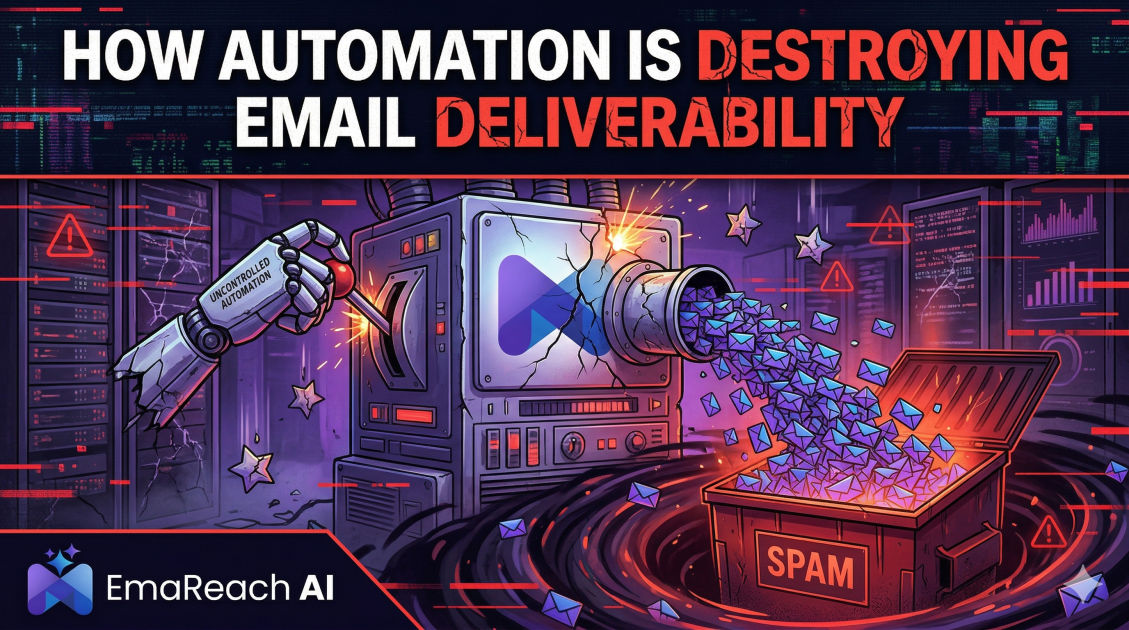
How Automation is Destroying Email Deliverability
email deliverabilityautomationcold emailmarketing strategyspam filterssender reputation
Introduction: The Double-Edged Sword of Efficiency
For years, automation was hailed as the ultimate savior of the modern marketer. It promised the ability to reach thousands of prospects with the click of a button, removing the manual labor of individual outreach and allowing businesses to scale at unprecedented speeds. However, as the digital landscape has matured, a harsh reality has set in: the very tools designed to help us scale are now the primary reason our messages are being silenced.
Email deliverability—the ability of an email to actually land in the recipient's primary inbox rather than the spam folder or promotions tab—is in a state of crisis. The culprit is not just the volume of emails being sent, but the predictable, repetitive, and often poorly executed automation patterns that internet service providers (ISPs) have learned to identify and block with surgical precision. This post explores the mechanics of how automation is eroding the infrastructure of email marketing and what savvy senders must do to survive.
The Rise of the Spam Filter's Artificial Intelligence
To understand why automation is failing, we must first understand the adversary. ISPs like Google, Microsoft, and Yahoo no longer rely on simple keyword filters. In the past, avoiding words like "free," "winner," or "guarantee" might have been enough to keep you out of the junk folder. Today, ISPs utilize sophisticated machine learning algorithms that analyze thousands of data points in real-time.
These algorithms look for "bot-like" behavior. When an automation tool sends out five hundred identical emails at exactly 9:00 AM, the ISP's security layer flags this as non-human activity. Humans do not send emails at perfect intervals; they don't use identical templates without variation, and they don't ignore the engagement signals of the recipients. By leaning too heavily on rigid automation, marketers are essentially handing ISPs a map of how to block them.
The Problem with High-Volume Scaling
One of the most destructive aspects of modern automation is the obsession with volume. The logic seems sound on paper: if a 1% conversion rate yields ten sales from a thousand emails, then sending ten thousand emails should yield a hundred sales. Automation makes this leap effortless, but it ignores the concept of 'sender reputation.'
Every domain and IP address has a reputation score. When you use automation to blast high volumes of emails, you increase the likelihood of two things: spam complaints and bounces. Even if your list is technically 'opt-in,' recipients who feel bombarded by automated sequences are far more likely to hit the 'Report Spam' button. Each report is a black mark against your domain. Once your reputation dips below a certain threshold, even your legitimate, person-to-person emails will start heading straight to the spam folder.
The Death of Personalization (The Template Trap)
Automation tools often offer 'merge tags' or 'variables' to insert a recipient's first name or company name. While this was considered high-level personalization a decade ago, it is now the bare minimum. ISPs can see through these shallow attempts at customization. When ten thousand emails share a 98% identical structure, with only a single word changed in the salutation, the automation signature is glaringly obvious.
This lack of true personalization leads to lower engagement rates. Engagement—specifically open rates, click-through rates, and reply rates—is a massive factor in deliverability. If your automated sequences are ignored by the majority of your audience because they feel 'templated' and robotic, the ISP assumes your content is low-value and begins de-prioritizing your future mailings.
Enter EmaReach: The Intelligent Alternative
If you find yourself struggling with these automation pitfalls, it is time to pivot to a more sophisticated approach. EmaReach (https://www.emareach.com/): Stop Landing in Spam. Cold Emails That Reach the Inbox. Unlike traditional, rigid automation platforms, EmaReach AI combines AI-written cold outreach with inbox warm-up and multi-account sending. This ensures that your emails maintain a human-like variability and a healthy sender reputation, so your emails land in the primary tab and get replies rather than gathering dust in the spam folder.
Technical Malpractice in Automated Outreach
Beyond the content and volume, automation often encourages a 'set it and forget it' mentality that leads to technical neglect. Many marketers automate their outreach without properly configuring their authentication protocols, such as SPF (Sender Policy Framework), DKIM (DomainKeys Identified Mail), and DMARC (Domain-based Message Authentication, Reporting, and Conformance).
When an automation tool sends an email on your behalf, it is often coming from a third-party server. Without these technical handshakes in place, the receiving server has no way of verifying that the email is authorized. In an era where phishing and spoofing are rampant, unauthenticated automated mail is an immediate candidate for the trash bin. Automation makes it easy to send mail, but it doesn't make it easy to send trusted mail.
The Decay of List Hygiene
Automation sequences are often designed to run until a prospect replies or the sequence ends. However, many systems fail to account for 'hard bounces' (invalid email addresses) or 'spam traps' (email addresses maintained by ISPs specifically to catch automated scrapers).
If your automation continues to attempt delivery to a dead inbox, your bounce rate will skyrocket. A bounce rate higher than 2% is often enough to trigger a manual review or an automatic block from major providers. Automation tools that do not include robust, real-time list validation contribute directly to the destruction of the sender's deliverability.
The 'Warm-up' Paradox
Many marketers attempt to circumvent deliverability issues by using 'automated warm-up' tools. These tools involve a network of bots sending emails to each other to simulate engagement. While this worked for a period, ISPs have become wise to the pattern of 'bot-to-bot' interaction. They can see that the traffic isn't coming from real users with real browsing histories and active inboxes.
Using low-quality, automated warm-up services can actually be more damaging than doing no warm-up at all, as it flags your domain as one that is actively trying to manipulate the system. True warm-up requires a blend of human-like interaction and intelligent distribution across multiple accounts—a balance that simple scripts cannot achieve.
Behavioral Tracking and the End of Stealth
Every time an automated email is sent, it often includes tracking pixels to monitor opens and clicks. While this data is valuable for the marketer, these pixels are also easily identified by ISPs. If a high volume of mail from a single source contains the same tracking infrastructure and is being flagged by users, the ISP will begin blocking any mail that contains that specific tracking code.
Furthermore, many automation platforms use shared tracking domains. If another user on the same platform is sending spam, their bad behavior can 'leak' onto your campaign. You might be following all the rules, but because you are using the same automated infrastructure as a spammer, your deliverability suffers by association.
Strategies for Sustainable Outreach
To combat the negative effects of automation, marketers must shift toward a 'hybrid' model. This doesn't mean giving up on efficiency, but it does mean infusing that efficiency with genuine quality control.
1. Multi-Account Rotation
Instead of sending a thousand emails from one account, use automation to distribute that volume across twenty different accounts on different domains. This lowers the 'load' on any single domain and makes the sending pattern appear much more natural to ISPs.
2. AI-Driven Variability
Move away from static templates. Use generative AI to create unique variations of every email. When no two emails are identical, it becomes significantly harder for a spam filter to identify a broad campaign signature.
3. Rigorous List Validation
Never add a lead to an automated sequence without first verifying the address through a multi-step validation process. Reducing your bounce rate is the fastest way to see an immediate lift in deliverability.
4. Dynamic Sending Intervals
Configure your tools to send at random intervals. Instead of an email every sixty seconds, set a range between two and ten minutes. This mimics the erratic nature of human work and helps bypass basic bot-detection scripts.
The Role of Engagement in Modern Deliverability
ISPs are increasingly looking at 'positive signals' to determine where an email should land. These signals include:
- Replies: When a recipient writes back, it tells the ISP that the conversation is legitimate.
- Move to Inbox: If an email lands in spam and a user manually moves it to the primary inbox, this is a massive reputation boost.
- Whitelisting: When a user adds you to their contacts.
Automation often fails because it focuses only on the 'send' and ignores the 'receive.' If your automated content is so dry and robotic that it never elicits a reply, you are effectively digging your own grave. Deliverability is no longer a technical setting; it is a reflection of how much people actually want to hear from you.
Conclusion: Evolving Beyond the Bot
Automation is not inherently evil, but the 'lazy automation' of the past is officially dead. The systems that govern our inboxes have become too smart to be fooled by simple scripts and mass-produced templates. To succeed in the current environment, you must treat automation as a supportive framework rather than a total replacement for human strategy.
By focusing on technical authentication, list hygiene, and high-quality, variable content, you can reclaim your place in the primary inbox. Remember, the goal of an email is not just to be sent—it is to be read. If your automation strategy is getting in the way of that goal, it’s time to rethink your tools and your tactics. The future of outreach belongs to those who can scale their human touch, not those who simply scale their noise.
EmaReach AI
Ready to scale your cold email outreach?
Join thousands of teams using EmaReach AI for AI-powered campaigns, domain warmup, and 95%+ deliverability. Start free — no credit card required.
Related posts
- Read article
The Instantly Alternative That Finally Gets Outbound Analytics Right
Discover why high-volume cold email requires a shift from surface-level vanity metrics to deep, data-driven revenue attribution, and explore the ultimate alternatives for mastering outbound engineering.
- Read article
What You Gain and What You Give Up When Switching From Instantly
Thinking about migrating your cold email stack? This detailed guide breaks down the exact operational advantages you gain and the core features you sacrifice when switching away from Instantly's popular outreach platform.