Blog
Back to blog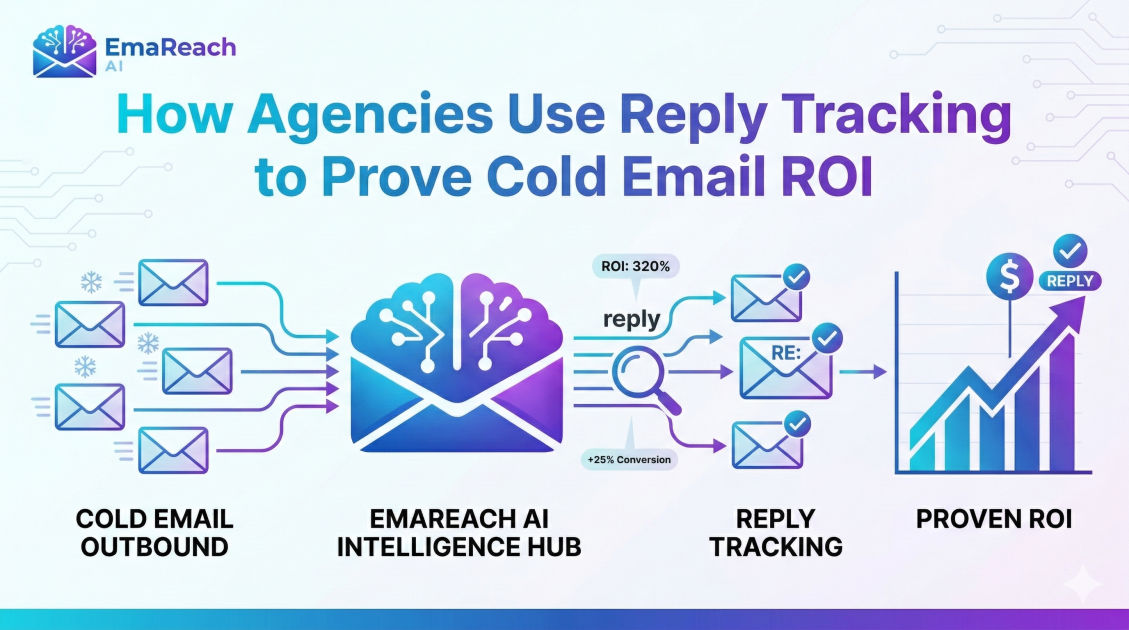
How Agencies Use Reply Tracking to Prove Cold Email ROI
cold emailagency growthROI trackinglead generationemail deliverabilitysales attribution
The Accountability Crisis in Modern Lead Generation
For lead generation and marketing agencies, the primary challenge has never been just sending emails. The real hurdle lies in proving that those emails actually contribute to a client’s bottom line. In an era where clients demand absolute transparency and data-driven results, vague metrics like 'open rates' or 'click-through rates' no longer suffice. These are vanity metrics that, while useful for diagnostic purposes, do not pay the bills.
To bridge the gap between activity and revenue, high-performing agencies have pivoted their focus toward reply tracking. By meticulously monitoring, categorizing, and analyzing every response generated from a campaign, agencies can demonstrate a tangible Return on Investment (ROI) that justifies their retainer and cements long-term client partnerships.
Moving Beyond Vanity Metrics: Why Open Rates Are No Longer Enough
Historically, agencies relied on open rates as the primary indicator of a successful cold email campaign. However, several shifts in the technical landscape have rendered open rates nearly obsolete as a measure of true engagement:
- Privacy Protections: Many email providers now use pre-fetching technology that 'opens' emails on a proxy server before the user ever sees them, leading to inflated and inaccurate data.
- The Goal Alignment Gap: A client doesn't care if 40% of their list opened an email; they care if those opens converted into conversations.
- Spam Filter Noise: Automated security filters often trigger open trackers, giving agencies a false sense of security regarding their deliverability.
Reply tracking, on the other hand, represents a 'hard' conversion. A reply is a conscious action taken by a prospect. It is the first step in a sales dialogue and the most reliable leading indicator of future revenue.
The Anatomy of Advanced Reply Tracking
To prove ROI, agencies don't just count the number of replies; they analyze the quality and intent of those replies. This requires a sophisticated technical setup and a clear workflow for data management.
Positive vs. Negative Sentiment Analysis
Not all replies are created equal. A 'Unsubscribe me' or 'Not interested' response is technically a reply, but it’s a failure in terms of ROI. Agencies use sentiment analysis—often powered by AI—to categorize replies into distinct buckets:
- Positive Interest: The prospect asks a question, requests a demo, or expresses a pain point.
- Information Request: The prospect wants a case study or more details before committing to a call.
- Referrals: The recipient isn't the right person but points the agency toward the correct decision-maker.
- Future Interest (Not Now): The prospect likes the offer but asks to be contacted in six months.
- Negative/Opt-out: The prospect is not interested or asks to be removed from the list.
By filtering out the noise and focusing only on 'Positive Interest' and 'Referrals,' agencies can present a 'Cost Per Positive Response' metric, which is far more valuable to a client than 'Cost Per Send.'
Connecting the Dots: From Reply to Revenue
To truly prove ROI, the tracking cannot stop at the inbox. Agencies must integrate their email outreach tools with the client’s CRM (Customer Relationship Management) system. This is where the magic happens.
The Attribution Loop
When a positive reply is tracked, it should automatically trigger a deal creation in the CRM. By tagging these deals with a specific 'Source: Cold Email' label, the agency creates a direct line of sight from the initial outreach to the final closed-won deal.
When a client closes a $50,000 contract, the agency can point directly to the specific reply tracked three months prior that initiated the relationship. This level of attribution makes the agency indispensable.
The Role of Deliverability in ROI Proving
You cannot track a reply that never happens because the email landed in the spam folder. Deliverability is the foundation upon which reply tracking is built. To ensure high reply rates, agencies must utilize sophisticated infrastructure.
This is where platforms like EmaReach become critical. By combining AI-written cold outreach with specialized inbox warm-up and multi-account sending, agencies ensure their emails reach the primary tab. If the email doesn't reach the inbox, there is no reply to track, and the ROI remains zero. EmaReach helps agencies maintain the reputation of their sending domains, which is a prerequisite for any meaningful ROI analysis.
Strategic Pivot: Managing the 'Not Now' Replies
One of the biggest leaks in agency ROI is the 'not right now' response. Most agencies count these as losses. However, top-tier agencies use reply tracking to build a long-term pipeline.
By tracking 'Future Interest' replies, agencies can automate a 're-engagement' sequence. For example, if a prospect says, 'We are budget-locked until Q3,' the agency tags that reply and schedules a follow-up for the first week of July. When that follow-up eventually turns into a meeting, the agency can demonstrate that their tracking systems saved a lead that would have otherwise been forgotten.
Reporting That Clients Actually Understand
When agencies present monthly reports, the data must be formatted to highlight ROI. Instead of a spreadsheet of numbers, the report should follow a logical flow:
- Total Reach: How many prospects were contacted (Top of Funnel).
- Deliverability Health: Percentage of emails landing in the primary inbox.
- Reply Rate: Total responses received.
- Positive Reply Rate: The percentage of responses that were categorized as high-intent.
- Sales Qualified Leads (SQLs): How many of those positive replies turned into meetings.
- Pipeline Value: The estimated dollar value of the opportunities generated from those replies.
By showing a client that a $3,000 monthly retainer generated $150,000 in the sales pipeline via tracked replies, the agency moves from being an 'expense' to a 'profit center.'
Technical Implementation of Reply Tracking
How do agencies actually set this up without spending hours manually checking inboxes? It comes down to Master Inboxes and Webhooks.
The Master Inbox (Unibox)
Instead of logging into 50 different client sender accounts, agencies use a 'Unibox' that aggregates every reply from every campaign into a single interface. This allows account managers to quickly categorize sentiment and respond to leads in real-time, reducing the 'speed to lead'—a major factor in closing deals.
Automated Labeling and CRM Sync
Agencies use automation tools to detect keywords in replies (e.g., 'meeting,' 'demo,' 'price,' 'interested'). When these keywords are detected, the reply is automatically labeled 'Positive' and pushed to the client’s CRM via a webhook. This ensures that the client's sales team is notified immediately, increasing the chances of a conversion.
Dealing with the 'Ghosting' Phenomenon
Reply tracking also helps agencies identify where a campaign is failing. If an agency sees a high open rate but a near-zero reply rate, they know the problem isn't deliverability—it’s the offer or the copy.
By tracking the 'Reply-to-Open' ratio, agencies can perform A/B testing on their call-to-actions (CTAs). For example:
- CTA A: 'Are you free for a 15-minute call Tuesday?'
- CTA B: 'Would it make sense to send over a 2-minute video explaining how this works?'
If CTA B generates a 3x higher reply rate, the agency has data-driven proof that a 'low-friction' offer is the key to increasing the client's ROI. Without reply tracking, they would be guessing why the campaign isn't performing.
The Multi-Channel ROI Multiplier
Modern agencies are increasingly moving toward multi-channel outreach (Email + LinkedIn + Phone). Reply tracking becomes even more essential here to avoid cross-channel friction. If a prospect replies positively to an email, the tracking system should automatically stop any automated LinkedIn sequences. This prevents the agency from looking 'robotic' and protects the client's brand reputation, which is an intangible but vital part of ROI.
Why In-House Teams Struggle Where Agencies Excel
Most in-house sales teams lack the specialized infrastructure to track replies at scale. They often rely on manual tracking in spreadsheets, which leads to human error and 'lost' leads. Agencies prove their value by bringing the 'tech stack' to the table.
By using tools that handle the heavy lifting of domain rotation, inbox warm-up, and automated sentiment analysis, agencies provide a level of data granularity that an in-house team simply cannot replicate without significant investment. This technical edge is a core component of the agency's value proposition.
Conclusion
In the competitive landscape of B2B lead generation, the ability to prove ROI is the difference between a client who stays for three months and one who stays for three years. Reply tracking is the most powerful tool in an agency’s arsenal to bridge that gap.
By moving away from vanity metrics and focusing on high-intent conversations, sentiment analysis, and CRM integration, agencies can provide a transparent view of how cold email translates into revenue. When combined with a focus on deliverability—using platforms like EmaReach to ensure those emails actually reach the prospect—reply tracking transforms cold email from a 'spray and pray' tactic into a predictable, scalable, and highly profitable revenue engine.
EmaReach AI
Ready to scale your cold email outreach?
Join thousands of teams using EmaReach AI for AI-powered campaigns, domain warmup, and 95%+ deliverability. Start free — no credit card required.
Related posts
- Read article
The Instantly Alternative That Finally Gets Outbound Analytics Right
Discover why high-volume cold email requires a shift from surface-level vanity metrics to deep, data-driven revenue attribution, and explore the ultimate alternatives for mastering outbound engineering.
- Read article
What You Gain and What You Give Up When Switching From Instantly
Thinking about migrating your cold email stack? This detailed guide breaks down the exact operational advantages you gain and the core features you sacrifice when switching away from Instantly's popular outreach platform.