Blog
Back to blog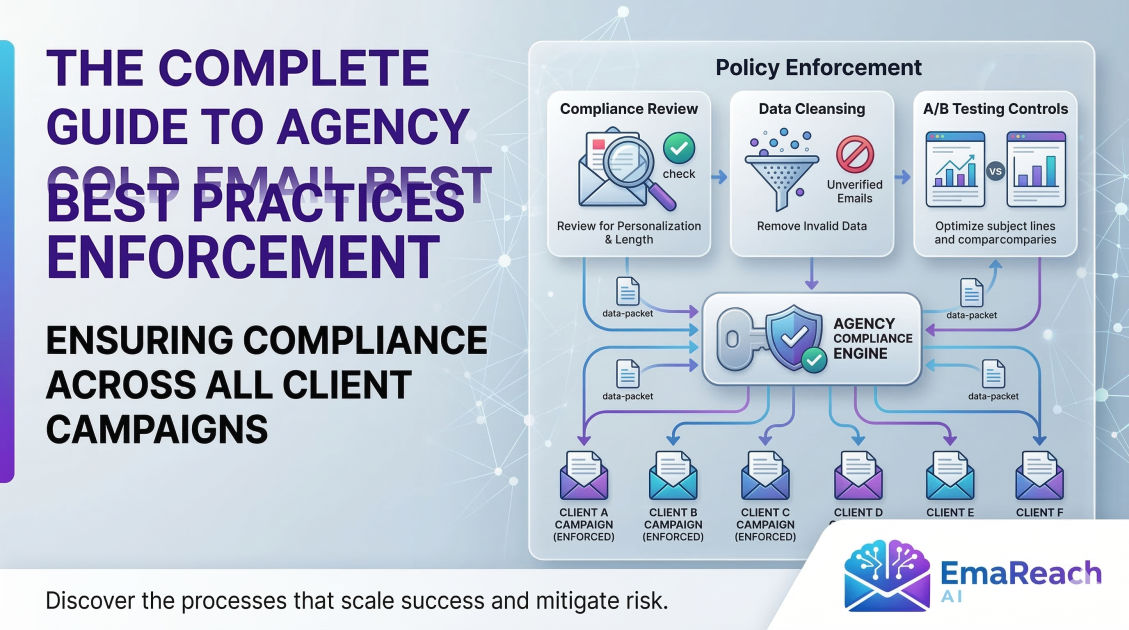
How Agencies Enforce Cold Email Best Practices Across Client Campaigns
cold emaillead generationemail deliverabilityagency growthoutreach strategymarketing automation
Introduction
For lead generation agencies, the ability to deliver consistent, high-quality results across a diverse portfolio of clients is the ultimate benchmark of success. However, as the landscape of digital communication evolves, the technical and strategic hurdles of cold email become increasingly complex. It is no longer enough to simply hit 'send' on a bulk list of contacts. Today, agencies must act as gatekeepers of reputation, technical architects of deliverability, and master craftsmen of persuasive copy.
Enforcing cold email best practices across dozens or even hundreds of client campaigns requires a systematic approach. It demands a blend of rigorous technical setup, creative excellence, and ongoing performance monitoring. When an agency manages outreach for multiple brands, the stakes are high; a single mistake can burn a client’s domain reputation or result in a complete cessation of lead flow. This guide explores the multifaceted strategies agencies use to maintain the highest standards of cold email excellence, ensuring that every message sent on behalf of a client is optimized for the inbox and the individual.
The Foundation: Technical Infrastructure and Deliverability
Before a single word of copy is written, agencies must ensure the technical foundation is unshakeable. Deliverability is the lifeblood of cold email. If an email doesn't reach the inbox, its content is irrelevant. Agencies enforce best practices here by implementing a standardized 'warm-up' and authentication protocol for every new client account.
Domain Diversification and Health
One of the first rules agencies enforce is the use of secondary domains. Sending high volumes of cold outreach from a client’s primary corporate domain is a risk most professional agencies refuse to take. Instead, they procure 'look-alike' domains that mirror the client’s brand but remain isolated from critical business operations.
Agencies typically manage this by:
- Limiting volume per mailbox: Rather than sending 500 emails from one account, they might send 30 emails from 15 different accounts. This mimics natural human behavior and stays well under the radar of ISP spam filters.
- Automated Warm-up: Every new domain undergoes a rigorous warm-up period. This involves using specialized tools to send and receive emails, automatically moving them out of spam folders and marking them as 'important' to build a positive sender reputation with providers like Google and Microsoft.
Authentication Protocols (SPF, DKIM, and DMARC)
Agencies ensure that every client domain has its 'digital passport' in order. This means correctly configuring Sender Policy Framework (SPF), DomainKeys Identified Mail (DKIM), and Domain-based Message Authentication, Reporting, and Conformance (DMARC). Without these three pillars, an email is significantly more likely to be flagged as a spoofing attempt or spam. Agencies often use centralized dashboards to monitor the status of these records across all client domains simultaneously, ensuring that no record accidentally expires or is misconfigured.
Data Hygiene and List Building Standards
High-performing agencies know that the quality of the list is just as important as the quality of the pitch. Enforcing best practices in data procurement is a non-negotiable step in the agency workflow.
Multi-Step Verification
Bounces are a primary trigger for spam filters. To prevent this, agencies enforce a multi-step verification process. After scraping or purchasing lead data, the list is run through verification software to identify 'catch-all' addresses, invalid syntaxes, and inactive mailboxes. Only 'safe-to-send' leads make it into the final campaign.
Granular Segmentation
Agencies move away from 'blast' mentalities by enforcing strict segmentation. Instead of a single list of 'Marketing Managers,' they break lists down by industry, company size, recent funding rounds, or even specific technologies used by the prospect. This allows for hyper-relevant messaging that feels personal rather than automated. By enforcing this at the data entry level, agencies ensure that their account managers cannot take shortcuts that lead to generic outreach.
Crafting the Message: Copywriting and Personalization Standards
In a crowded inbox, the only way to stand out is through relevance. Agencies enforce best practices in copywriting by moving beyond simple 'First Name' tags to deep-level personalization.
The 'Three-Part' Framework
Many top-tier agencies enforce a specific structure for every cold email:
- The Hook: A personalized observation about the prospect (a recent LinkedIn post, a podcast appearance, or a specific company achievement).
- The Bridge: Connecting that observation to a common pain point seen in the industry.
- The Value Prop / CTA: A low-friction ask that focuses on a specific outcome rather than a long sales pitch.
Leveraging Advanced Technology
To scale this level of quality, agencies are increasingly turning to sophisticated solutions. For example, EmaReach helps agencies stop landing in spam by ensuring cold emails reach the inbox through a combination of AI-written outreach and robust inbox warm-up. By using platforms that prioritize the primary tab, agencies can guarantee their well-crafted copy actually gets seen by the intended recipient.
Spam Trigger Audits
Agencies maintain 'blacklists' of words and phrases that are known to trigger spam filters—terms like 'guaranteed,' 'free,' 'act now,' or excessive use of dollar signs. Content managers review templates to ensure the language remains professional and conversational, avoiding the 'salesy' tone that modern filters are designed to catch.
Testing and Optimization at Scale
What works for a SaaS client might fail for a logistics client. Agencies enforce a culture of continuous testing to ensure each campaign is performing at its peak.
A/B Testing Protocols
Agencies don't guess; they test. They enforce best practices by running simultaneous variations of:
- Subject Lines: Testing curiosity vs. directness.
- Call to Actions: Testing 'Are you free for a call?' vs. 'Should I send over a quick video?'
- Value Propositions: Focusing on 'saving time' vs. 'increasing revenue.'
By enforcing a rule that no campaign runs without at least two variations, agencies ensure they are always gathering data on what resonates with the specific target audience.
Monitoring Engagement Signals
Beyond just open rates (which can be skewed by privacy protections), agencies look at 'positive reply rates' and 'meeting booked' rates as the true North Star metrics. They monitor these across all clients. If one client's engagement drops, it triggers an immediate audit of the domain health, the lead list quality, and the messaging relevance.
Compliance and Ethical Standards
Global regulations like GDPR (Europe), CCPA (California), and CAN-SPAM (USA) make compliance a legal necessity, not just a best practice. Agencies act as the compliance layer for their clients.
Unsubscribe Mechanisms
Every email must have a clear way for the recipient to opt-out. Agencies enforce this by either including a clear 'unsubscribe' link or a text-based instruction (e.g., 'Reply "stop" if you'd rather not hear from me'). They also maintain global 'do-not-contact' lists across their entire agency to ensure that if a prospect opts out of one client’s campaign, they aren't accidentally contacted by another.
Legitimate Interest Documentation
For GDPR compliance, agencies often perform a 'Legitimate Interest Assessment' to ensure that the outreach is relevant to the recipient’s professional role. By documenting this process, they protect both themselves and their clients from potential legal scrutiny.
Managing the Human Element: Training and Standard Operating Procedures (SOPs)
The best tools in the world won't save a campaign if the person operating them makes a manual error. Agencies enforce best practices through rigorous internal SOPs.
- The Pre-Flight Checklist: Before any campaign goes live, a secondary account manager must review the settings. This includes checking the sending schedule (ensuring emails aren't going out at 3 AM in the prospect's time zone), verifying the 'from' name, and testing all personalization tags to ensure there are no '{First_Name}' blunders.
- Weekly Performance Reviews: Agencies hold internal meetings to discuss which campaigns are 'winning' and which are 'losing.' This cross-pollination of ideas ensures that a breakthrough for one client can be ethically applied to improve the results for others.
The Role of Multi-Account Management
As an agency scales, managing 50 or 100 separate sender identities becomes a logistical nightmare. Best practices are enforced here through centralization. Agencies use specialized software that allows them to view all client 'inboxes' in one master view. This ensures that no lead reply is missed and that response times remain fast—another critical factor in conversion rates.
By spreading the volume across many accounts, they also protect the longevity of the outreach. If one account is flagged, the remaining 95% of the campaign continues to function without interruption. This 'anti-fragile' approach is a hallmark of professional agency operations.
Conclusion
Enforcing cold email best practices across a diverse client base is a relentless pursuit of excellence. It requires a balance between the hard science of technical deliverability and the soft art of human-to-human persuasion. By standardizing domain health protocols, demanding high-quality data hygiene, and fostering a culture of rigorous A/B testing, agencies can move beyond the 'spam' stigma and deliver genuine value to their clients.
The most successful agencies recognize that cold email is not a volume game, but a relevance game. By implementing these frameworks, they ensure that their clients' messages land in the right place, at the right time, with the right message, ultimately turning the cold inbox into a consistent source of predictable growth.
EmaReach AI
Ready to scale your cold email outreach?
Join thousands of teams using EmaReach AI for AI-powered campaigns, domain warmup, and 95%+ deliverability. Start free — no credit card required.
Related posts
- Read article
The Instantly Alternative That Works Better for Trigger-Based Campaigns
Discover why Instantly falls short for advanced, signal-driven outbound and explore the ultimate API-first alternatives optimized for high-converting, trigger-based cold email campaigns.
- Read article
The Instantly Alternative That Handles High Bounce Rates Without Panic
Discover how transitioning to an advanced Instantly alternative can safeguard your cold email infrastructure. Learn to handle high bounce rates effortlessly using real-time verification, smart mailbox rotation, and automated safety nets to protect your sender reputation and maintain consistent primary inbox placement.