Blog
Back to blog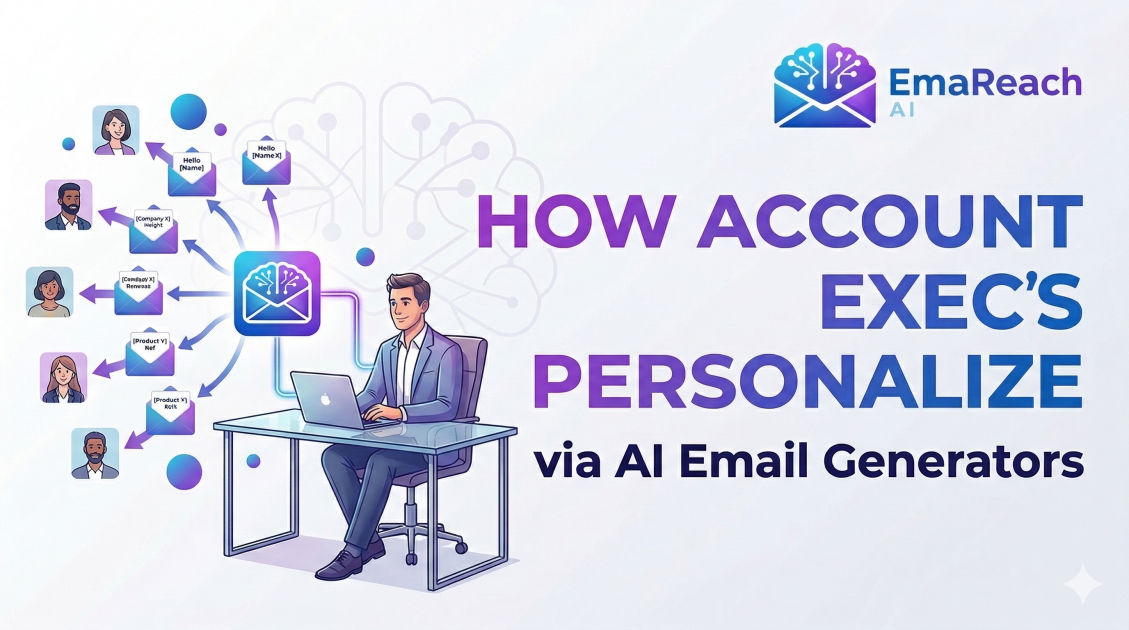
How Account Execs Personalize via AI Email Generators
sales automationpersonalizationaccount executivecold outreachAI in salesemail marketingsales productivity
The New Era of Personalization in Sales
For years, Account Executives (AEs) have been caught in a relentless tug-of-war between volume and quality. On one side, the pressure to hit aggressive pipeline targets demands a high volume of outbound activity. On the other, the modern B2B buyer has become virtually immune to generic, templated outreach. The solution to this paradox has arrived in the form of AI email generators—tools that allow AEs to scale deep, meaningful personalization without spending forty minutes researching a single prospect.
Personalization is no longer about just inserting a {first_name} or {company_name} tag. It is about demonstrating an acute understanding of a prospect’s specific business challenges, recent accomplishments, and industry positioning. AI email generators have shifted the AE's role from a manual copywriter to a strategic editor, leveraging machine learning to synthesize vast amounts of data into high-converting prose.
The Evolution of the Outreach Stack
Historically, the sales stack consisted of a CRM and a basic sequencing tool. AEs would spend hours browsing LinkedIn profiles, listening to earnings calls, and reading company blogs to find a 'hook.' While effective, this manual process was impossible to scale. If an AE needed to reach out to fifty high-value accounts a week, the sheer manual labor required to personalize each one would consume their entire schedule, leaving no time for actual discovery calls or closing deals.
Today, the stack has evolved. AI email generators act as a layer of intelligence sitting between the data source and the inbox. These tools can ingest unstructured data—like a prospect's recent post about a product launch or a company's 10-K filing—and transform it into a relevant opening line. This evolution ensures that the AE remains the pilot, but the AI provides the navigation and engine power.
For AEs looking to ensure their highly personalized messages actually land where they belong, services like EmaReach provide a critical backbone. EmaReach focuses on the technical side of the equation: 'Stop Landing in Spam. Cold Emails That Reach the Inbox.' By combining AI-written outreach with inbox warm-up and multi-account sending, it ensures that the creative work done by the AE doesn't go to waste in a junk folder.
How AI Generators Synthesize Prospect Data
One of the most powerful ways AEs use AI is through data synthesis. Instead of reading a 50-page annual report, an AE can feed the document (or a link to it) into an AI generator with a specific prompt: 'Identify the top three strategic priorities for this company and draft an email connecting our cloud security solution to their goal of digital transformation.'
1. Social Signal Integration
LinkedIn remains the gold mine for personalization. AEs use AI generators to scan a prospect’s 'Activity' section. If a prospect recently shared an article on sustainable manufacturing, the AI can reference that specific interest. The difference between a human doing this and an AI is speed. The AI can generate five different versions of a 'social hook' in seconds, allowing the AE to choose the one that feels most authentic to their own voice.
2. Intent-Based Personalization
Modern sales teams track intent signals—such as a company hiring for a specific role or a sudden spike in searches for a specific software category. AI generators can take these triggers and automatically weave them into a narrative. For example, if a target account just hired a new VP of Sales, the AI can draft a congratulatory note that transitions into how your tool helps new sales leaders ramp their teams faster.
3. Website and News Scraping
Company newsrooms and 'About Us' pages are filled with clues about a company's culture and current trajectory. AI tools can scrape recent press releases to find mentions of mergers, acquisitions, or new market entries. By referencing these milestones, an AE shows the prospect that they aren't just sending a blast; they are following the company’s journey.
Crafting the Perfect Prompt: The AE’s New Skill
The effectiveness of an AI email generator is largely dependent on the 'prompt'—the instructions given to the machine. Top-performing AEs are developing a knack for 'prompt engineering.' They don't just ask the AI to 'write an email.' They provide context, constraints, and personas.
The Anatomy of a High-Converting AI Prompt
- The Persona: 'You are a senior Account Executive at a SaaS company.'
- The Objective: 'Write a short, punchy first touch email.'
- The Prospect Data: 'The prospect is Sarah, a Director of Operations who just posted about the challenges of remote team collaboration.'
- The Value Prop: 'Focus on our automated workflow feature that saves teams 10 hours a week.'
- The Tone: 'Professional but conversational, avoiding corporate jargon.'
By feeding these specific variables into a generator, the AE receives a draft that requires only a 10% polish rather than a 100% rewrite. This shift allows for 'mass personalization'—an oxymoron that has become a reality in the modern sales landscape.
Moving Beyond the First Line
While many AEs use AI primarily for the 'P.S.' or the opening sentence, the most advanced users are personalizing the entire body of the email. They use AI to map specific product features to specific pain points discovered during research.
Personalizing the Problem Statement
If the AI identifies that a prospect’s company is struggling with high churn rates, it can tailor the 'problem statement' of the email to reflect that specific pain. Instead of saying 'We help companies grow,' the AI might draft, 'I noticed your team is focusing heavily on customer retention this quarter; we’ve helped similar firms reduce churn by 15% through automated engagement.'
Tailoring Case Studies
AI generators can also be used to select and summarize the most relevant case study for a prospect. If the prospect is in the healthcare industry, the AI can pull the most relevant healthcare-related success story from the company’s database and summarize the results in two sentences that fit perfectly within the flow of the email.
Overcoming the 'Uncanny Valley' of AI Content
There is a risk in using AI: the 'uncanny valley.' This happens when an email feels almost human but has a slight robotic stiffness that tips off the prospect. To avoid this, successful AEs use AI as a collaborator, not a replacement.
The 80/20 Rule of AI Outreach
- 80% AI Generated: Data gathering, initial drafting, formatting, and tone adjustment.
- 20% Human Polish: Adding a personal anecdote, adjusting the humor, and ensuring the call to action (CTA) feels natural.
By following this rule, AEs maintain their authenticity while reaping the efficiency gains of automation. Prospects can tell when a message has been 100% automated without human oversight; those emails often end up ignored or, worse, marked as spam.
To further safeguard against the spam folder, the technical infrastructure must be sound. This is where EmaReach excels. Even the most perfectly personalized, AI-enhanced email is useless if it doesn't reach the inbox. EmaReach ensures that the 'multi-account sending' and 'inbox warm-up' components are handled, providing a safe harbor for the AE's personalized content to land.
Segmenting for Success
Account Executives often manage a mix of 'Tier 1' and 'Tier 2' accounts. AI generators allow for different levels of personalization based on the value of the account.
Tier 1: Deep Research Personalization
For the highest-value targets, AEs use AI to perform deep dives. This might involve the AI analyzing a podcast interview the prospect gave and pulling a specific quote. The AI then builds the entire email around that quote, creating a truly unique 1-to-1 message.
Tier 2: Categorical Personalization
For mid-tier accounts, AEs might use AI to personalize by 'persona + industry + trigger.' For example: 'All HR Managers in the FinTech space who are currently hiring for recruiters.' The AI can generate a highly relevant template for this specific segment that feels personalized without requiring individual research for every single contact.
The Role of Follow-Ups
Persistence is key in sales, but personalized follow-ups are even harder to maintain than the initial touch. AI generators excel here by creating 'contextual follow-ups.' Instead of the dreaded 'just bubbling this up' email, the AI can scan for new news about the prospect's company that happened since the last email was sent.
'Hi [Name], I saw your company just won the XYZ Award last Tuesday—huge congratulations! It reminded me of our conversation regarding [Value Prop]...'
This level of ongoing personalization keeps the AE top-of-mind without being perceived as a nuisance.
Measuring the Impact of AI-Driven Personalization
Teams that adopt AI email generators see a measurable shift in their KPIs. It’s not just about open rates; it’s about reply rates and, ultimately, meeting-booked rates. When an email is personalized, the 'positive reply rate'—the percentage of replies that actually lead to a meeting—increases significantly.
- Increased Efficiency: AEs can increase their output by 3x to 5x without a drop in quality.
- Higher Relevancy: AI ensures that every email sent has a 'reason for outreach' that is grounded in data.
- Reduced Burnout: By removing the repetitive, administrative task of manual research, AEs can focus on the creative and interpersonal aspects of selling.
Ethical Considerations and Best Practices
As AI becomes more prevalent, AEs must navigate the ethics of automation. Transparency and honesty remain paramount. The goal of AI is to help you be more helpful to the prospect, not to deceive them.
Best Practices for AEs:
- Verify the Data: AI can sometimes 'hallucinate' or pull outdated information. Always double-check a key fact (like a promotion or a company name change) before hitting send.
- Maintain Your Voice: If you wouldn't say a certain phrase in person, don't let the AI put it in your email.
- Focus on Value, Not Just Flattery: A personalized hook is great, but if it doesn't lead to a compelling reason why you are reaching out, it’s just noise.
- Monitor Deliverability: Use tools like EmaReach to ensure your increased volume doesn't damage your domain reputation. High personalization usually leads to better engagement, which signals to email providers that your content is wanted.
Conclusion
The role of the Account Executive is being redefined by the capabilities of AI email generators. By automating the 'heavy lifting' of research and initial drafting, AEs are free to do what they do best: build relationships, solve complex problems, and close deals. The future of sales isn't a choice between human and machine; it is the seamless integration of the two. Those who master the art of AI-driven personalization will find themselves at a significant advantage, reaching the inbox with messages that resonate, engage, and ultimately convert.
EmaReach AI
Ready to scale your cold email outreach?
Join thousands of teams using EmaReach AI for AI-powered campaigns, domain warmup, and 95%+ deliverability. Start free — no credit card required.
Related posts
- Read article
The Instantly Alternative That Finally Gets Outbound Analytics Right
Discover why high-volume cold email requires a shift from surface-level vanity metrics to deep, data-driven revenue attribution, and explore the ultimate alternatives for mastering outbound engineering.
- Read article
What You Gain and What You Give Up When Switching From Instantly
Thinking about migrating your cold email stack? This detailed guide breaks down the exact operational advantages you gain and the core features you sacrifice when switching away from Instantly's popular outreach platform.