Blog
Back to blog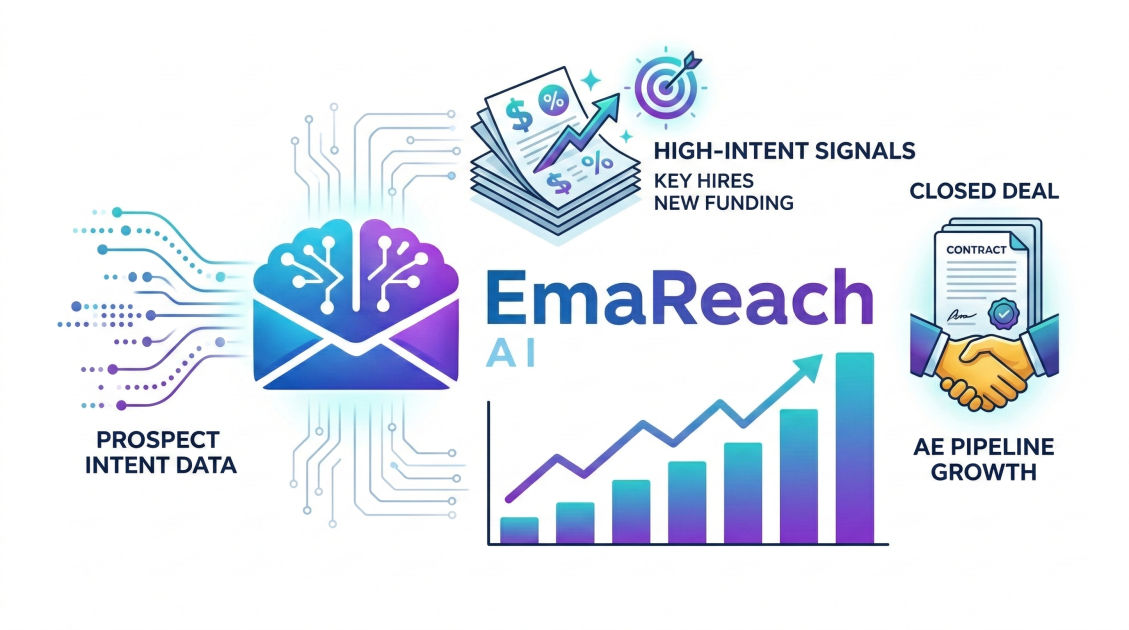
High-Intent AI Cold Email Tools for Account Execs
cold emailsales automationaccount executiveoutreach toolsintent dataAI in salesemail deliverability
The Evolution of the Account Executive Role
For years, the life of an Account Executive (AE) was clearly divided: Sales Development Representatives (SDRs) handled the top-of-funnel prospecting, and AEs focused on closing. However, the modern sales landscape has shifted. AEs are increasingly responsible for their own pipeline generation. In an era of record-high noise and overflowing inboxes, the traditional 'spray and pray' method is no longer viable. Success now hinges on the ability to identify and engage prospects who are already showing signs of readiness to buy. This is where high-intent AI cold email tools have become the secret weapon for the high-performing AE.
High-intent outreach isn't just about personalization; it’s about timing. It’s the difference between emailing a prospect because they fit a demographic profile and emailing them because their company just expanded into a new territory, hired a specific lead, or started researching solutions in your category. AI has made it possible to track these signals at scale, allowing AEs to act with the precision of a heat-seeking missile.
Understanding High-Intent Signals
Before diving into the tools, it is crucial to understand what constitutes 'high intent' in the context of cold outreach. High-intent signals are digital breadcrumbs that suggest a company or individual is facing a problem your product can solve, or is actively looking for a solution.
1. Technographic Changes
When a company adds or removes a specific piece of software from their tech stack, it creates a window of opportunity. For instance, if an AE sells a CRM integration and a prospect just installed a new CRM, that is a high-intent signal. AI tools can now scrape headers and job postings to identify these shifts in real-time.
2. Hiring Patterns and Leadership Changes
New leadership often means new budgets and a desire to change existing processes. When a new VP of Sales or Head of Operations is hired, they are often looking to make an impact within their first ninety days. AI tools monitor LinkedIn and company career pages to alert AEs the moment these transitions occur.
3. Funding and Financial Milestones
An injection of capital typically leads to aggressive growth targets. Companies that have recently closed a Series B or C round are often in a 'buy' mindset to scale their infrastructure. High-intent tools filter these triggers so AEs can reach out exactly when the budget is unlocked.
4. Intent Data (Third-Party Research)
This is perhaps the most powerful signal. Platforms that track 'intent data' monitor what people are reading across the web. If five executives at a target account are all reading whitepapers about 'cloud security optimization,' and you sell cloud security, that account is currently in a high-intent state.
The Anatomy of an AI-Powered Outreach Strategy
To effectively leverage these signals, an AE needs a tech stack that does more than just send emails. They need a system that integrates data intelligence with generative AI. A cornerstone of this strategy is ensuring that these highly researched emails actually reach the prospect. This is why many top-tier sales teams utilize EmaReach. Stop Landing in Spam. Cold Emails That Reach the Inbox. EmaReach AI combines AI-written cold outreach with inbox warm-up and multi-account sending—so your emails land in the primary tab and get replies. When you have identified a high-intent lead, the last thing you want is for your perfectly crafted message to vanish into a junk folder.
Data Enrichment: The Foundation
High-intent tools start with data. They don't just provide an email address; they provide context. This includes the prospect’s recent social media activity, the company's recent press releases, and even transcripts from recent earnings calls. By feeding this data into an AI model, the AE can generate a 'reason for reach out' that feels organic and deeply researched.
Hyper-Personalization at Scale
In the past, personalizing an email took fifteen minutes per prospect. An AE doing their own prospecting could only realistically contact twenty people a day. With generative AI, that same AE can produce a thousand hyper-personalized emails in the same timeframe. The AI doesn't just swap out the 'First Name' field; it references specific details found in the high-intent triggers mentioned earlier.
Top Categories of High-Intent AI Tools
To build a comprehensive outbound engine, Account Executives typically look at several categories of tools that work in tandem.
1. Intent Platforms (The 'Who' and 'When')
These platforms are the radar system. They tell the AE which accounts are currently in-market. By aggregating data from across the web, these tools assign 'intent scores' to accounts. An AE can filter their CRM to show only accounts with a score of 80 or higher, ensuring they never waste time on 'cold' leads.
2. AI Personalization Layers (The 'What')
Once the AE knows who to contact, these tools help craft the message. They act as a bridge between the data and the email draft. Some tools focus on 'first-line generation,' where the AI writes a custom opening sentence based on a prospect’s LinkedIn profile or a recent podcast they appeared on.
3. Deliverability and Infrastructure (The 'How')
As mentioned, the best content in the world is useless if it isn't delivered. Infrastructure tools manage the technical side of cold email—SPF, DKIM, DMARC records, and 'inbox warming.' This ensures that as an AE scales their high-intent outreach, their sender reputation remains pristine.
Writing the High-Intent Cold Email
Using AI doesn't mean the AE should step out of the process entirely. The most successful outreach follows a specific framework that the AI executes under the AE's supervision.
The 'Trigger-Problem-Solution' Framework
- The Trigger: 'I noticed your team just expanded its engineering department in Berlin...'
- The Problem: 'Usually, when teams scale that quickly, maintaining code quality and documentation becomes a bottleneck...'
- The Solution: 'We helped Company X automate their documentation during a similar growth spurt...'
- The CTA: 'Worth a brief chat to see if we can do the same for you?'
AI tools are exceptionally good at finding the 'Trigger' and connecting it to the 'Problem.' The AE provides the 'Solution' and 'CTA' templates, and the AI weaves them together into a seamless narrative.
Overcoming the 'AI-Generated' Stigma
A common fear among Account Executives is that their emails will sound robotic. The key to avoiding this is 'Human-in-the-Loop' (HITL) AI. Instead of letting the AI send emails autonomously, the AE uses the tool to generate drafts. They then spend sixty seconds reviewing and tweaking the draft to add their unique voice or a specific industry insight that only a human would know.
Furthermore, high-intent tools allow for 'multichannel' AI. If a prospect doesn't reply to a high-intent email, the tool can automatically suggest a LinkedIn comment or a personalized video script based on the same intent data. This persistence, powered by AI intelligence, is what separates the top 1% of AEs from the rest.
The Role of Inbox Warm-up and Technical Setup
Modern email providers use sophisticated algorithms to detect automated outreach. To bypass these, AEs must ensure their 'sending health' is high. This involves using multiple 'burner' domains or subdomains to protect the primary corporate domain. High-intent tools often include features that slowly increase the volume of emails sent from a new account—a process known as warming up.
Without this, even the most relevant, high-intent email will be flagged as spam because the sudden spike in volume looks suspicious to Google or Outlook. Tools that integrate these technical safeguards are essential for any AE who plans on staying in the inbox over the long term.
Measuring Success in the AI Era
The metrics for cold email are changing. In the past, AEs looked at open rates. Today, open rates are often skewed by 'bot clicks' from security filters. The modern AE focuses on Reply Rate and Meeting Set Rate.
High-intent AI tools provide analytics that show which 'triggers' are performing best. For example, an AE might find that 'New VP Hire' triggers have a 15% reply rate, while 'New Funding' only has a 5% rate. This feedback loop allows the AE to double down on the most effective signals, optimizing their time and maximizing their commission.
Implementing a High-Intent Workflow
If you are an Account Executive looking to start using these tools, the best approach is to start small.
- Select your trigger: Choose one signal (e.g., job postings for a specific role).
- Pick your AI tool: Find a tool that can scrape this data and generate a draft.
- Ensure Deliverability: Use a service like EmaReach to make sure your outbound efforts aren't being blocked at the gate.
- Test and Iterate: Run a sequence of 100 emails and analyze the sentiment of the replies.
The Future of AI in Sales Outreach
We are moving toward a future where AI will not just write the email, but will also predict the best minute of the day to send it and the specific tone (aggressive, helpful, or inquisitive) that will resonate with a specific individual's personality type. Personalization will move beyond 'what you do' to 'how you think.'
Account Executives who embrace these high-intent tools now will have a significant advantage. They will be able to manage larger territories, maintain fuller pipelines, and close deals faster because they are only talking to people who actually need their help. The days of 'grinding out' 100 random calls are over; the era of the 'Intelligent AE' has arrived.
Conclusion
High-intent AI cold email tools are no longer a luxury; they are a necessity for any Account Executive who wants to hit their quota in a competitive market. By focusing on intent signals—such as technographic changes, hiring patterns, and third-party research—AEs can move away from generic outreach and toward meaningful conversations. The combination of data-driven triggers, generative AI personalization, and robust deliverability infrastructure creates a powerhouse sales engine. When the right message reaches the right person at the exactly right time, the sale is halfway done before the first meeting even begins. Success in modern sales is about working smarter, not harder, and high-intent AI is the bridge to that smarter future.
EmaReach AI
Ready to scale your cold email outreach?
Join thousands of teams using EmaReach AI for AI-powered campaigns, domain warmup, and 95%+ deliverability. Start free — no credit card required.
Related posts
- Read article
The Instantly Alternative That Finally Gets Outbound Analytics Right
Discover why high-volume cold email requires a shift from surface-level vanity metrics to deep, data-driven revenue attribution, and explore the ultimate alternatives for mastering outbound engineering.
- Read article
What You Gain and What You Give Up When Switching From Instantly
Thinking about migrating your cold email stack? This detailed guide breaks down the exact operational advantages you gain and the core features you sacrifice when switching away from Instantly's popular outreach platform.