Blog
Back to blog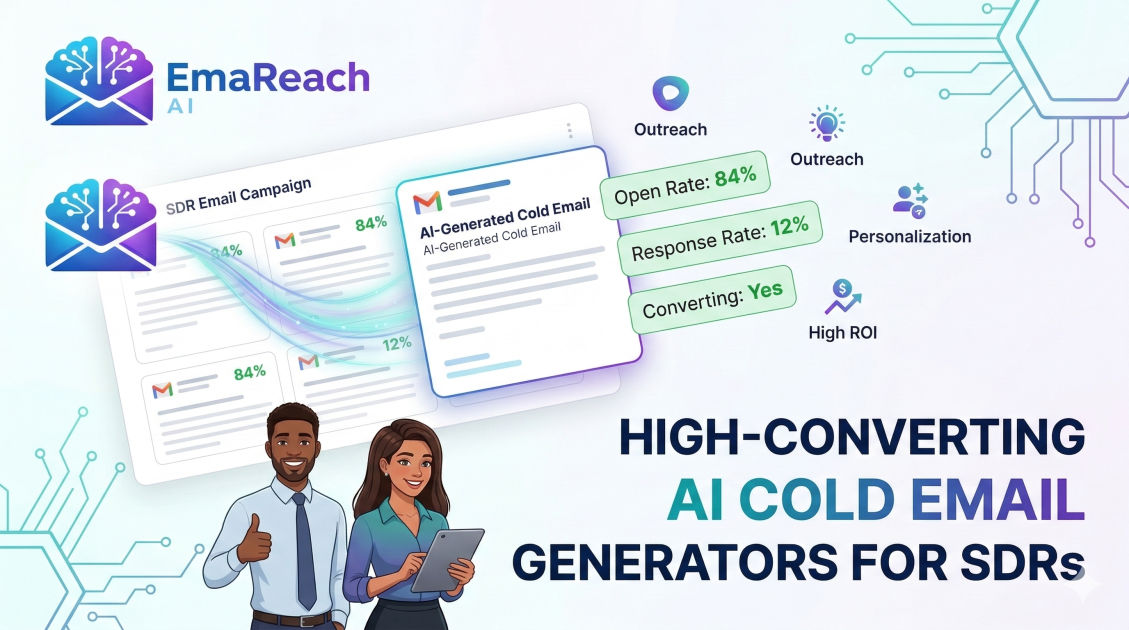
High-Converting AI Cold Email Generators for SDRs
cold emailSDRsales automationAI writingoutreach strategyemail deliverabilitylead generation
The Evolution of Sales Development: Why AI Generators are Essential
Sales Development Representatives (SDRs) have traditionally spent hours every day researching prospects and manually drafting personalized emails. While personalization is the key to high conversion rates, it is inherently difficult to scale. For years, the trade-off was simple: send more emails with lower quality, or send fewer emails with higher quality.
AI cold email generators have fundamentally changed this dynamic. By leveraging Large Language Models (LLMs) and deep data integration, these tools allow SDRs to produce hyper-personalized outreach at a scale that was previously impossible. This guide explores how AI generators are transforming the sales landscape and which tools are helping SDRs hit their quotas more efficiently than ever.
Understanding High-Converting AI Cold Email Generators
A high-converting AI cold email generator is not just a template engine. It is a sophisticated system that analyzes prospect data—such as LinkedIn profiles, recent company news, financial reports, and social media activity—to generate unique, relevant messages.
The goal of these tools is to mimic the nuance of a human-written email while removing the time-consuming labor of manual research. When used correctly, these generators help SDRs overcome the 'blank page' problem and ensure that every touchpoint provides value to the recipient.
The Core Mechanics of AI Personalization
To understand why these tools convert, we must look at the mechanics behind them. Most top-tier AI generators utilize a combination of the following:
- Intent Data Integration: Identifying when a company is likely to buy based on recent events.
- Natural Language Processing (NLP): Ensuring the tone is professional yet conversational.
- Variable Injection: Moving beyond basic [First_Name] tags to include [Specific_Achievement] or [Recent_Observation].
- Sentiment Analysis: Adjusting the pitch based on the likely pain points of a specific job title.
Top AI Cold Email Generators for Modern SDRs
Selecting the right tool depends on your specific workflow and the volume of outreach required. Here are the leading categories of AI generators currently used by high-performing sales teams.
1. Research-First Personalization Tools
These tools focus on the 'first line' of the email. They scan the web for information about a prospect and write a custom opening sentence that proves the email isn't a blast.
- Lyne.ai: Known for its ability to scrape deep data points to create 'lines' that reference podcasts the prospect was on or specific articles they wrote.
- Smartwriter.ai: Focuses on creating high-converting openers based on LinkedIn activity and backlink requests, making it a favorite for both SDRs and SEO professionals.
2. Full-Sequence AI Orchestrators
Some platforms don't just write one email; they build entire multi-step sequences. They adjust the messaging for follow-ups based on whether the prospect opened the previous email or clicked a link.
- Lavender: More than just a generator, Lavender acts as a sales assistant. It scores your emails in real-time and provides AI-driven suggestions to make the copy more concise and impactful.
- Regie.ai: This tool helps SDRs build entire campaigns in minutes by using AI to align the messaging with specific buyer personas and pain points.
3. Deliverability-Focused AI Platforms
Even the best-written email is useless if it lands in the spam folder. Some AI generators prioritize the technical health of your outreach alongside the copy.
EmaReach is a prime example of this integrated approach. By combining AI-written cold outreach with automated inbox warm-up and multi-account sending, it ensures that your high-converting copy actually reaches the primary tab. This 'all-in-one' philosophy is becoming the standard for SDRs who want to stop landing in spam and start getting replies.
The Anatomy of a High-Converting AI Cold Email
Regardless of the tool you use, the output must follow a proven structure to convert. AI is most effective when guided by a strong framework.
The Hook (The AI's Strength)
This is where the AI shines. A high-converting hook references something specific to the prospect. For example: "I noticed your recent comment on the shift toward remote infrastructure in the fintech sector..."
The Bridge
The bridge connects the personalized hook to the reason for your email. It should feel seamless. If the AI identifies a growth milestone, the bridge should explain how your solution supports that specific type of growth.
The Value Proposition
Avoid the 'feature dump.' The AI should be programmed to highlight a single, clear benefit. Use data-backed claims, such as: "We helped [Competitor] reduce their churn by 15% using the same logic."
The Call to Action (CTA)
A high-converting CTA is low-friction. Instead of asking for a 30-minute meeting, ask for interest.
- Weak CTA: "Are you free for a call on Tuesday at 2 PM?"
- AI-Optimized CTA: "Would you be opposed to seeing a brief overview of how this works?"
Overcoming the Challenges of AI-Generated Outreach
While AI is a force multiplier, it is not infallible. SDRs must be aware of common pitfalls to maintain high conversion rates.
Avoiding the 'Robot Voice'
Sometimes AI can sound too formal or too repetitive. The best SDRs use AI-generated drafts as a starting point (the 80/20 rule). The AI does 80% of the work, and the human adds the final 20% of 'soul' and brand-specific nuance.
Preventing Hallucinations
AI can occasionally 'hallucinate' facts about a company. It might claim a prospect won an award they didn't, or that a company offers a service they don't. High-converting workflows always include a quick human verification step before the 'send' button is hit.
Managing Deliverability at Scale
As you increase volume with AI, email providers may flag your activity. This is why using tools that offer inbox warm-up and rotation is critical. Without a solid technical foundation, even the most persuasive AI copy will be filtered out by spam algorithms.
How to Prompt AI for Better Cold Email Results
If you are using a general AI tool like ChatGPT or Claude to generate your emails, your prompts determine your success. A basic prompt yields a basic email. A sophisticated prompt yields a high-converting one.
The 'Context-Action-Constraint' Framework
- Context: "I am an SDR at a cybersecurity firm. My prospect is a CISO at a mid-sized healthcare company."
- Action: "Write a short cold email referencing their recent HIPAA compliance update."
- Constraint: "Keep it under 100 words. Use a casual but professional tone. Do not use the word 'hope this finds you well.'"
By providing these parameters, you force the AI to produce copy that fits the modern 'short and punchy' style that actually gets read on mobile devices.
The Role of Personalization Layers
Modern SDR teams are moving toward 'layered' personalization. This involves using AI to generate different elements of the email from different data sources.
- Level 1 (Company Data): Mentions of funding rounds, product launches, or mergers.
- Level 2 (Persona Data): Tailoring the pain points to the specific job title (e.g., CFOs care about cost; CTOs care about integration).
- Level 3 (Individual Data): References to personal interests, social media posts, or past career history.
AI generators that can pull from all three layers simultaneously represent the gold standard of high-converting outreach.
Integrating AI Generators into Your CRM
Efficiency is lost if an SDR has to copy-paste between an AI tool and their CRM (like Salesforce or HubSpot). The most effective setups involve native integrations where the AI generates the text directly within the lead record.
Tools like Salesloft and Outreach.io have begun integrating AI features directly into their platforms. However, specialized third-party generators often provide more creative and less 'templated' results. The key is to find a balance between the speed of the platform and the quality of the generator.
Measuring the Success of Your AI Outreach
To optimize your AI generator, you must track specific KPIs beyond just 'open rates.'
- Positive Reply Rate: The percentage of replies that actually lead to a meeting. AI can sometimes get 'replies' that are just people correcting a mistake the AI made.
- Meeting Show Rate: Does the AI-generated hype actually translate to people showing up? If the email was too aggressive, the prospect might book a meeting just to end the sequence and then ghost.
- Sales Velocity: How much faster are SDRs moving leads through the top of the funnel using AI compared to manual methods?
The Future of AI in Sales Development
We are moving toward a future of 'Autonomous Sales.' Soon, AI generators will not just write the email; they will research the lead, verify the email address, write the copy, send the message, and handle the initial objection handling.
However, the human SDR remains vital. The human's job is shifting from 'writer' to 'editor' and 'strategist.' Understanding how to direct the AI and which 'hooks' resonate with different market segments is the new elite skill for sales professionals.
Best Practices for SDRs Using AI Generators
To maximize your ROI from AI generators, follow these evergreen principles:
- Always A/B Test: Run one AI-generated campaign against a human-written control group. Constantly tweak the prompts based on which performs better.
- Focus on the Signature: Ensure your signature is clean and professional. AI often ignores this part, but it is a major credibility signal for the prospect.
- Clean Your Data: AI is only as good as the data it consumes. If your CRM is full of 'LLC' and 'Inc' in company names, your AI emails will look automated. Clean the data before feeding it to the generator.
- Use Multi-Channel Outreach: Don't rely solely on email. Use AI to generate a LinkedIn connection request and a phone script that align with the email you just sent.
Conclusion
High-converting AI cold email generators are no longer a luxury for SDRs; they are a necessity for staying competitive in a crowded inbox. By leveraging the power of personalization at scale, SDRs can focus on what they do best: building relationships and closing deals. Whether you are using specialized tools for research, full-sequence orchestrators, or deliverability-first platforms like EmaReach, the goal remains the same—delivering the right message to the right person at the right time. The tools are here; the only question is how effectively you will use them to dominate your market.
EmaReach AI
Ready to scale your cold email outreach?
Join thousands of teams using EmaReach AI for AI-powered campaigns, domain warmup, and 95%+ deliverability. Start free — no credit card required.
Related posts
- Read article
The Instantly Alternative That Finally Gets Outbound Analytics Right
Discover why high-volume cold email requires a shift from surface-level vanity metrics to deep, data-driven revenue attribution, and explore the ultimate alternatives for mastering outbound engineering.
- Read article
What You Gain and What You Give Up When Switching From Instantly
Thinking about migrating your cold email stack? This detailed guide breaks down the exact operational advantages you gain and the core features you sacrifice when switching away from Instantly's popular outreach platform.