Blog
Back to blog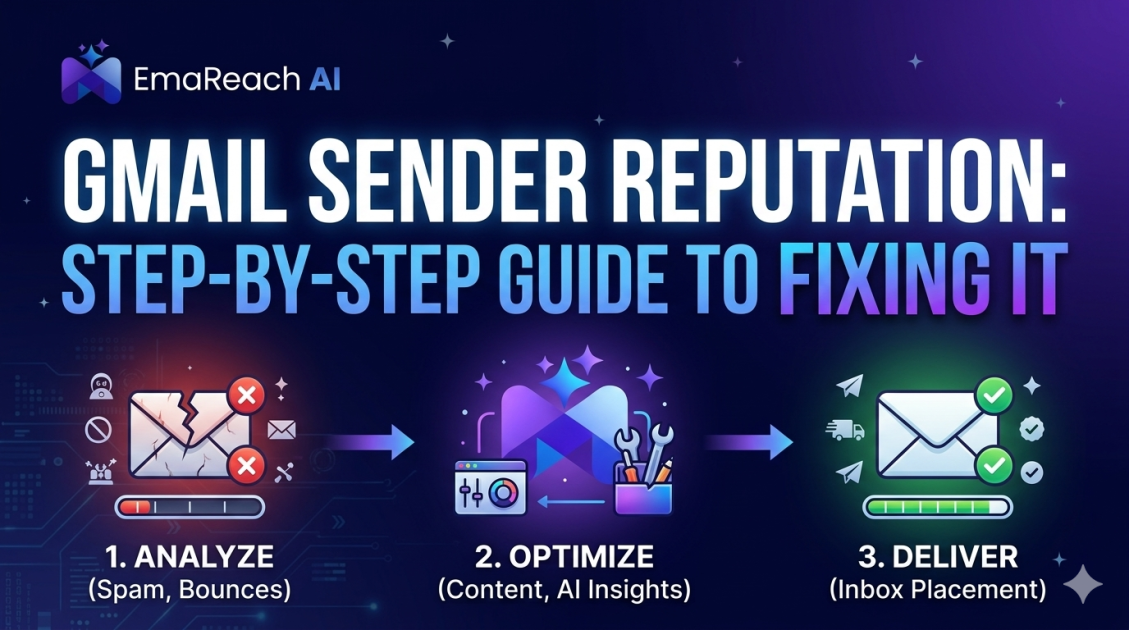
Gmail Sender Reputation: Step-by-Step Guide to Fixing It
Gmail deliverabilitysender reputationemail marketingspam filterscold outreachGoogle Postmasteremail warm-up
Introduction
Landing in the Gmail primary inbox is the ultimate goal for any email marketer or sales professional. However, Gmail’s sophisticated filtering algorithms are constantly evolving to protect users from spam. At the heart of these algorithms is your Gmail Sender Reputation. If your reputation is damaged, your emails will bypass the inbox and head straight for the spam folder—or worse, be rejected entirely.
Fixing a damaged sender reputation is not an overnight task. It requires a technical audit, a strategic shift in sending habits, and the right tools to maintain health over time. This comprehensive guide provides a detailed, step-by-step roadmap to diagnosing, repairing, and maintaining your Gmail sender reputation to ensure your outreach reaches its intended audience.
Understanding Gmail Sender Reputation
Gmail calculates sender reputation based on two primary pillars: IP Reputation and Domain Reputation. While IP reputation tracks the health of the specific server sending the mail, domain reputation follows your brand across different sending platforms. Gmail places a significantly higher weight on domain reputation because it is harder to 'burn and churn' than an IP address.
Why Your Reputation Matters
Google’s primary mission is to provide a clean user experience. If users consistently ignore your emails, mark them as spam, or if your technical setup is leaky, Gmail flags you as a low-quality sender. A poor reputation leads to:
- Lower open rates.
- Decreased click-through rates.
- Wasted budget on email automation tools.
- Blacklisting by major security providers.
Step 1: Diagnose the Damage
Before you can fix the problem, you need to understand the severity. Use these primary indicators to assess your current standing.
Google Postmaster Tools
This is the most critical resource. By verifying your domain with Google Postmaster Tools, you gain access to dashboards showing your IP reputation, domain reputation, spam rate, and delivery errors. If your domain reputation is marked as 'Low' or 'Bad,' you have a significant repair job ahead.
Monitoring Spam Rates
Gmail recommends keeping your spam complaint rate below 0.1%. If you consistently hit 0.3% or higher, Gmail will begin aggressively filtering your messages. Check your Postmaster dashboard to see where your current spikes are occurring.
Seed List Testing
Send a test campaign to a 'seed list'—a group of controlled email accounts. If the emails land in spam across all test accounts, your reputation is likely the culprit rather than individual content issues.
Step 2: Audit and Fix Technical Authentication
Gmail requires strict technical proof that you are who you say you are. If your authentication is missing or broken, your reputation will plummet.
SPF (Sender Policy Framework)
SPF is a DNS record that lists the IP addresses authorized to send emails on behalf of your domain. If you use multiple services (like a CRM and a marketing platform) without updating your SPF record, Gmail may flag your emails as unauthorized.
DKIM (DomainKeys Identified Mail)
DKIM adds a digital signature to your emails. It ensures that the content of the email wasn't tampered with during transit. Missing DKIM signatures are a massive red flag for Gmail’s security filters.
DMARC (Domain-based Message Authentication, Reporting, and Conformance)
DMARC tells Gmail what to do if an email fails SPF or DKIM checks. Setting a DMARC policy (e.g., p=quarantine or p=reject) signals to Google that you take security seriously, which boosts your reputation.
Step 3: Clean Your Email List
Sending emails to dead accounts or users who don't want them is the fastest way to destroy your reputation. High bounce rates and low engagement are primary signals of a 'spammer.'
Remove Hard Bounces
Identify and remove email addresses that return a 'permanent' error. High bounce rates signal to Google that you are using an unverified or purchased list.
Identify 'Ghost' Subscribers
Unengaged subscribers—those who haven't opened an email in 60 to 90 days—are harming your reputation. Gmail looks at 'TSR' (Total Success Rate) and 'User Engagement.' If a large portion of your list never interacts with you, Gmail assumes your content is irrelevant and moves it to spam.
Use Double Opt-in
Ensure every new subscriber truly wants to be there. Double opt-in prevents 'spam traps' and bot signups from entering your database, protecting your sender health from the start.
Step 4: Implement an Inbox Warm-up Strategy
If your reputation is already low, you cannot continue sending at high volumes. You must 're-warm' your domain to prove to Gmail that you are a legitimate sender.
Warm-up involves sending small batches of emails to highly engaged users and gradually increasing the volume over several weeks. During this period, it is essential that these emails are opened, replied to, and marked as 'not spam' if they land in the junk folder.
For those running high-volume outreach, manual warm-up is nearly impossible. This is where specialized platforms become essential. Stop Landing in Spam. Cold Emails That Reach the Inbox. EmaReach AI combines AI-written cold outreach with inbox warm-up and multi-account sending—so your emails land in the primary tab and get replies. By automating the engagement process, you can repair your reputation while focusing on your core business.
Step 5: Content Optimization and Behavioral Signals
Google doesn't just look at who is sending; it looks at what is being sent. Certain 'spammy' characteristics can trigger filters even if your technical setup is perfect.
Avoid Spam Trigger Words
Words like 'Free,' 'Winner,' 'Act Now,' and 'Money Back' are often flagged. While a single word won't sink you, a high density of these terms combined with low engagement will.
Manage Link-to-Text Ratios
Too many links in a short email can look suspicious. Ensure your links point to reputable domains and avoid using link shorteners (like bit.ly), as spammers frequently use them to hide malicious destinations.
Personalization at Scale
Gmail's AI can detect if you are sending the exact same template to thousands of people. Using dynamic tags to change the recipient's name, company, or specific pain points helps distinguish your mail from automated spam blasts.
Step 6: Managing Your Sending Volume
Consistency is key to a healthy reputation. Gmail’s filters are sensitive to sudden spikes in volume. If you usually send 100 emails a day and suddenly send 10,000, your domain will likely be throttled or blacklisted.
Use a Sending Schedule
Distribute your email sends throughout the day rather than blasting them all at once. This 'drip' approach mimics human behavior and is much more favorable to Gmail's algorithms.
Monitor Daily Limits
Be aware of Gmail’s internal sending limits. For Google Workspace users, the limit is generally 2,000 messages per day, but reaching this limit consistently can still put your reputation at risk if engagement is low.
Step 7: Feedback Loops and Unsubscribe Management
How you handle people who want to leave is just as important as how you handle those who stay.
One-Click Unsubscribe
Gmail now requires a clear, one-click unsubscribe header in marketing and bulk emails. If you make it hard for people to leave, they will hit the 'Report Spam' button instead, which is significantly more damaging to your reputation.
Monitor Feedback Loops (FBL)
While Gmail doesn't offer a traditional FBL like Yahoo or Outlook, they provide the data through Postmaster Tools. Use this data to immediately suppress any user who marks your email as spam.
Step 8: The Long-Term Maintenance Plan
Fixing your reputation is a marathon, not a sprint. Once you have moved from 'Low' to 'High' reputation in Postmaster Tools, you must maintain strict hygiene.
- Monthly Audits: Check your SPF/DKIM/DMARC records once a month to ensure no changes have broken your authentication.
- Quarterly List Cleaning: Scrub your list every 90 days to remove inactive users.
- Content Evolution: Regularly update your email templates to avoid 'fingerprinting' by spam filters.
Leveraging Multi-Account Sending
One of the best ways to protect your primary domain reputation is to distribute your sending volume across multiple secondary domains or accounts. This 'distributed sending' model ensures that if one account faces a temporary reputation dip, your entire business isn't paralyzed. Tools like EmaReach are specifically designed to handle this complexity, allowing you to manage multiple accounts while maintaining a high overall deliverability rate.
Common Myths About Gmail Reputation
To effectively fix your reputation, you must ignore common misinformation:
- Myth: Buying a new domain fixes everything.
- Reality: New domains have 'neutral' reputation, but they are also under a microscope. If you move your bad habits to a new domain, it will be flagged even faster than the old one.
- Myth: Images always cause spam.
- Reality: High image-to-text ratios are bad, but a well-optimized image or a company logo won't hurt your reputation. Balance is key.
- Myth: Unsubscribes hurt your reputation.
- Reality: Unsubscribes are actually a positive signal compared to spam complaints. They show Google that you are a responsible sender providing an exit path for users.
Conclusion
Gmail Sender Reputation is a dynamic score that reflects your trustworthiness as a communicator. By following this step-by-step guide—fixing your technical authentication, cleaning your lists, warming up your inbox, and optimizing your content—you can reclaim your place in the primary inbox.
Remember that deliverability is a combination of technical precision and human-centric marketing. Treat your recipients with respect by sending relevant, requested content, and Google will reward you with the visibility your business deserves. If the technical burden of maintaining this reputation feels overwhelming, utilizing AI-driven platforms to handle the heavy lifting of warm-up and multi-account management can be the difference between a failing campaign and a successful outreach strategy.
EmaReach AI
Ready to scale your cold email outreach?
Join thousands of teams using EmaReach AI for AI-powered campaigns, domain warmup, and 95%+ deliverability. Start free — no credit card required.
Related posts
 Read article
Cold Email Subject Lines for Follow-Ups That Feel Fresh Not Pushy
Master the art of the non-pushy follow-up with this comprehensive guide. Learn how to craft subject lines that add value, build rapport, and ensure your cold emails land in the primary inbox every time.

Cold Email Subject Lines That Work When Selling Into New Markets
Learn the most effective strategies for crafting cold email subject lines when expanding into new geographic regions or industry verticals. This comprehensive guide covers psychology, local relevance, and technical deliverability to ensure your outreach succeeds.
