Blog
Back to blog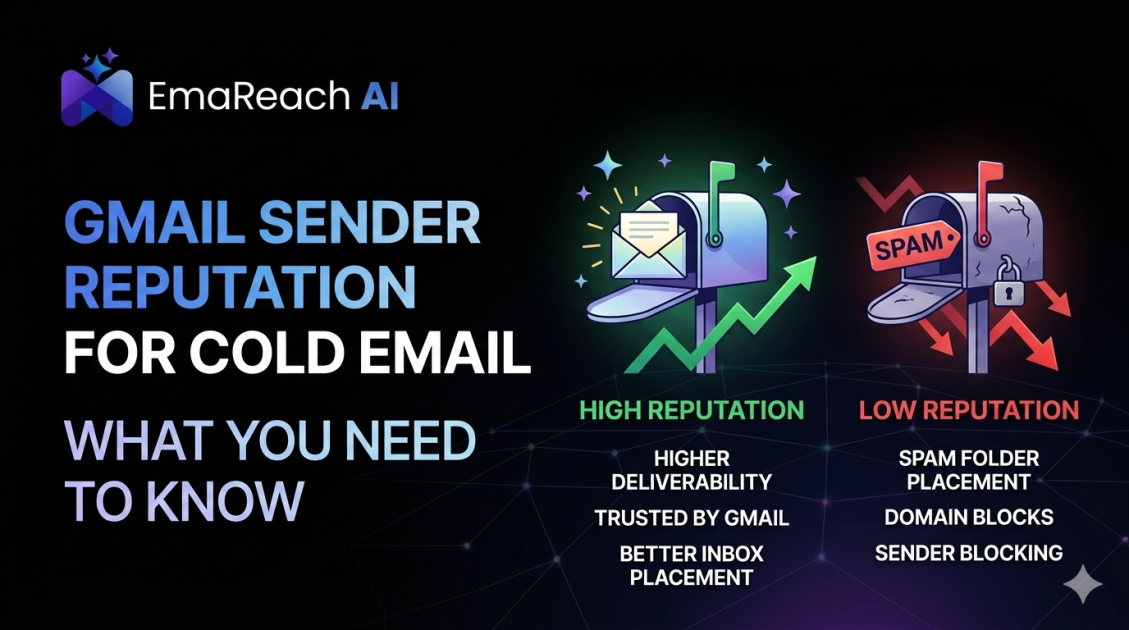
Gmail Sender Reputation for Cold Email: What You Need to Know
email deliverabilitycold outreachgmail reputationsender scoreemail marketingsales automation
Understanding Gmail Sender Reputation
Gmail sender reputation is the invisible score that Google assigns to your domain and IP address. This score determines whether your emails land in the primary inbox, the promotions tab, or the dreaded spam folder. For anyone involved in cold outreach, understanding this metric is not just a technical necessity—it is the difference between a successful campaign and a complete waste of resources.
Google's primary goal is to protect its users from unwanted content. To achieve this, Gmail employs sophisticated machine learning algorithms that analyze billions of signals daily. When you send a cold email, Gmail evaluates your sender reputation in real-time to decide if your message is helpful or harmful to the recipient.
The Components of Reputation
Sender reputation is not a single number but a combination of several critical factors. These can be broadly categorized into domain reputation and IP reputation.
Domain reputation is tied to your specific web address. It follows you regardless of which email service provider you use. IP reputation, on the other hand, is tied to the specific server address used to send the email. For most Gmail users, especially those using Google Workspace, domain reputation carries more weight because Google manages the IP pools for its users.
Why Gmail Sender Reputation Matters for Cold Email
In cold outreach, you are contacting people who have not previously interacted with you. This naturally puts you at a higher risk of being flagged as a spammer. If your sender reputation is low, Gmail will preemptively block your emails or route them to spam, meaning your prospects will never even see your message.
High deliverability is the foundation of any outbound sales strategy. Without a solid reputation, even the most compelling copy and the most targeted lead list will fail to generate results. Maintaining a pristine reputation ensures that your hard work reaches the eyes of your target audience.
Key Factors Influencing Your Reputation
1. Authentication Protocols
To prove to Gmail that you are who you say you are, you must implement technical authentication. Without these, your emails look like phishing attempts.
- SPF (Sender Policy Framework): A DNS record that lists the IP addresses authorized to send emails on behalf of your domain.
- DKIM (DomainKeys Identified Mail): A digital signature that ensures the email content hasn't been tampered with during transit.
- DMARC (Domain-based Message Authentication, Reporting, and Conformance): A policy that tells Gmail what to do if an email fails SPF or DKIM checks.
2. Engagement Metrics
Gmail looks at how recipients interact with your emails. Positive engagement (opens, replies, marking as 'not spam') boosts your reputation. Negative engagement (deleting without opening, marking as spam) destroys it.
High reply rates are the gold standard for reputation. When a prospect replies to your cold email, it signals to Google that a meaningful conversation is happening, which validates you as a legitimate sender.
3. Bounce Rates
Sending emails to addresses that don't exist is a major red flag. A high hard bounce rate tells Google that you are using a poor-quality, non-verified list, which is a hallmark of spammy behavior. Keeping your bounce rate below 2% is essential for long-term health.
4. Spam Complaint Rate
This is perhaps the most damaging factor. If even a small percentage of your recipients click "Report Spam," your reputation will plummet. Google takes user feedback very seriously, and a spike in complaints can lead to immediate blacklisting.
Best Practices for Maintaining a Healthy Reputation
Start with a Proper Warm-up
You cannot start sending hundreds of emails from a brand-new domain on day one. This behavior is highly suspicious to Google's algorithms. You must "warm up" your inbox by gradually increasing the volume of emails sent and received.
This process builds a history of positive interactions. While manual warm-up is possible, it is incredibly time-consuming. This is where specialized tools become invaluable. For instance, EmaReach helps you stop landing in spam by ensuring cold emails reach the inbox. EmaReach AI combines AI-written cold outreach with inbox warm-up and multi-account sending, allowing your emails to land in the primary tab and get replies automatically.
Volume Consistency
Spikes in sending volume are a common trigger for spam filters. If you send 10 emails one day and 500 the next, Gmail will likely flag your account. Aim for a consistent, steady volume of outreach. If you need to scale, do so slowly over several weeks.
Quality Over Quantity
The era of "spray and pray" is over. To maintain a high reputation, your outreach must be highly targeted and personalized. Irrelevant emails lead to more spam complaints. By focusing on a smaller list of high-intent prospects, you improve engagement rates and protect your domain.
Technical Setup and Maintenance
Monitoring via Google Postmaster Tools
Google Postmaster Tools is a free resource provided by Google that gives you direct insight into your domain's health. It provides data on:
- Spam rate
- IP reputation
- Domain reputation
- Authentication success
- Encryption levels
Checking these metrics regularly allows you to identify issues before they become catastrophic. If you see your domain reputation shifting from "High" to "Medium," it is time to pause your campaigns and investigate the cause.
Using Subdomains for Outreach
A common strategy to protect your primary business domain is to use a dedicated subdomain or a slightly different domain for cold outreach (e.g., yourcompany.io instead of yourcompany.com). If the outreach domain gets flagged, your primary business communications remain unaffected.
Content Strategy to Avoid Spam Filters
Gmail's filters also scan the content of your emails for "spammy" characteristics. To stay in the clear:
- Avoid Spam Trigger Words: Words like "Free," "Guarantee," "Urgent," and "$$$" can alert filters, especially when used in subject lines.
- Balance Text and Links: Too many links in a first-touch email can look like a phishing attempt. Stick to one clear call to action.
- Personalize Beyond the First Name: Use snippets about the prospect’s company, recent achievements, or specific pain points. AI tools can now help generate these personalized lines at scale without sacrificing quality.
- Include a Clear Opt-out: Making it easy for people to unsubscribe prevents them from marking your email as spam. A simple, polite opt-out link or sentence is a requirement for both legal compliance and reputation management.
The Impact of Inbox Placement on ROI
It is important to view sender reputation as a financial asset. Every email that goes to spam is a lost opportunity and a waste of the money spent on lead generation and sales development representative (SDR) time.
When your reputation is high, your cost per lead drops significantly because your reach is maximized. Conversely, a poor reputation acts as a hidden tax on your entire sales organization, forcing you to work twice as hard for half the results.
Handling a Reputation Crisis
If your emails suddenly stop getting opens and your metrics in Postmaster Tools show a decline, you are in a reputation crisis. Here is how to recover:
- Stop All Campaigns: Continuing to send emails while your reputation is low will only make the situation worse.
- Audit Your List: Ensure your leads are valid and that you haven't been hitting spam traps.
- Review Your Content: Check if your latest templates are triggering filters.
- Increase Warm-up Activity: Use a tool like EmaReach to generate a high volume of positive interactions (replies and "not spam" marks) to counteract the negative signals.
- Wait: Domain reputation doesn't heal overnight. It often takes several weeks of consistent, positive behavior to earn back Google's trust.
The Future of Gmail Outreach
As Google's AI continues to evolve, the emphasis on "human-like" behavior will only increase. Automation tools that mimic real human engagement—including varied sending times, realistic reply threads, and natural language patterns—will become the standard.
Maintaining a Gmail sender reputation requires a proactive approach. It is not a "set it and forget it" task but an ongoing process of monitoring, adjusting, and adhering to best practices. By prioritizing the health of your domain and focusing on delivering value to your recipients, you can ensure that your cold outreach remains a powerful engine for business growth.
Conclusion
Mastering Gmail sender reputation is the key to unlocking consistent success in cold email outreach. From the technical foundations of SPF and DKIM to the nuances of engagement and volume management, every detail matters. By monitoring your metrics via Google Postmaster Tools and utilizing sophisticated platforms like EmaReach to handle warm-up and AI-driven personalization, you can navigate the complexities of Gmail's filters with confidence. Remember that the goal is always to provide value; when your emails are relevant and helpful, both your prospects and Google’s algorithms will reward you with a place in the primary inbox.
EmaReach AI
Ready to scale your cold email outreach?
Join thousands of teams using EmaReach AI for AI-powered campaigns, domain warmup, and 95%+ deliverability. Start free — no credit card required.
Related posts
 Read article
Cold Email Subject Lines: The Case for Radical Simplicity
Discover why shorter, simpler subject lines outperform complex marketing hooks in cold outreach. Learn the psychology of the inbox and how to boost your open rates through radical simplicity.
 Read article
Cold Email Subject Lines for Follow-Ups That Feel Fresh Not Pushy
Master the art of the non-pushy follow-up with this comprehensive guide. Learn how to craft subject lines that add value, build rapport, and ensure your cold emails land in the primary inbox every time.
 Read article
Cold Email Subject Lines That Work When Selling Into New Markets
Learn the most effective strategies for crafting cold email subject lines when expanding into new geographic regions or industry verticals. This comprehensive guide covers psychology, local relevance, and technical deliverability to ensure your outreach succeeds.