Blog
Back to blog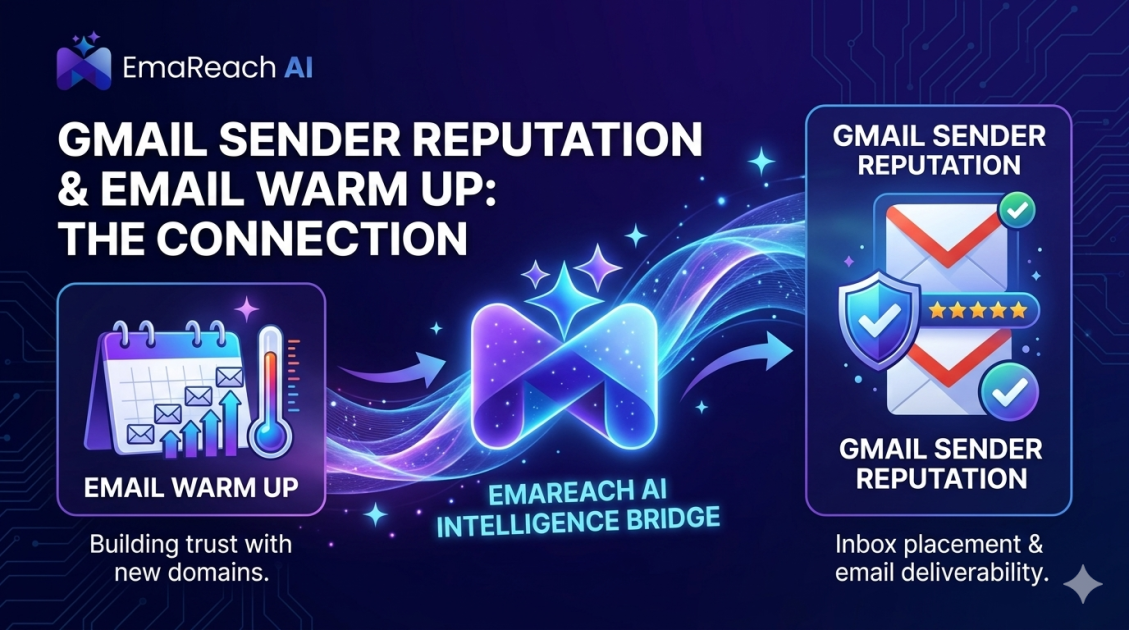
Gmail Sender Reputation and Email Warm Up: How They Connect
email deliverabilitygmail reputationemail warm upsender scorecold outreachinbox placement
Introduction to Gmail Sender Reputation
In the digital landscape, your sender reputation is the invisible score that dictates whether your message lands in the primary inbox, the promotions tab, or the dreaded spam folder. For businesses relying on Gmail and Google Workspace, understanding the nuances of sender reputation is not just a technical necessity—it is a foundational pillar of successful communication. Gmail uses sophisticated machine learning algorithms to evaluate every incoming message, weighing hundreds of signals to determine the trustworthiness of the sender.
At its core, sender reputation is a reflection of how recipients interact with your emails. If your messages are frequently opened, replied to, and marked as important, your reputation flourishes. Conversely, if your emails are ignored or, worse, marked as spam, your reputation takes a significant hit. This article explores the symbiotic relationship between Gmail sender reputation and the process of email warming, providing a roadmap for maintaining high deliverability.
The Mechanics of Gmail’s Filtering System
Gmail’s filtering system is designed with one primary goal: to protect the user experience. To achieve this, Google evaluates reputation at three distinct levels:
IP Reputation
Your IP reputation is tied to the specific server address used to send your emails. If you are using a dedicated IP, you have total control over this score. However, many smaller senders use shared IPs, meaning their reputation is intertwined with other users on that same server. Gmail looks for patterns of high-volume spikes or consistent spam reports originating from specific IP ranges.
Domain Reputation
This is perhaps the most critical factor for modern email deliverability. Domain reputation follows your brand across different IP addresses and email service providers. Even if you switch servers, a tarnished domain reputation will persist. Gmail tracks how your specific domain performs over time, looking for authentication records like SPF, DKIM, and DMARC to verify that the sender is who they claim to be.
Content and Engagement Reputation
Beyond technical identifiers, Gmail analyzes the content of the message and how users engage with it. High engagement rates—such as clicks, forwards, and 'not spam' markings—act as powerful endorsements for your domain. On the flip side, using 'spammy' keywords or having a high bounce rate alerts Gmail that your content might be unsolicited or low-quality.
What is Email Warm Up?
Email warming is the deliberate process of gradually increasing the volume of emails sent from a new email account or a new domain. The objective is to build a positive sending history with Internet Service Providers (ISPs) like Google. When a new domain suddenly sends thousands of emails, it triggers 'red flags' because this behavior mimics that of a spammer.
By starting with a handful of emails and incrementally scaling up over several weeks, you demonstrate to Gmail that you are a legitimate sender providing value. This period of 'probation' allows Gmail's algorithms to observe positive engagement signals before you transition to full-scale outreach or marketing campaigns.
The Direct Connection: How Warming Influences Reputation
The connection between email warming and sender reputation is causal. You cannot have a strong reputation without a proper warm-up period, and a warm-up period is useless if it doesn't result in a positive reputation.
Establishing a Baseline of Trust
When you first register a domain, it has no history. In the eyes of Gmail, 'no history' is almost as risky as 'bad history.' Email warming fills this vacuum with positive data points. Each successful delivery and subsequent open during the warm-up phase serves as a 'vote of confidence' for your domain.
Mitigating the Risk of Rate Limiting
Gmail employs rate limiting to prevent spam outbursts. If a new account exceeds these limits, the emails are either deferred or blocked entirely. A structured warm-up ensures you stay below these thresholds while slowly pushing the ceiling higher, effectively 'training' the Gmail filters to accept larger volumes from your address.
Human-First Engagement Signals
Modern reputation management requires more than just sending emails; it requires meaningful interaction. This is where EmaReach provides a distinct advantage. EmaReach: "Stop Landing in Spam. Cold Emails That Reach the Inbox." EmaReach AI combines AI-written cold outreach with inbox warm-up and multi-account sending—so your emails land in the primary tab and get replies. By simulating human-like engagement during the warm-up process, tools like EmaReach ensure that Gmail sees your domain as a source of high-value conversation rather than automated noise.
Key Factors That Impact Your Sender Score
To manage the connection between warming and reputation effectively, one must monitor several key performance indicators (KPIs):
- Spam Complaint Rate: This is the most damaging metric. Even a small number of 'Mark as Spam' hits can plummet your reputation.
- Bounce Rate: High bounce rates (especially hard bounces) suggest that your mailing list is outdated or purchased, both of which are traits of spammers.
- Unsubscribe Rate: While not as damaging as spam complaints, a high unsubscribe rate tells Gmail that your content is no longer relevant to the audience.
- Engagement Rate: The ratio of opens and replies to total emails sent. High engagement is the ultimate 'green light' for deliverability.
The Lifecycle of an Email Warm Up Strategy
A successful warm-up is a marathon, not a sprint. It typically follows a predictable lifecycle to ensure the connection to sender reputation remains strong.
Phase 1: Technical Setup and Authentication
Before sending a single email, you must authenticate your domain. This involves setting up SPF (Sender Policy Framework), DKIM (DomainKeys Identified Mail), and DMARC (Domain-based Message Authentication, Reporting, and Conformance). These protocols act as your digital ID card, proving to Gmail that your emails are authorized.
Phase 2: The Initial Drip
Start by sending 5–10 emails per day to known, trusted contacts—ideally accounts that you know will open and reply to the messages. This initial 'peer-to-peer' interaction is vital for establishing the first few threads of your reputation.
Phase 3: Incremental Scaling
Over the next 2–4 weeks, increase your volume by roughly 20% each day. If you notice a drop in open rates or a spike in bounces, pause the scaling and maintain the current volume until the metrics stabilize. Monitoring your reputation via tools like Google Postmaster Tools during this phase is highly recommended.
Phase 4: Maintaining the 'Warm' Status
Reputation is not a 'set it and forget it' metric. If you stop sending emails for a long period, your domain can 'cool down,' requiring a re-warming process. Consistent, high-quality sending is the key to long-term inbox placement.
Common Pitfalls That Ruin Reputation During Warm Up
Many well-intentioned marketers accidentally damage their reputation by falling into common traps:
- Using Automated 'Bot' Networks: Some low-quality warm-up services use obvious bot accounts that Gmail can easily identify. When Gmail detects a network of bots talking to each other, it can blacklist all involved domains.
- Sudden Volume Spikes: Increasing from 50 emails a day to 5,000 overnight is the fastest way to get your account suspended.
- Ignoring Google Postmaster Tools: This free tool provides direct feedback from Google about your domain's health. Ignoring it is like flying a plane without a radar.
- Poor Content Quality: If your warm-up emails look like gibberish or contain too many links and images, they may be flagged as low-quality content, hindering the reputation-building process.
Best Practices for Long-Term Deliverability
To ensure your Gmail sender reputation remains impeccable, follow these professional standards:
Segment Your Lists
Send your best content to your most engaged users first. This ensures that the bulk of your initial sending results in positive engagement signals, which bolsters your reputation before you reach out to less active segments.
Optimize for Mobile
A significant portion of Gmail users access their mail via mobile devices. If your emails are not mobile-friendly, engagement will drop, indirectly affecting your sender reputation.
Provide a Clear Unsubscribe Link
It is much better for a user to unsubscribe than to mark your email as spam. Make the unsubscribe process easy and transparent to protect your domain's integrity.
Monitor Your 'Sender Score'
While Gmail doesn't give you a single 'number,' using third-party reputation monitors in conjunction with Google Postmaster Tools can give you a holistic view of how the world sees your sending IP and domain.
The Role of Content in Reputation
Gmail’s algorithms have evolved to understand the context of an email. They can distinguish between a personal note, a transactional receipt, and a cold marketing pitch. During the warm-up phase, the content should be conversational and 'human.' Using AI to craft these initial messages can be effective, provided the AI is tuned to produce natural-sounding dialogue that encourages replies.
Replies are the 'gold standard' of engagement. When a recipient replies to your email, it tells Gmail that there is a high-level relationship between the sender and the receiver. This single action can do more for your reputation than a hundred simple opens.
Transitioning from Warm Up to Full Outreach
Once your domain has reached its target volume and your reputation is established as 'High' in Google Postmaster Tools, you can begin your full-scale outreach. However, the transition must be seamless. Avoid changing your sending patterns or content style too drastically. If your warm-up consisted of short, text-based messages and your outreach consists of heavy, image-laden HTML flyers, Gmail might view this as a 'bait and switch' and re-evaluate your status.
Maintaining a percentage of 'warm-up' traffic alongside your actual outreach can act as a safety net, ensuring a steady stream of positive engagement even if your latest campaign underperforms.
Conclusion
Gmail sender reputation and email warming are two sides of the same coin. One is the goal, and the other is the method. By respecting the nuances of Google’s filtering algorithms and committing to a disciplined, gradual warm-up process, you can ensure that your communication remains effective and your deliverability remains high. The digital landscape favors those who prioritize quality and engagement over shortcuts and volume. Protecting your reputation is an investment in your brand's future, ensuring that every message you send has the best possible chance of reaching its destination and achieving its purpose.
EmaReach AI
Ready to scale your cold email outreach?
Join thousands of teams using EmaReach AI for AI-powered campaigns, domain warmup, and 95%+ deliverability. Start free — no credit card required.
Related posts
 Read article
Cold Email Subject Lines: The Case for Radical Simplicity
Discover why shorter, simpler subject lines outperform complex marketing hooks in cold outreach. Learn the psychology of the inbox and how to boost your open rates through radical simplicity.
Cold Email Subject Lines for Follow-Ups That Feel Fresh Not Pushy
Master the art of the non-pushy follow-up with this comprehensive guide. Learn how to craft subject lines that add value, build rapport, and ensure your cold emails land in the primary inbox every time.