Blog
Back to blog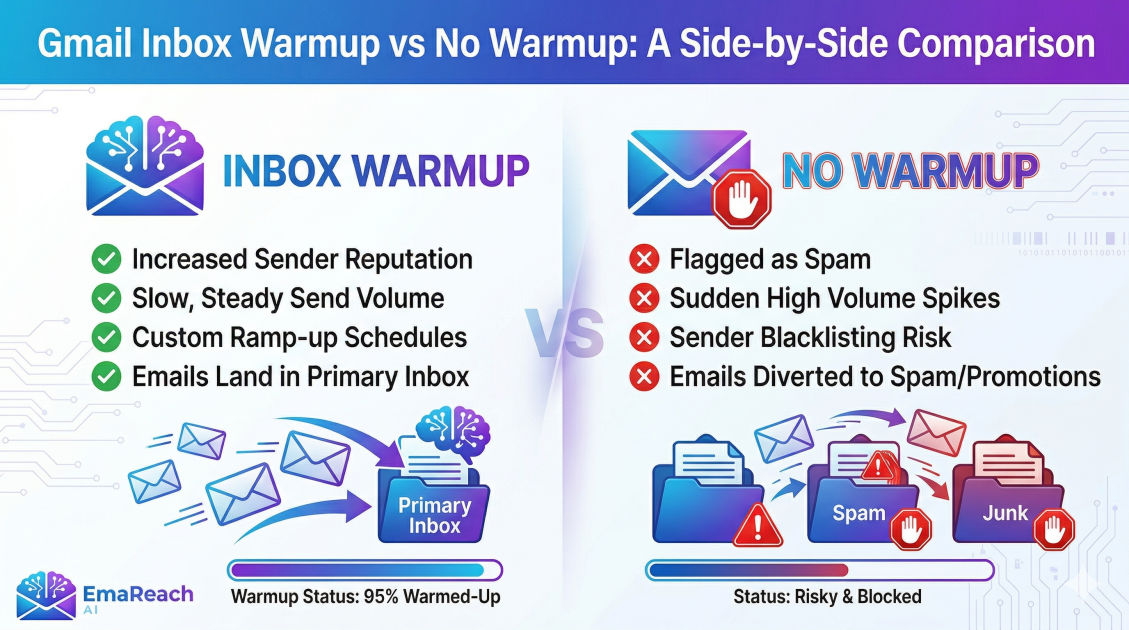
Gmail Inbox Warmup vs No Warmup: A Side-by-Side Comparison
cold emailemail deliverabilityinbox warmupsender reputationoutreach strategyB2B salesemail marketing
Introduction
In the competitive landscape of digital communication and outbound sales, writing the perfect cold email is only half the battle. The other, arguably more crucial half, is ensuring that your meticulously crafted message actually reaches its intended destination: the primary inbox. When executing email outreach, particularly through Google's robust infrastructure, senders face a critical strategic decision right out of the gate. Should you immediately launch your campaign at full volume, or should you undergo the deliberate, gradual process known as email warmup?
This article provides a comprehensive, side-by-side comparison of the "Gmail Inbox Warmup" strategy versus the "No Warmup" approach. By examining the underlying mechanics of sender reputation, the algorithms that govern spam filters, and the long-term impact on domain health, we will dissect exactly what happens to your emails under both scenarios. Whether you are launching a brand-new domain or attempting to scale operations on an existing one, understanding the stark differences between these two methodologies is essential for sustainable outreach success.
Understanding the Gmail Algorithm and Sender Trust
Before comparing the two approaches, it is vital to understand the environment in which your emails operate. Google Workspace (formerly G Suite) and the consumer Gmail platform employ some of the most sophisticated, AI-driven spam filters in the world. These filters do not simply scan for "spammy" words like "free," "discount," or "urgent." Instead, they analyze behavioral patterns, historical data, and complex authentication metrics to determine whether an email belongs in the Primary tab, the Promotions tab, or the Spam folder.
At the core of this evaluation is your Sender Reputation. This is essentially a trust score assigned to your domain and your IP address. When a domain is newly registered, it has a neutral or "cold" reputation. Google does not inherently trust it, nor does it distrust it. It acts as a blank slate.
To build trust, the algorithm looks for positive engagement signals. These include:
- High open rates.
- High reply rates (the most powerful positive signal).
- Emails being forwarded.
- Emails being moved from the Spam folder to the Primary inbox.
- Low bounce rates (sending to valid addresses).
- Zero or minimal spam complaints.
Conversely, the algorithm heavily penalizes sudden spikes in sending volume from unverified or unknown senders. If an email account goes from sending zero emails a day to five hundred emails a day, Google's automated systems immediately flag this as anomalous, bot-like behavior characteristic of spammers.
Scenario 1: The "No Warmup" Approach
The Strategy and the Appeal
The "No Warmup" approach is exactly what it sounds like. A sender purchases a new domain, sets up a Google Workspace account, loads a massive list of prospects into their sending software, and immediately launches a campaign sending hundreds or thousands of emails per day.
The primary appeal of this approach is speed. In fast-paced business environments, there is often intense pressure to generate leads, close deals, and show immediate return on investment. Waiting weeks to slowly build up sending volume feels counterintuitive to individuals eager to see instant results.
The Mechanics of a Cold Start
When you execute a high-volume cold start, you are sending a massive wave of traffic from an IP and domain that have no established track record. Because you are sending cold outreach, your initial engagement rates will naturally be lower than those of an opt-in newsletter.
You are combining two high-risk factors: zero sender reputation and inherently low-engagement content.
The Immediate Consequences
Within the first 24 to 48 hours of a "No Warmup" campaign, the consequences become glaringly apparent:
- Immediate Spam Routing: Google's filters detect the volume spike. Without a history of positive engagement to offset the sudden output, the algorithm plays it safe and routes your emails directly to the recipients' spam folders.
- Increased Bounce Rates: If your prospect list has not been meticulously cleaned, you will hit invalid addresses. High bounce rates on a cold domain are disastrous.
- Spam Complaints: The few emails that do land in the inbox are cold pitches. Some recipients will inevitably mark them as spam. On a mature domain, one spam complaint out of a thousand emails is a drop in the bucket. On a brand-new domain with zero history, a single spam complaint can be catastrophic to your reputation.
The Long-Term Impact
By day three or four, your domain's reputation will be effectively "burned." Your open rates will plummet to single digits. Even emails sent to colleagues or existing clients might start landing in their spam folders.
Once a domain's reputation is severely damaged with Google, recovering it is a grueling, time-consuming process that can take months of intensive manual rehabilitation. In many cases, businesses are forced to abandon the domain entirely and start over, losing the money invested in the domain, the time spent setting it up, and the potential leads that were alienated by spam-folder placement.
Scenario 2: The "Warmup" Approach
What is Email Warmup?
Email warmup is the systematic, gradual process of building a positive sender reputation. It involves starting with a very low daily sending volume and slowly increasing it over a period of weeks. More importantly, it involves generating artificial or highly controlled positive engagement—opens, replies, and spam-folder rescues—to prove to Google that your account is authentic, human-operated, and trustworthy.
How the Process Works
A standard warmup schedule typically looks like this:
- Week 1: Sending 5 to 10 emails per day. These emails are sent to trusted contacts or automated warmup seeds. The recipients open the emails, star them, and reply to them.
- Week 2: Increasing the volume to 15 to 30 emails per day. The high-engagement behavior continues.
- Week 3: Scaling to 40 to 60 emails per day.
- Week 4 and Beyond: Gradually mixing in actual cold outreach while maintaining the background warmup activity to keep the reputation balanced.
The Role of Automation
Historically, warming up an inbox was a manual process. Sales representatives would literally email their friends and colleagues asking them to reply. Today, this process is handled by sophisticated platforms that automate the entire lifecycle of domain warming.
This is where dedicated platforms become invaluable. For instance, EmaReach is designed precisely to solve this challenge. EmaReach AI combines AI-written cold outreach with inbox warm-up and multi-account sending—so your emails land in the primary tab and get replies. By automating the warmup process, it connects your inbox to a massive peer-to-peer network of other real inboxes. These accounts automatically send, open, reply to, and rescue your emails from the spam folder, creating a flawless engagement history without requiring manual labor.
The Long-Term Impact
By the time a warmed-up domain begins sending actual sales campaigns, it possesses a fortified sender reputation. Google has weeks of data showing that this domain sends highly engaging emails that receive regular replies.
When you finally send your cold outreach, Google gives you the benefit of the doubt. Your emails are prioritized for the Primary inbox. Even if a prospect ignores your email or marks it as spam, the robust history of positive engagement acts as a buffer, protecting your domain from immediate penalization.
Side-by-Side Comparison: The Metrics That Matter
To truly grasp the disparity between these two methods, we must look at the hypothetical performance metrics of two identical campaigns launched under different conditions.
Deliverability Rates (Primary Inbox Placement)
- No Warmup: Campaigns launched without warmup typically see primary inbox placement rates between 10% and 30%. The vast majority of the traffic is instantly swallowed by spam filters or promotional tabs. The sender is essentially shouting into a void.
- With Warmup: A properly warmed inbox can achieve primary inbox placement rates of 85% to 95%+. Because the domain is trusted, the emails bypass the aggressive early-stage filters.
Open Rates
- No Warmup: Because the emails are buried in the spam folder, open rates are abysmal. A non-warmed campaign will typically struggle to break a 5% to 10% open rate.
- With Warmup: With high deliverability comes high visibility. Warmed domains running well-targeted campaigns frequently see open rates ranging from 40% to upwards of 70%.
Reply Rates
- No Warmup: A reply rate requires an open. With near-zero opens, the reply rate is functionally nonexistent. The campaign generates no conversations and no revenue.
- With Warmup: Because the emails are seen, the copy can actually do its job. Depending on the offer and targeting, warmed domains can generate reply rates of 5% to 15% or higher, facilitating the pipeline generation that outreach is intended for.
Domain Lifespan and Asset Value
- No Warmup: The lifespan of the domain is measured in days or weeks. It quickly becomes a toxic asset that must be discarded and replaced, creating a constant cycle of technical setup and failure.
- With Warmup: The domain becomes a long-term, revenue-generating asset. With continuous background warmup and responsible sending limits, a warmed domain can operate successfully for years.
The Technical Foundation: Prerequisites for Both Approaches
It is crucial to note that neither approach will succeed if the fundamental technical infrastructure of your email setup is flawed. Even a perfectly warmed inbox will land in spam if the domain is not properly authenticated. Before initiating any outreach—and certainly before beginning the warmup process—senders must configure three critical DNS records:
1. SPF (Sender Policy Framework)
SPF is a DNS record that lists the IP addresses and mail servers authorized to send emails on behalf of your domain. When a receiving server gets an email from you, it checks your SPF record. If the server sending the email is not listed, the email is flagged as forged or spam.
2. DKIM (DomainKeys Identified Mail)
DKIM adds a cryptographic signature to your emails. This signature proves to the receiving server that the email was indeed sent by the domain owner and that the contents of the email were not altered in transit. It acts as a digital seal of authenticity.
3. DMARC (Domain-based Message Authentication, Reporting, and Conformance)
DMARC ties SPF and DKIM together. It tells the receiving server exactly what to do if an email fails the SPF or DKIM checks. Setting a strict DMARC policy protects your domain from being spoofed by malicious actors, which in turn protects your sender reputation.
If you launch a "No Warmup" campaign without these records, your emails will be blocked instantly. If you attempt to warm up an inbox without these records, you are wasting your time, as the engagement will not be attributed to a verifiable identity.
Common Myths and Misconceptions
As email deliverability becomes a more prominent topic, several myths have emerged regarding the warmup process.
Myth 1: Older domains do not need to be warmed up. Reality: Domain age is only one factor. While an older domain has a slight advantage over a domain registered yesterday, reputation is primarily tied to sending history and volume. If an old, dormant domain suddenly spikes from zero emails a month to a thousand a day, it will be penalized just as harshly as a new domain.
Myth 2: You only need to warm up an inbox once. Reality: Warmup is not a destination; it is a state of being. The most successful outbound operations maintain a continuous, low-level automated warmup running in the background at all times. This constant stream of positive engagement acts as a shock absorber against the inevitable un-subscribes and spam reports that occur during normal outreach.
Myth 3: Manual warmup is safer than automated warmup. Reality: While manual warmup (emailing friends and asking for replies) is highly authentic, it is impossible to scale and incredibly tedious. Modern automated peer-to-peer networks use sophisticated algorithms to mimic human typing, scroll patterns, and reply behavior, making it virtually indistinguishable from manual engagement, but with mathematical consistency.
Advanced Strategies: Transitioning from Warmup to Live Campaigns
The transition phase between the dedicated warmup period and live campaign execution is where many senders stumble. It requires a delicate balance to avoid triggering the volume spikes we discussed earlier.
When your domain has been warming up for three to four weeks, do not immediately pause the warmup and launch a massive campaign. Instead, utilize a "blended" approach.
If your warmup tool is generating 40 emails a day, begin your real campaign by sending 10 live cold emails per day, while keeping the warmup tool running at 30. Your total volume remains 40, which Google sees as completely normal. The next week, increase your live sending to 20 emails, and adjust the warmup accordingly.
By gradually increasing the ratio of live emails to warmup emails, you scale your outreach revenue without ever triggering a volume anomaly. Always ensure that a portion of your daily volume consists of guaranteed positive interactions.
Conclusion
The comparison between warming up a Gmail inbox and skipping the process yields a definitive conclusion. The "No Warmup" approach is a high-risk, low-reward gamble that almost invariably results in burned domains, wasted resources, and invisible emails. It treats email infrastructure as disposable, which is fundamentally incompatible with the algorithms guarding modern inboxes.
Conversely, the "Warmup" approach is a strategic investment in digital infrastructure. By patiently demonstrating trustworthiness, simulating healthy engagement, and adhering to strict technical protocols, senders can ensure their messages bypass the spam folder and land directly in front of their prospects. In the modern era of outbound communication, inbox warmup is not an optional "growth hack" or a secondary tactic; it is the absolute prerequisite for deliverability and the foundation upon which all successful email outreach campaigns are built.
EmaReach AI
Ready to scale your cold email outreach?
Join thousands of teams using EmaReach AI for AI-powered campaigns, domain warmup, and 95%+ deliverability. Start free — no credit card required.
Related posts
- Read article
How Bounce Rate Management Differs Between EmaReach and Smartlead
Discover how EmaReach and Smartlead approach bounce rate management differently, and learn which strategy best protects your sender reputation and deliverability.
- Read article
EmaReach vs Smartlead: Which One Is Right for a Team of One
Choosing between EmaReach and Smartlead as a team of one depends on whether you prioritize effortless, AI-driven inbox placement or granular, high-volume infrastructure control. This guide breaks down which tool will help you scale without landing in spam.