Blog
Back to blog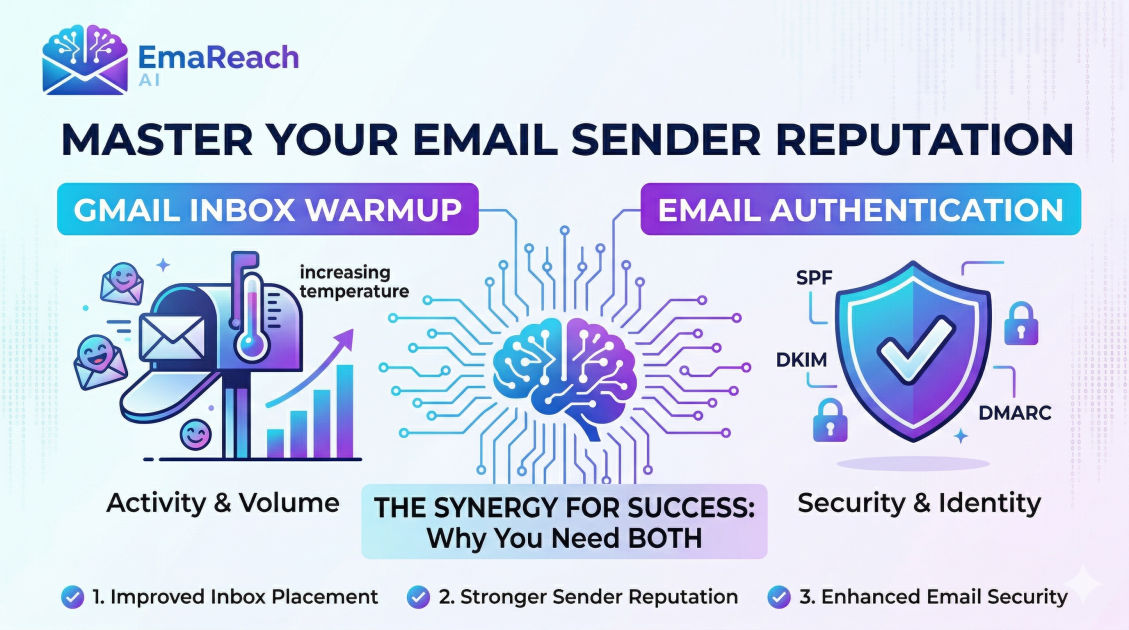
Gmail Inbox Warmup vs Email Authentication: Why You Need Both
email deliverabilitygmail warmupSPF DKIM DMARCcold outreachemail marketingsender reputation
Introduction
In the competitive world of digital communication, the success of your email marketing or cold outreach campaign hinges on a single factor: deliverability. You can craft the most compelling subject line and the most persuasive body copy, but if your message lands in the spam folder—or worse, is blocked entirely—your efforts are wasted. For businesses relying on Gmail and Google Workspace, navigating the complexities of inbox placement requires a two-pronged strategy.
Many marketers find themselves debating which is more important: Email Authentication or Inbox Warmup. The reality is that these are not competing tactics but complementary pillars of a healthy sender reputation. One establishes your identity and right to send, while the other demonstrates your quality as a sender through positive engagement. To achieve consistent results, you must master both.
Understanding the Basics: What is Email Authentication?
Email authentication is the technical foundation of your email ecosystem. It is a set of protocols designed to verify that an email actually comes from the person or organization it claims to be from. In an era where phishing and spoofing are rampant, mailbox providers like Gmail use these protocols to protect their users.
The Three Pillars of Authentication
To pass Gmail's stringent security checks, every sender must implement three specific DNS records:
- SPF (Sender Policy Framework): This is a list of IP addresses and domains authorized to send email on behalf of your domain. When an email arrives, Gmail checks the SPF record to see if the sending server is on the approved list.
- DKIM (DomainKeys Identified Mail): This adds a digital signature to your emails. It ensures that the content of the email hasn't been tampered with in transit. It acts like a wax seal on a physical letter.
- DMARC (Domain-based Message Authentication, Reporting, and Conformance): This is the policy layer. It tells Gmail what to do if an email fails SPF or DKIM checks—whether to do nothing, move the email to spam, or reject it entirely.
Without these protocols, Gmail’s filters view your messages with immediate suspicion. Authentication is essentially your "digital ID card." It proves you aren't an impostor, but it doesn't necessarily prove you are a good sender. That is where warmup comes in.
What is Gmail Inbox Warmup?
If authentication is your ID card, then inbox warmup is your credit score. When you start sending from a new email account or a new domain, Gmail has no historical data on your behavior. If you suddenly send 500 emails in a single day from a fresh account, the algorithms will flag this as "spammy" behavior and likely block your messages.
The Mechanics of Warming Up
Inbox warmup is the process of gradually increasing your email volume over time to build a positive sender reputation. It involves:
- Starting with a very low volume (e.g., 5-10 emails per day).
- Ensuring those emails receive high engagement (opens, replies, and being marked as "not spam").
- Incrementally increasing the daily limit over several weeks.
By simulating natural, human-like interaction, you signal to Gmail that you are a legitimate user participating in meaningful conversations. This builds trust, making it more likely that your future marketing or sales emails will land in the Primary tab rather than the Promotions or Spam folders.
Why Authentication Alone Isn’t Enough
You might assume that if your technical setup is perfect (SPF, DKIM, and DMARC are all green), your emails are safe. This is a dangerous misconception. Authentication only addresses identity; it does not address reputation.
A bad actor can easily set up a fully authenticated domain and send a million spam emails. Because of this, Gmail looks beyond the technical headers. They analyze engagement metrics. If your authenticated emails have high bounce rates, low open rates, or are frequently marked as spam by recipients, your authentication won't save you. Your domain will be blacklisted regardless of how "verified" it is.
Why Warmup Alone Isn’t Enough
Conversely, trying to warm up an account without proper authentication is an uphill battle. If you attempt to build engagement but your emails fail SPF or DKIM checks, many of those emails will be blocked before the recipient ever has a chance to interact with them.
Furthermore, modern email filters are increasingly biased toward authenticated mail. Gmail has recently implemented stricter requirements for bulk senders, making DMARC and SPF mandatory for reaching the inbox. If you skip the technical setup, your warmup process will be inefficient because you'll be fighting the system rather than working with it.
The Synergy: How They Work Together
The most successful outreach strategies treat authentication and warmup as a combined workflow. Here is how they interact to protect your deliverability:
1. Verification Meets Reputation
Authentication gets you through the front door (the server), while warmup gets you a seat at the table (the Primary inbox). When Gmail receives an email that is both authenticated and coming from a domain with a history of high engagement, it clears a path for that message.
2. Reducing "False Positives"
Sometimes, legitimate emails are caught in spam filters due to aggressive algorithms. Having a strong warmup history provides a "buffer." If you have a high reputation score, Gmail is more likely to give you the benefit of the doubt if a single email contains a word that might otherwise trigger a filter. When combined with DMARC, this creates a robust shield for your domain.
3. Long-Term Scalability
If you want to scale your outreach, you need a foundation that can handle volume. Authentication ensures that as you grow, your identity remains consistent across different sending tools. Warmup ensures that the volume increase doesn't look like a sudden spike. Together, they allow you to reach thousands of prospects without compromising your domain's health.
Practical Steps to Mastering Both
To ensure your emails land where they belong, follow this comprehensive checklist for both technical setup and reputation building.
The Technical Setup (The "ID Card")
- Audit Your DNS Records: Use a tool to verify that your SPF, DKIM, and DMARC records are correctly formatted. Ensure there are no multiple SPF records, as this is a common error that invalidates the protocol.
- Set a DMARC Policy: Start with a
p=nonepolicy to monitor your traffic, but eventually move top=quarantineorp=rejectfor maximum security. - Use Custom Tracking Domains: If your email service provider uses a shared tracking domain for clicks, it can hurt your reputation if other users are sending spam. Set up a custom tracking domain that points back to your own authenticated domain.
The Warmup Strategy (The "Credit Score")
- Start Slow: Do not send more than 10-20 emails per day in the first week.
- Focus on Engagement: Reach out to colleagues or friends first to ensure your initial emails are opened and replied to. This "primes" the account.
- Automate the Process: Manually warming up an account is tedious and often inconsistent. Using a dedicated tool is more effective.
For those looking to streamline this entire process, EmaReach offers a sophisticated solution. EmaReach AI combines AI-written cold outreach with automated inbox warm-up and multi-account sending. This ensures that your emails not only pass the technical authentication checks but also benefit from a constant stream of positive engagement, helping your messages land in the primary tab and get the replies they deserve.
Common Pitfalls to Avoid
Even with the best intentions, many senders make mistakes that sabotage their deliverability. Be wary of these traps:
- Buying Email Lists: This is the fastest way to ruin your reputation. Purchased lists are full of "spam traps"—email addresses designed specifically to catch spammers. Sending to one of these will immediately tank your sender score, regardless of your authentication.
- Ignoring Bounce Rates: If your bounce rate exceeds 2%, stop sending immediately. High bounce rates signal to Gmail that you are using an unverified list or scraping data, which is a hallmark of spam.
- Sudden Volume Spikes: If you have been sending 50 emails a day and suddenly jump to 500 because of a new campaign, you will likely be flagged. Scale gradually, increasing volume by no more than 20% per day.
- Lack of Unsubscribe Links: While it might seem counterintuitive to make it easy for people to leave, Gmail prefers to see a clear unsubscribe path. If users can't find an unsubscribe link, they will hit the "Report Spam" button instead, which is much more damaging to your reputation.
The Role of Content in Deliverability
While authentication and warmup handle the "who" and the "how," your content handles the "what." Gmail's sophisticated AI reads your content to determine its intent.
- Avoid "Spammy" Keywords: Words like "Free," "Guarantee," "Cash," and excessive exclamation marks can trigger filters.
- Personalization is Key: If you send the exact same template to 1,000 people, Gmail identifies it as a mass blast. By using variables (like the recipient's name, company, or a specific detail about their work), each email becomes unique, which is a positive signal.
- Balance Text-to-Image Ratio: Emails that are just one large image are often used by spammers to hide text from filters. Maintain a healthy balance of plain text.
Monitoring Your Progress
Deliverability is not a "set it and forget it" task. You must monitor your health regularly.
- Google Postmaster Tools: This is an essential resource for anyone sending to Gmail users. It provides data on your IP reputation, domain reputation, and spam rate according to Google's internal metrics.
- Sender Score: Check your domain's sender score periodically to see how you rank against other senders.
- Blacklist Checks: Use online tools to ensure your IP or domain hasn't been added to common blacklists like Spamhaus or Barracuda.
Conclusion
In the ecosystem of Gmail deliverability, Email Authentication and Inbox Warmup are two sides of the same coin. Authentication provides the security and legitimacy required by modern mail servers, while Warmup builds the trust and engagement history required to reach the human on the other side of the screen.
By implementing SPF, DKIM, and DMARC, you tell Gmail who you are. By consistently warming up your inbox and maintaining high engagement, you show Gmail that you are a valuable sender. Ignoring either of these components is a recipe for poor performance and wasted resources. However, when used together, they create a powerful shield that protects your domain and ensures your message is heard. Invest the time to set your foundation correctly, and the ROI on your outreach will follow.
EmaReach AI
Ready to scale your cold email outreach?
Join thousands of teams using EmaReach AI for AI-powered campaigns, domain warmup, and 95%+ deliverability. Start free — no credit card required.
Related posts
- Read article
Instantly vs EmaReach: What SDRs Actually Think After 90 Days
After 90 days, SDRs prioritize deliverability over volume. We compare Instantly and EmaReach to see which tool actually helps you land in the primary inbox.
- Read article
EmaReach vs Instantly: Everything You Need to Make the Right Decision
Deciding between EmaReach and Instantly is about choosing between technical deliverability-first precision and all-in-one sales engagement features. We break down the key differences to help you scale your B2B outreach.